
Nitte DU inaugurates Centre for Indian Knowledge Systems to promote traditional wisdom

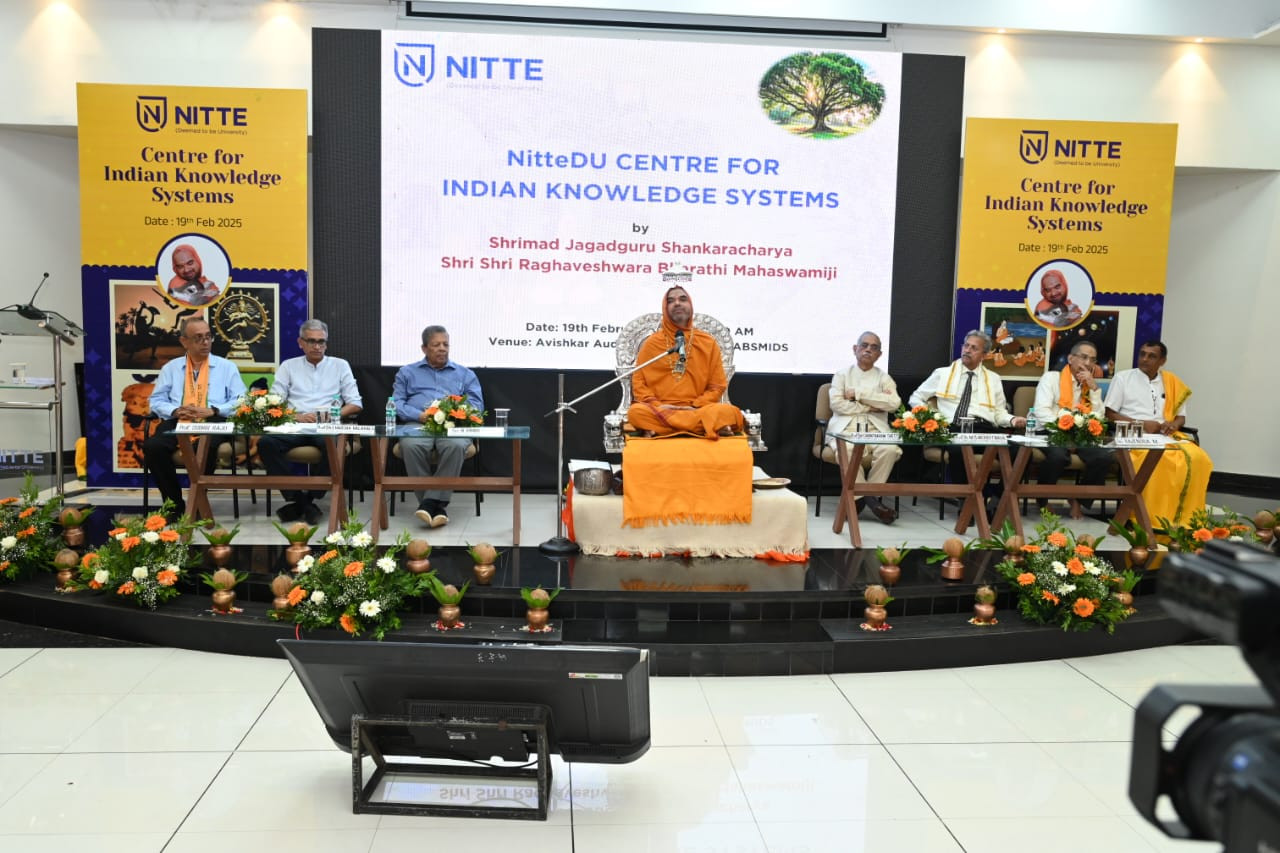
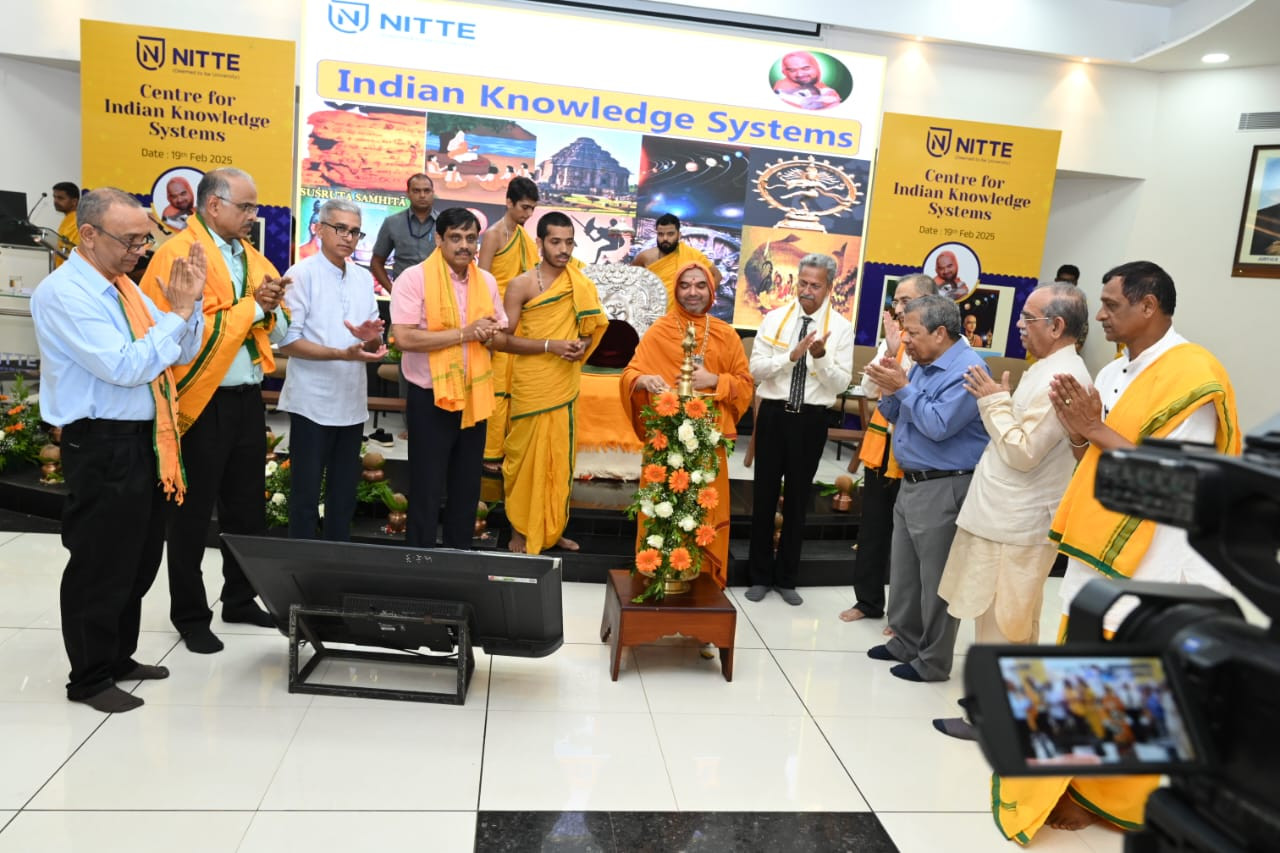
Mangaluru: Nitte Deemed to be University Centre for Indian Knowledge Systems (Nitte DU Centre for IKS) was inaugurated on 19 February 2025, in line with the directives of the Ministry of Education, Government of India. The event was graced by Srimadjagadguru Shankaracharya Sri Sri Raghaveshvara Swamiji of Ramachandrapura Mutt, who formally launched the centre. Sri Vinaya Hegde, Chancellor of the university, presided over the function, while Pro-Chancellor Prof. Shantharam Shetty highlighted the importance of promoting Indian culture and ancient knowledge systems. Vice-Chancellor Prof. M. S. Moodithaya welcomed the gathering. Swamiji extended his blessings to the centre and expressed hope that more such institutions would be established to preserve and promote India’s rich value systems.
The primary vision of the Nitte DU Centre for IKS is to foster interdisciplinary and transdisciplinary research on various aspects of Indian Knowledge Systems (IKS). It aims to preserve, document, and disseminate India’s traditional knowledge for further research and societal applications.
The centre focuses on several key strategies for effective implementation. Curriculum integration will involve incorporating IKS into mainstream education across disciplines like philosophy, history, social sciences, engineering, and medicine. Research and documentation will encourage interdisciplinary studies to analyze and modernize traditional knowledge. Public awareness campaigns will educate the public on the relevance of IKS in addressing contemporary challenges such as sustainability, health, and mental well-being. Policy support will advocate for government policies that promote IKS in higher education, research, and development programs. Technology integration will leverage AI, data analytics, and digital platforms to preserve and globally disseminate traditional knowledge. Community engagement will involve local, rural, and tribal communities in the practice and preservation of traditional knowledge. Global collaboration will foster partnerships with international academic institutions and platforms to promote India’s knowledge systems on a global scale.
Let the Truth be known. If you read VB and like VB, please be a VB Supporter and Help us deliver the Truth to one and all.
Two arrested in K'taka for assaulting minors, uploading CSAM content

Bengaluru (PTI): Two men were arrested for allegedly sexually assaulting two minor girls, recording the acts on mobile phones and uploading the videos online as child sexual abuse material, police said on Thursday.
The accused have been identified as Kiran Kumar (29), hailing from Chitradurga district, and Aditya M K (20), hailing from Shivamogga district, they said.
A probe was initiated after information was received from the NCRP portal regarding a suspected instance of creation of Child Sexual Abuse Material (CSAM) for online dissemination, police said.
Accordingly, a case was registered at Kaggalipura Police Station under relevant sections of the IT Act on May 10, they added.
Investigation revealed that two minor girl victims were exploited and videos were created and uploaded to the internet. The child victims have subsequently recorded their statements as per procedure and further necessary legal steps have been taken, Pronab Mohanty Director General of Police, Cyber Command, said in a statement.
Based on the statements of the victims, the accused persons, who allegedly assaulted the minors, recorded the acts on mobile phones and uploaded the videos online, were arrested, he said.
Following the probe, sections 65(2) (rape) and 70 (gangrape) of the Bharatiya Nyaya Sanhita, along with relevant sections of the POCSO Act, have been added to the FIR, police said.
Officials collected relevant information and on May 12, arrested the accused persons and seized three mobile phones belonging to them, in which the videos had allegedly been recorded, he said.
The accused were later produced before the court and taken into police custody for further investigation, he added.
According to him, in CSAM cases, police usually apprehend offenders who have downloaded such content or have kept them in their possession after obtaining them from elsewhere, usually the internet.
"The present case is one of the very few instances where content creators and uploaders have been apprehended," Mohanty added.


