
Postmortem report reveals brutal assault in Ashraf mob-lynching case in Mangaluru

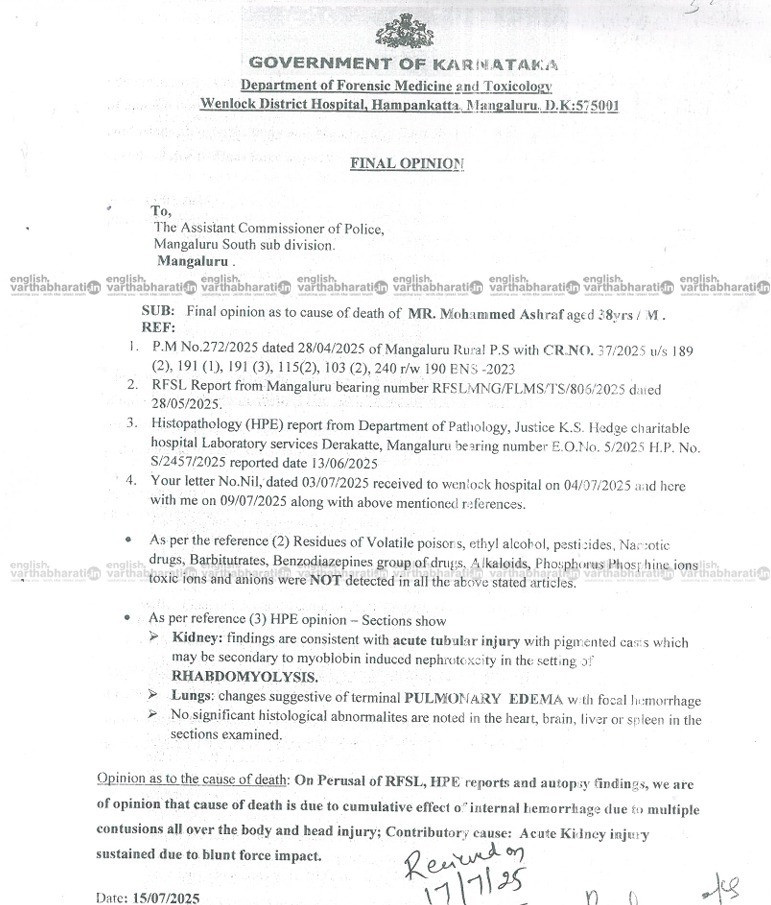
Mangaluru: The final postmortem and forensic reports in the case of 38-year-old Mohammed Ashraf, whose body was found behind Kudupu Bhairakutarti Temple on April 27, 2025, has revealed shocking details of a violent and brutal assault. The reports, compiled after thorough forensic examination and histopathological analysis, confirm that Ashraf died due to the cumulative impact of multiple injuries across his body and head, with acute kidney damage as a contributing factor.
Ashraf’s postmortem was conducted on April 28, 2025, at Wenlock Hospital between 10:00 PM and 11:30 PM in the presence of forensic experts, including Dr. Mahabalesh Shetty from KSHEMA, Deralakatte.
Injuries Found on the Body
The examination report, accessed by Vartha Bharati, noted severe injuries across multiple parts of Ashraf's body, all of which were fresh and antemortem in nature, sustained due to blunt force trauma.
Back and Buttocks:
A large contusion (50 x 35 cm) covered the back.
Multiple abrasions and linear contusions were found across the upper and lower back, indicating repeated impact.
Several tramline contusions—characteristic of being beaten with long objects—were found just below both buttocks, measuring up to 22 x 10 cm.
Face and Head:
Swelling was noted on the right parietal region of the head.
Abrasions and contusions were found around the right ear, forehead, under the right eye, on the nose, left cheek, and inner lip.
A laceration was seen just below the right eye.
Chest and Abdomen:
Obliquely placed linear contusions were seen on the right side of the chest and below the nipple area.
Multiple linear contusions were also found under the left nipple and over the left shoulder area.
Upper Limbs:
The entire right arm, shoulder, forearm, and hand had large contusions.
Similar injuries were seen on the left arm and hand, including abrasions on the elbow.
Lower Limbs:
Tramline contusions and abrasions were found across both thighs and knees.
A large abrasion of 13 x 6 cm was observed across the right knee joint.
Both thighs and knees showed multiple blunt force injuries.
Internal Injuries and Organ Damage
Brain and Skull:
Although no skull fractures were noted, there were signs of internal bleeding in the brain, including subarachnoid and subdural hemorrhages.
The brain was edematous and congested, with petechial hemorrhages noted in the white matter, the post-mortem report added.
Lungs and Heart:
Both lungs were congested and showed signs of pulmonary edema with blood-stained frothy discharge.
The heart was pale but structurally intact, with minor old patches seen over the right ventricle.
Kidneys and Liver:
Both kidneys showed congestion and loss of normal structure.
The liver was also congested with a visible contusion on the right lobe.
Histopathology confirmed acute tubular injury in the kidneys, suggestive of rhabdomyolysis (muscle breakdown due to trauma), which contributed to kidney failure.
Abdomen and Other Organs:
The stomach contained undigested food and thick greenish-black fluid.
Other organs like the spleen, intestines, and bladder were generally intact but showed signs of congestion.
Forensic Analysis of Suspected Weapons
The Assistant Commissioner of Police had sent four wooden sticks, suspected to have been used in the assault, for forensic examination. The sticks ranged in size and condition, some broken and others intact, with rough surfaces and visible damage.
Dr. Rashmi K. S., Forensic Medicine Specialist at Wenlock District Hospital, concluded that the pattern of injuries found on Ashraf's body matched the characteristics of the wooden sticks examined. This includes tramline contusions and multiple blunt force injuries, confirming that such objects could have been used to inflict the fatal assault.
Toxicology and Histopathology Findings
Toxicology reports from the Regional Forensic Science Laboratory in Mangaluru confirmed that no poisonous substances, drugs, alcohol, or narcotics were found in Ashraf's body.
Histopathology reports indicated acute kidney injury due to rhabdomyolysis, while the lungs showed signs of terminal pulmonary edema and focal hemorrhage. Other organs such as the heart, brain, liver, and spleen did not show significant abnormalities.
Cause of Death
The final medical opinion, based on autopsy, RFSL, and histopathology findings, stated:
"The cause of death is due to the cumulative effect of internal hemorrhage due to multiple contusions all over the body and head injury. A contributory cause is acute kidney injury sustained due to blunt force impact."
Let the Truth be known. If you read VB and like VB, please be a VB Supporter and Help us deliver the Truth to one and all.
South Africa beat India by six wickets in 1st Women's T20I

Durban (PTI): South Africa skipper Laura Wolvaardt struck a fluent 51 as the hosts defeated India by six wickets in the opening Women's T20I here on Friday.
Chasing a modest 157/7, built around captain Harmanpreet Kaur's 33-ball 47, South Africa overhauled the target in 19.1 overs to go 1-0 up in the five-match series.
Wolvaardt and Annerie Dercksen (44 not out) shared a crucial 52-run stand for the third wicket, which formed the backbone of the comfortable chase.
Earlier, India got off to a brisk start through Shafali Verma, who made 34 off 20 balls, while Jemimah Rodrigues (36 off 29) and Harmanpreet stitched a 71-run stand to lift the total.
Brief scores:
India 157 for 7 in 20 overs (Jemimah Rodrigues 36, Harmanpreet Kaur 47 not out; Ayabonga Khaka 3/16).
South Afrcia 158 for 4 in 19.1 overs (Laura Wolvaardt 51, Annerie Dercksen 44 not out; Shreyanka Patil 2/26).


