
Bearys Group wins prestigious "Sword of Honour" award from British Safety Council London

Bengaluru: Bearys Group has received the prestigious Sword of Honour from the British Safety Council for the NTT Global Data Centre in Ambattur, Chennai, a facility developed by the company.
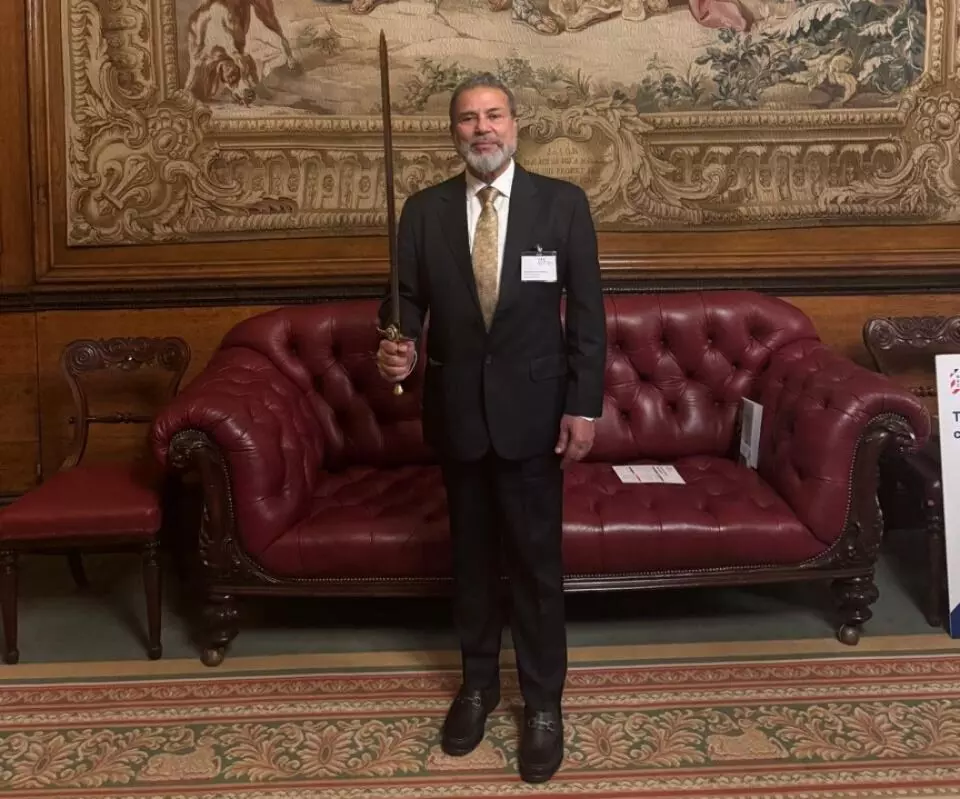
The award, regarded as one of the highest international recognitions for workplace safety, health and environmental management, was presented at a ceremony held on 28 November 2025 at Drapers’ Hall in London. Founder Syed Mohamed Beary and GM (Quality & HSE) Balasubramanian received the honour on behalf of the Bearys group.
The Sword of Honour is awarded only to organisations that secure a Five-Star rating in the British Safety Council’s comprehensive Health and Safety Audit and subsequently demonstrate exceptional performance in the adjudication process. With this recognition, the NTT Chennai project now joins a select group of facilities worldwide that have met these stringent standards.
In a statement, Bearys Group said the award reaffirms its commitment to maintaining safe and sustainable work environments. The company described the achievement as an acknowledgement of its efforts to ensure worker safety, promote environmental responsibility and deliver projects that meet global benchmarks for operational excellence.
The Group also noted that the recognition strengthens its longstanding partnership with NTT Global and reflects shared priorities in innovation, responsible development and adherence to international best practices.
Founder Syed Mohamed Beary said the honour motivates the organisation to continue upholding high safety standards across all construction sites, adding that safety is not just a compliance measure but a moral responsibility for the company.


Let the Truth be known. If you read VB and like VB, please be a VB Supporter and Help us deliver the Truth to one and all.
Congress using hijab issue to pacify minority anger, alleges Karnataka LoP R Ashoka

Bengaluru: Leader of Opposition in the Assembly R. Ashoka has accused the Congress government of using the hijab issue to placate what he described as discontent among minority voters after the Davanagere by-election.
In a post on X on Wednesday, Ashoka alleged that the state government, instead of addressing issues such as price rise, corruption, farmers’ distress and law and order, was attempting to retain its minority vote base by reviving the hijab issue.
Referring to the 2022 dress code introduced by the BJP government, which prohibited hijab in schools and colleges, Ashoka said the Karnataka High Court had upheld the policy and emphasised the importance of discipline in educational institutions.
He questioned the Congress government’s move to revisit the issue and asked whether setting aside the court-backed policy to benefit one community could be described as secularism.
Ashoka further alleged that while the government was willing to permit hijab, it continued to prohibit saffron shawls.
He accused the government of dividing students on religious lines rather than treating schools and colleges as spaces of equality.
Drawing a comparison with Mamata Banerjee’s government in West Bengal, Ashoka claimed that excessive appeasement politics had harmed the state and warned that the Congress in Karnataka could face a similar political response.
He said voters in Karnataka would teach the Congress a lesson for what he termed “vote-bank politics” and for compromising constitutional and judicial principles.


