
Bengaluru Archbishop appeals priests to hearken more to the poor

Bengaluru, Dec 19: Reaffirming the need to hear the voice of the poor and feel their pain, Archbishop Rev. Peter Machado said that “our love for the poor and less privileged and marginalized, and voiceless will bring us to receive the God’s blessings”.
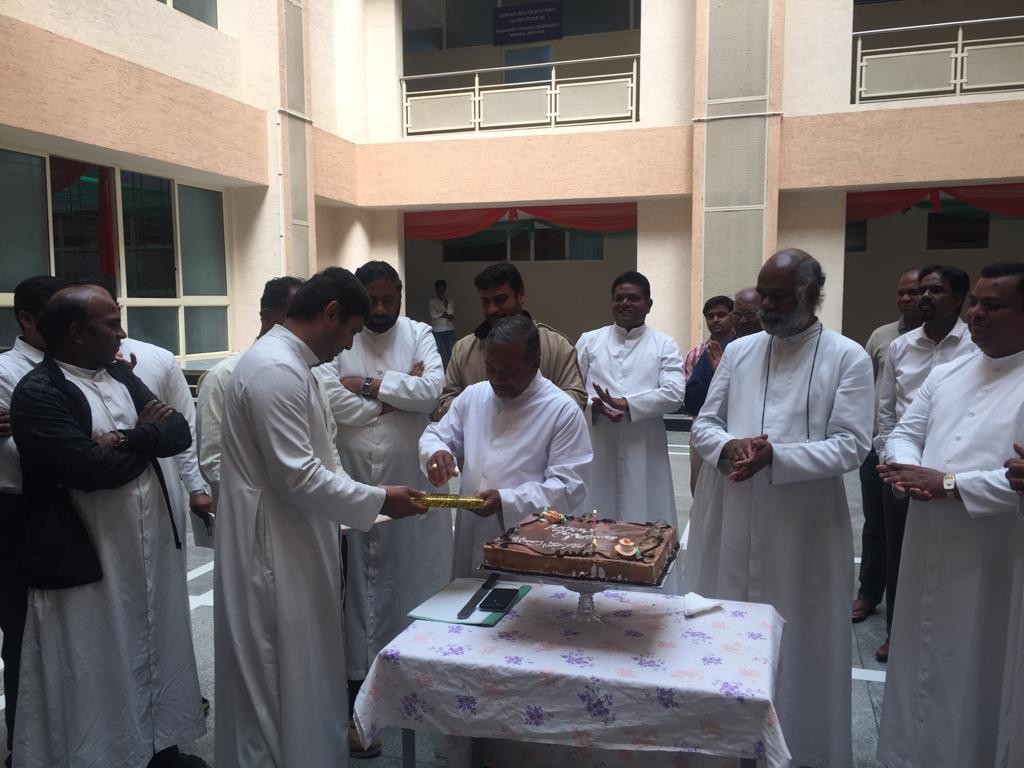
Addressing a gathering of over 200 priests at the annual priests Christmas Fellowship, hosted by him at his house here on Wednesday, he said that no poor should be left out from feeling that they were not loved by God.
“Christmas is always a time to re-focus our attention who are less privileged. People of all religions, with a heart filled with love, will share, care and comfort those who need to feel they are not discounted by the God”, he said.
The Archbishop called for greater concern for those who became homeless and lost because of natural calamities. He contemplated on how people could rehabilitate ‘as much as we can’ to help those in distress, he said.
The Prelate appealed to avoid lavish spending on religious celebrations and saving money for the poor instead. “Jesus Christ was born among the poor and helpless in a stable in Bethlehem which indicated that He chose to identify with the poor”, he said.
Peter Machado, who is the new Archbishop of Bengaluru since May 31, 2018, released the annual report of the activities of the Bangalore Multi-purpose Social Society (BMSSS). BMSSS director Fr. Navin coordinated the activities of the Archdiocese which has already raised over Rs 1 crore for flood victims of Kodagu.


Let the Truth be known. If you read VB and like VB, please be a VB Supporter and Help us deliver the Truth to one and all.
Virudhunagar firecracker unit blast: Toll climbs to 25, Rs 5.5 lakh ex gratia announced

Virudhunagar (Tamil Nadu) (PTI): With most bodies charred beyond recognition, identification remains difficult, police said on Monday, as the toll in the massive explosion at a fireworks unit near Kattanarpatti here rose to 25.
The Virudhunagar district administration has announced Rs 5.5 lakh ex gratia to the kin of deceased.
The accident is one of the deadliest industrial disasters in the region in recent years.
"Bodies were so badly charred that we were able to identify mostly with jewellery that the victims were wearing," a police official told PTI.
He said that the families have not yet claimed the bodies due to the uncertainly in the identities.
The factory owner is absconding, he added.
The accident occurred at the Vanaja firecracker unit, owned by one Muthumanickam, which functions under the Vachakarapatti police station limits.
The unit is reportedly licensed by the Petroleum and Explosives Safety Organisation (PESO), Nagpur.
Post-mortem reports have established that the 25 victims, include 22 women and three men, the police official added.
Eight workers, mostly women, are critically injured with 60 per cent burn injuries. Twelve others, including eight policemen, were injured in a second blast on Sunday evening while rescue operations were underway.
Rescue operations were severely hampered for hours, as unexploded materials continued to detonate.
A second blast at 7.20 pm, triggered as an earthmover was clearing debris, caused chaos and injured several responders, including a revenue official.
Meanwhile, sources said about 1,000 people, including the families of the victims and residents of nearby villages, are threatening a road roko, demanding the arrest of the owner of the factory.
Local eyewitnesses, including Ranganathan from the nearby Seervaikarampatti village, described hearing a massive blast that sent "thick black smoke" into the sky.
"Nothing was recognisable. We saw bodies being loaded four at a time into vehicles," he told PTI Videos.
Many of the deceased were from Seervaikarampatti village, with residents claiming that at least 20 victims belonged to their village.
Among those killed was 46-year-old Indrani, a veteran worker of 25 years.
"My mother was the sole breadwinner. My father is disabled and stays home. I have an MSc degree, but I’m working at a petrol bunk to help out, and we haven't even paid my brother's school fees yet," said Madhubala, Indrani’s daughter, while pleading for government employment assistance.
Virudhunagar Collector N O Sukhaputra confirmed that the unit was operating without permission on a rest day.
Preliminary findings suggest the blast originated in a chemical mixing shed, where nearly 40 workers were busy making crackers, a violation of safety norms that typically limit occupancy to four workers per shed.
"Had these workers followed primary safety norms, the casualties could have been minimal," a senior official stated.
Chief Minister M K Stalin has ordered a high-level probe and directed ministers to oversee relief efforts.
The tragedy follows a similar accident in Vembakottai just days earlier, which claimed four lives, intensifying calls for stricter enforcement of safety regulations in the district’s firecracker hub.
The explosion occurred at approximately 3.15 pm on Sunday. Although the fireworks industry is officially shut on Sundays, over 100 workers were reportedly engaged in production.
Later in the day, Sukhaputra said Rs 5.5 lakh ex gratia each has been finalised for the families of 25 persons killed in the explosion.
Speaking to PTI Videos, he said the ex gratia cheques are ready for immediate distribution to the legal heirs.
"Out of 25 deaths, we have finished conducting post-mortems on 22 bodies. Already we have cheques (that) are ready,” Sukhaputra said.
The announcement followed intense demands from grieving relatives for financial security and government employment.


