
Book Launch of Corporate Yoga
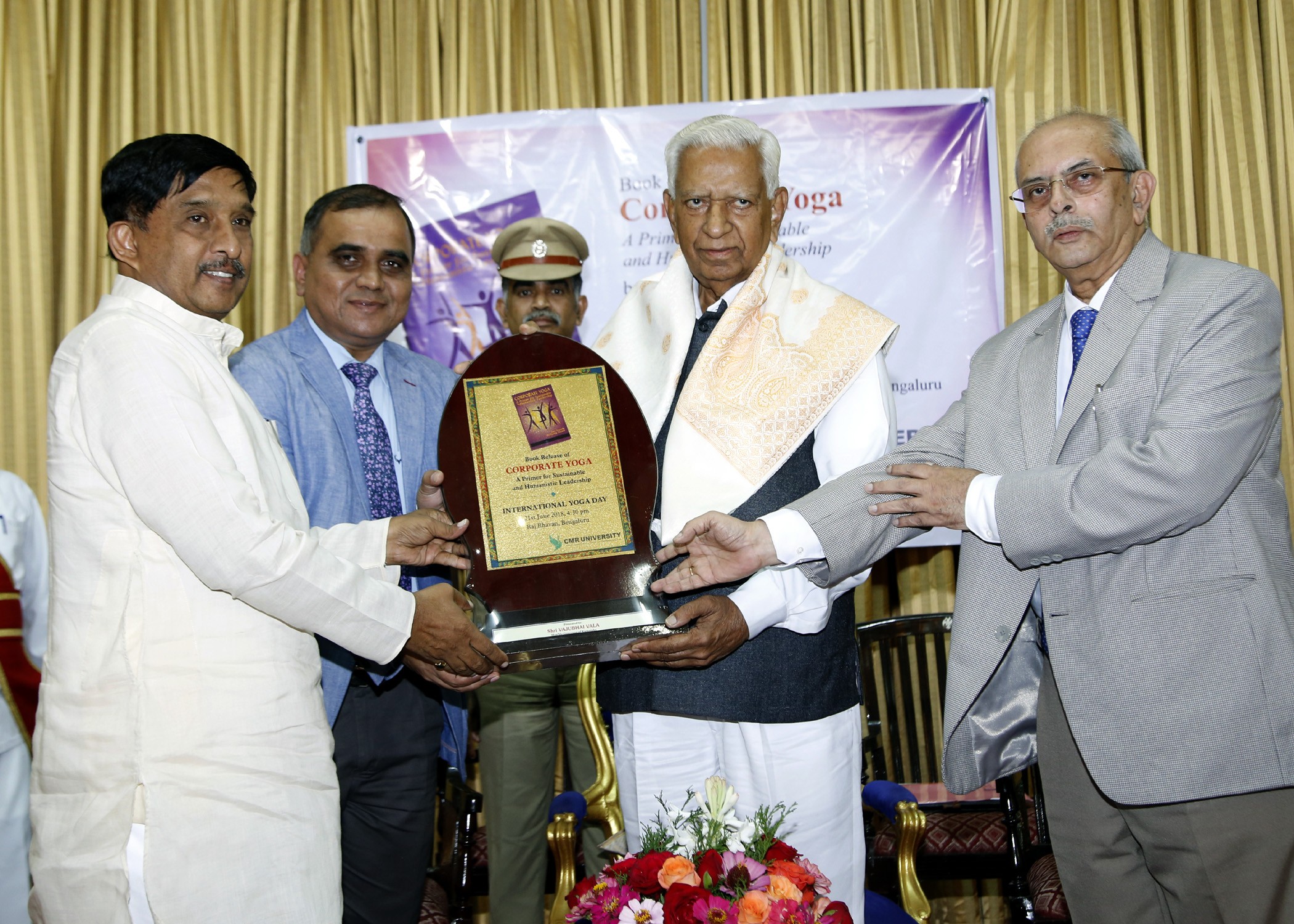
Co-authored by Dr. Shiv K Tripathi (Dean - CMRU), the book was launched by the Governor of Karnataka

Bengaluru, June 22: On the occasion of International Yoga Day, Hon. Governor of Karnataka, Shri Vajubhai Vala, launched the book Corporate Yoga: A Primer for Sustainable and Humanistic Leadership in a well-attended event at Raj Bhavan, Bengaluru. Written by Dr. Shiv K. Tripathi, Dean at CMR University (CMRU), and Prof. Wolfgang C. Amann, Academic Programme Director at HEC Paris (Doha), the book emphasizes on how morality and ethics should be developed in day-to-day decision-making and actions in the organizations.
Speaking at the event, the Hon’ble Governor highlighted the importance of Yoga in the modern age and said, "Yoga is an essential part of life and it is beyond just a physical activity, which is just a part of wider yoga philosophy.” He added that the philosophy of Yoga can be instrumental in promoting sustainable and balanced development across the world. While congratulating the authors for this unique work, he emphasized that this book will be a great contribution of knowledge in promoting ethical and value-driven leadership.
While introducing the book, Dr. Tripathi said that the book is based on Indian wisdom and stresses on practical ethics and prudence for ethical managerial action and decision-making. He stressed that the ethics and morality are at core of the sustainable enterprise.
Speaking on the occasion, Prof. M S Shivakumar, Vice Chancellor of CMRU, said that CMR University is committed for creation and dissemination of high quality knowledge, which will contribute to larger social good. Appreciating the efforts of Dr. Tripathi in writing this book, he mentioned that the publication of this book is a beginning of CMR University publishing initiative, which will take full-shape in near future to come.
Hon’ble Shri K.C. Ramamurthy, Member of Parliament and Chairman, CMR Group of Institutions also participated in the programme and congratulated the author.
Other dignitaries in the programme included Prof. K. Janardhanam from Bangalore University and faculty members and staff from CMR University.
Published by Information Age Publishing, USA, the book can be purchased at all leading bookstores and e-commerce websites. Both authors of the book are renowned management experts. Prior to joining CMR University, Prof. Tripathi had worked in different roles in India and abroad for more than two decades.
Apart from the book launch, the university also organized a Yoga session in its premises which was attended by the staff members.

Let the Truth be known. If you read VB and like VB, please be a VB Supporter and Help us deliver the Truth to one and all.
Time has come to implement Women's Reservation Act: PM Modi's letter to LS, RS floor leaders
_vb_91.jpeg)
New Delhi (PTI): Prime Minister Narendra Modi has said that the time has come for the implementation of the Women's Reservation Act in its true spirit and the 2029 Lok Sabha elections and Assembly elections are conducted with the quota for women in place.
In a letter to the floor leaders of Lok Sabha and Rajya Sabha, ahead of the three-day special sittings of Parliament, Modi also asked all members to come together in one voice to pass the amendments to the women's reservation law, officially known as Nari Shakti Vandan Adhiniyam.
"After extensive deliberations, we have reached the conclusion that the time has now come to implement the Nari Shakti Vandan Adhiniyam in its true spirit across the country.
"It is imperative that the 2029 Lok Sabha elections and Assembly elections are conducted with women's reservation in place," the Prime Minister said in his letter dated April 11.
The Budget Session of Parliament has been extended, and a special three-day sitting of the House has been convened on April 16 to 18.
The Women's Reservation Act will ensure an increase in the number of Lok Sabha seats to 816, of which 273 will be reserved for women.
The provision to provide 33 per cent reservation to women in the Lok Sabha and state assemblies was brought by amending the Constitution in 2023.
However, the women's quota would have come into effect only after the completion of the delimitation exercise on the basis of the 2027 Census. This meant the reservation would not have become enforceable before 2034 if the present law remains as is.
To implement it from the 2029 Lok Sabha elections, changes were needed in the Nari Shakti Vandan Adhiniyam; hence, the government is holding a special session to pass the amendments to the law.
_vb_07.jpeg)
_vb_85.jpeg)
_vb_84.jpeg)