
MP Shobha makes false claim that 2 lakh toilets were constructed in her constituency in 5 years
Government statistics tell a different story

Chikmagalur: Government records have rubbished MP Shobha Karandlaje's claim that under the Swachh Bharat Abhiyan, 2 lakh toilets were built in her constituency in the span of five years.
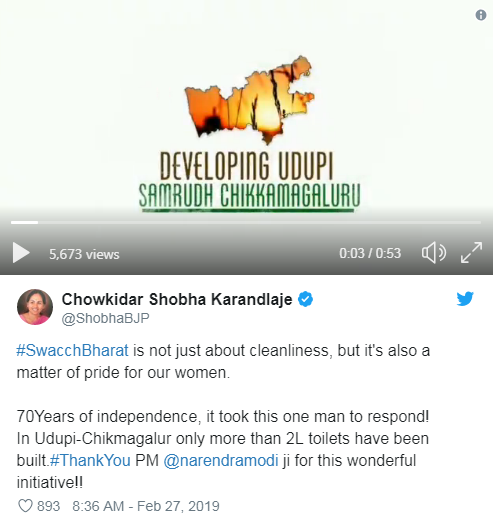
Praising Prime Minister Narendra Modi, MP Shobha Karandlaje had recently tweeted, "2 lakh toilets have been built in the constituency under Swachh Bharat Abhiyan in the last five years".
What is the reality?
Shobha tweeted: "#SwacchBharat is not just about cleanliness, but it is also a matter of pride for our women" Along with this, she posted a campaigning video saying, "70Years of Independence, it took this one man to respond! In Udupi-Chikmagalur only more than 2L toilets have been built. #ThankYou PM @narendramodi ji for this wonderful initiative!".
But, government statistics tell a different story.
Udupi
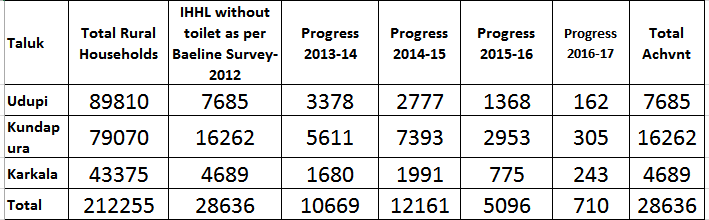
Udupi district was declared as the "Open Defecation Free District" in 2017. The official records of Udupi Zilla Panchayat have revealed that only 28,636 toilets were constructed in the district between 2013 and 2017. In Udupi, Kundapura, and Karkala taluks, there were 7685, 16262 and 4689 toilets required, respectively (according to the 2012 survey). In 2013-14, 3378, 5611 and 1680 toilets were constructed, respectively. The construction of 2777, 7393 and 1991 toilets was completed in 2014-15. Similarly, 1368, 2953 and 775 toilets were built in 2015-16, whereas 162, 305 and 243 toilets were constructed in 2016-17.
In all, the number of toilets built during this period was 28,636. (Brahmavara, Kapu, Byndoor and Hebri Taluks were announced on January 1, 2018).
Chikmagalur:
According to the records available at the Chikkamagaluru ZP office, only 69,418 toilets were constructed in Chikkamagaluru district from 2012 to 2018. What we need to note here is 'from 2012'. For this, Rs 7,192.71 lakh has been spent under Swachh Bharat Abhiyan.
According to Baseline Survey, after 2018, 6,615 families in Chikkamagaluru district were left out of the toilet facility. Of these, only 493 toilets were constructed between 2018 and March 2019, for which the fund of Rs 7.41 lakh has been used. 6,122 toilets are yet to be built in the district.
Nirmal Bharat-Swachh Bharat
ZP officials informed that the Swachh Bharat Abhiyan was not implemented in 2012. Nirmala Bharat campaign was then in existence. Only, the name was changed to 'Swachh Bharat Abhiyan' for the same project. A total of 69,418 toilets were constructed in the district from 2012 to 2018 in the same fund.
This is not for the first time!
This is not the first time that MP Shobha Karandlaje is manipulating the information. Shobha Karandlaje had written a letter to the Union Home Minister demanding an NIA probe into the murders of Hindu / Sangh Parivar activists in the state. However, one man in Shobha's list of dead people was alive and employed while suicide and accident were the reason behind the death of some other people who were mentioned in the list.
Vartha Bharati has first exposed the reality behind the letter written by Shobha. Later she expressed regret for the same.
Let the Truth be known. If you read VB and like VB, please be a VB Supporter and Help us deliver the Truth to one and all.
2 detained after comment over wedding procession to Dalit house sparks clash in UP's Shahjahanpur

Shahjahanpur (UP) (PTI): Two persons have been detained after a clash broke out allegedly over remarks targeting a Dalit family's wedding procession in Uttar Pradesh's Shahjahanpur district, police said on Saturday.
The incident occurred in Lai Kheda village under Tilhar police station area, where a wedding procession from Bareilly had arrived at a Dalit household on April 20.
According to SP Saurabh Dixit, when the procession was near the house of Rajpal Yadav, he allegedly made a remark saying "Now, Dalits will also take out wedding processions riding a buggy", leading to an argument. Yadav's side allegedly turned aggressive, escalating the conflict further.
Police said a scuffle ensued between the two sides. Upon receiving information, police personnel reached the spot and ensured that the procession was conducted peacefully after the incident.
An FIR was registered on Friday against Rajpal Yadav, Sumit, Amit, Surendra, Avdhesh Yadav and five unidentified persons based on a complaint. Rajpal Yadav and his son Sumit have been taken into custody and are being questioned, Dixit said.
The case has been registered under provisions of the Bharatiya Nyaya Sanhita (BNS), 2023 and the Scheduled Castes and Scheduled Tribes (Prevention of Atrocities) Act, police said.
Dixit said preliminary findings suggest that Yadav, too, was hosting a function and processions from both sides had arrived around the same time. A dispute may have initially arisen due to a narrow passage and attempts to move the processions quickly.
Police have registered the case under relevant sections of the BNS and initiated further probe, officials said.


