Toyota Kirloskar Motor to invest Rs 3,300 cr to set up 3rd plant in Karnataka

Bengaluru: Toyota Kirloskar Motor on Tuesday announced plans to invest Rs 3,300 crore to set up its third plant at Bidadi in Karnataka.
The new unit, which will commence production by 2026, will have an annual capacity of 1 lakh units in two shifts.
It will come up at the company's existing facility at Bidadi, near here where it currently has two units with a combined installed production capacity of up to 3.42 lakh units annually.
The new plant, apart from producing multi-utility vehicle Innova HyCross, will be ''future ready'' to roll out models spanning across different fuel technologies, Toyota Kirloskar Motor (TKM) Executive Vice President & Country Head Vikram Gulati told PTI.
''I believe, we are as a company future-ready, both in terms of access to technology, access to well-accepted products across various powertrains as also access to the ability to bring these products to market,'' he said.
He further said in the industry, it doesn't take too much for the same line or some lines to be made ready for introducing any kind of powertrains.
''It does take a bit of doing but it's not really a huge barrier, in my opinion. So that that makes us ready and flexible in terms of any of the powertrains going forward. And I'm sure the new plant is going to be much more advanced and much more future ready,'' Gulati said when asked if the third plant will have the provision for producing new technology vehicles such as electric vehicles.
He, however, said it is too early to give any specifics.
The third plant will create 2,000 jobs, adding to the current 11,200 strong workforce across the existing two plants, he added.
The company has signed a memorandum of understanding with the Karnataka government regarding the fresh investment to set up the third plant coinciding with its 25th year of operations in India.
''As a future-ready mobility company, we are certain that today's significant MoU with the Karnataka government for the new plant will positively contribute through consequent employment generation and expand adoption of advanced clean technologies,'' TKM Managing Director and CEO Masakazu Yoshimura said at the event.
He further said TKM would continue to work with the government to develop a world-class local system that promises best solutions for India by focusing in improving energy security, promoting economic growth and achieving carbon neutrality.
In a statement, Toyota CEO Asia Region Masahiko Maeda said, ''The Indian market has always been of great importance of us. We are confident that the new investments in India, we will further elevate TKM's role in our global vision for a more promising future by creating sustainable mobility solutions that enrich people's lives worldwide.'' Last year, Toyota group firms comprising TKM and Toyota Kirloskar Auto Parts had signed an MoU with Karnataka government to invest Rs 4,100 crore to enhance electrification, fast paced shift towards greener technologies and deeper cut in CO2 emissions.
So far Totoya has invested a total of Rs 16,000 crore in India on various activities.
Let the Truth be known. If you read VB and like VB, please be a VB Supporter and Help us deliver the Truth to one and all.
KMES Institutions shine in SSLC result, continue four-decade legacy of education in rural Karkala

Karkala: KMES Institutions of Education at Kukkundooru in Karkala taluk has recorded outstanding results in the 2025-26 SSLC and PUC examinations, continuing a four-decade educational journey that began with just 22 kindergarten students and no building of its own.
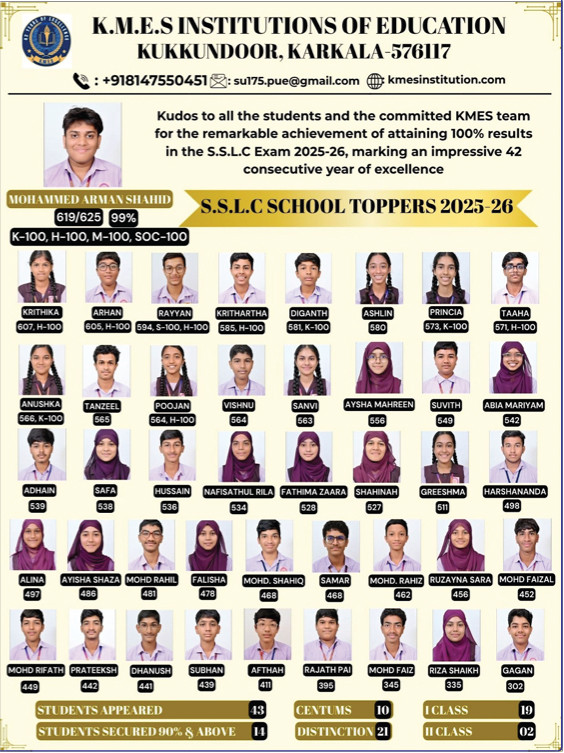
The institution secured a 100 per cent result in the SSLC examinations, with all 43 students passing the examination this year.
Muhammad Arman Shahid emerged as the school topper by scoring 619 marks out of 625, securing 99 per cent and also ranking sixth at the state level. He scored full marks in Kannada, Hindi, Mathematics and Social Science.
Krithika V. Nayak secured the second position in the school with 607 marks and 97.12 per cent, while Arhan stood third with 605 marks and 96.8 per cent.
Out of the 43 students, 21 passed with distinction, 19 secured first class, two students obtained second class and one student passed in third class. Fourteen students scored above 90 per cent.
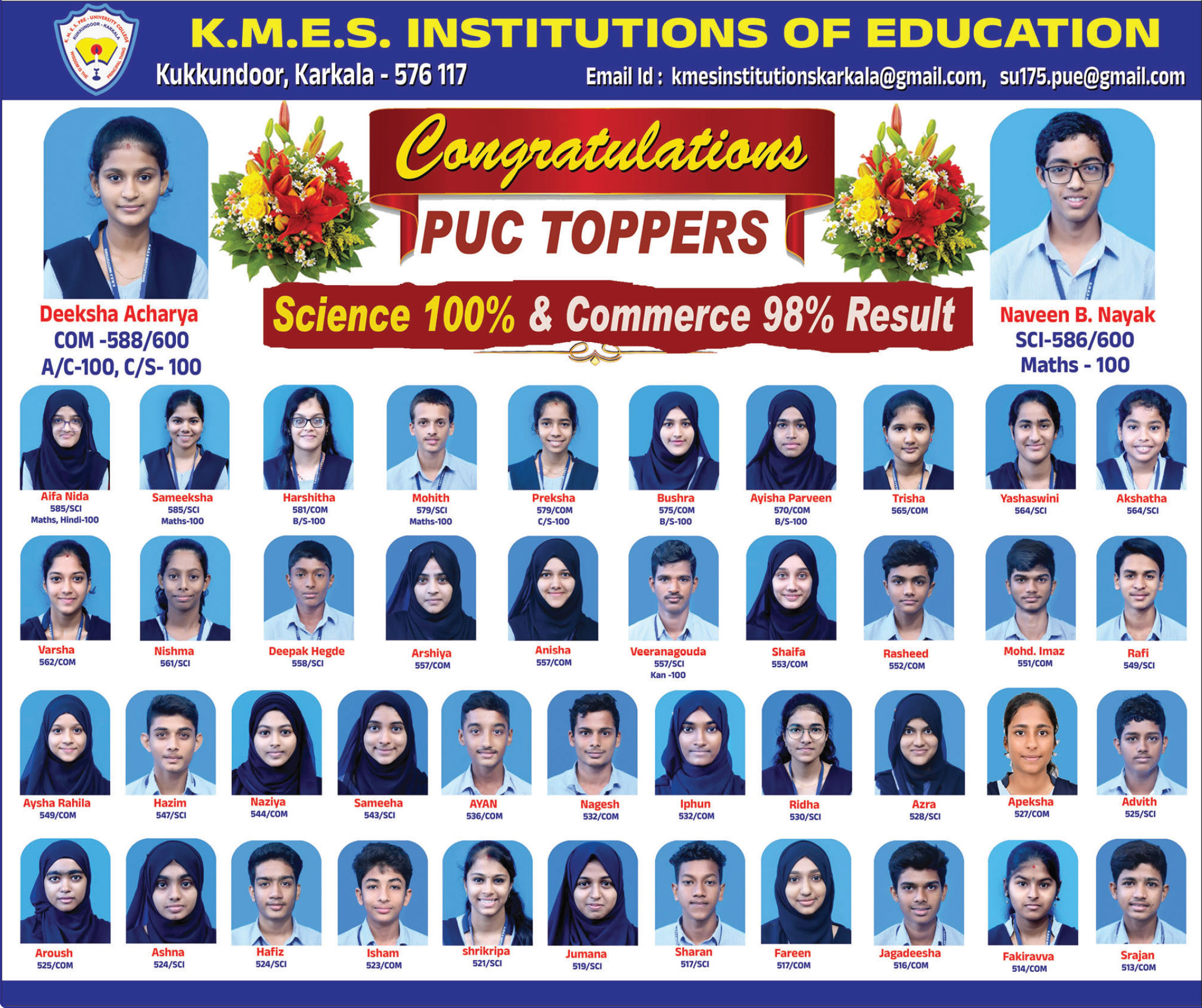
The institution also performed strongly in the PUC examinations. The Science stream recorded a 100 per cent result, with all 44 students passing, while Commerce secured a 98 per cent pass percentage.
Twelve students scored full marks in different subjects, including Mathematics.
In Commerce, Deeksha Acharya topped the college with 588 marks, while Harshitha H. Kini secured the second position with 581 marks.
In Science, Naveen B. Nayak emerged as topper with 586 marks, followed closely by Sameeksha Moily and Aifa Nidha, who both secured 585 marks.
Speaking about the achievement, High School head teacher Shrimati Patkar said the institution has always focused on supporting academically weak students through affordable education and free special classes.
“Our ambition is to provide quality education even to students who struggle in studies. The fees are very low, and free coaching classes are conducted. I have worked here for 28 years and have always found the atmosphere supportive of education,” she said.
Primary School head teacher Lolita Zeena D’Silva appreciated the dedication of the teaching staff and said the school encourages students not only to achieve high marks but also to become role models.
PU College Principal Balakrishna Rao said the institution focuses on value-based education and overall personality development.
“The aim is to help students succeed not only academically but also in cultural activities, sports and leadership. We encourage qualities such as patience, tolerance and discipline,” he said.
Rao also credited the institution’s growth to the support of founders K.S. Mohammed Masood and K.S. Nissar Ahmed, along with President K.S. Imtiaz Ahmed.
Speaking on the occasion, Imtiaz Ahmed said the institution was built on the dream of making quality education accessible to financially backward families in rural areas.
He said the guidance and encouragement of his elder brothers, Mohammed Masood and Nissar Ahmed, along with the contribution of teachers, students and parents, helped transform the institution into a model educational centre.
The KMES Institutions trace their roots back to 1984, when they were founded by senior social activists Haji P.M. Khan, K.S. Nazeer Ahmed and Haji A.S. Rashid Haider.
The institution initially functioned from the Government Urdu School premises as it did not have a building of its own. Classes began with only 22 students in lower kindergarten and two teachers.
Later, under the leadership of K.S. Mohammed Masood and with continuous financial and moral support from non-resident businessman K.S. Nissar Ahmed, the institution gradually expanded.
In 1993, the school shifted to its own building and began conducting classes from LKG to Class 5.
As student admissions increased, Nissar Ahmed personally funded the construction of three additional classrooms to address infrastructure shortages.
The institution’s new school building was completed in 1997, while the PU College building was constructed in 2001.
From humble beginnings in a borrowed building to producing state-level rank holders and consistent academic results, the KMES Institutions have grown into one of the prominent educational centres in the Karkala region.