
Afghans vote in presidential election amid deadly violence

Kabul, Sep 28: Afghans voted in presidential elections amid tight security Saturday, as Taliban insurgents determined to disrupt the process unleashed a string of attacks on polling centres across the country that killed at least five people.
The first-round vote marked the culmination of a bloody election campaign that despite a large field of candidates is seen as a close race between President Ashraf Ghani and his bitter rival Abdullah Abdullah, the country's chief executive.
Authorities placed Kabul under partial lockdown, flooding streets with troops and banning trucks from entering the city in an effort to stop would-be suicide bombers targeting residents as they cast their votes.
The Taliban, who carried out multiple bombings during the two-month election season, claimed to have conducted hundreds of attacks against Afghanistan's "fake elections".
Officials said five security officials had been killed and 37 civilians wounded.
"The enemy carried out 68 attacks against election sites across the country... but security forces repelled most of the attacks," acting defence minister Asadullah Khalid said.
Compared to previous elections, the initial toll appeared relatively light, though authorities in the past have suppressed information on election day only to later give much larger numbers.
Having voted at a Kabul high school, Ghani said the most important issue was finding a leader with a mandate to bring peace to the war-torn nation.
"Our roadmap (for peace) is ready, I want the people to give us permission and legitimacy so that we pursue peace," said Ghani, who is seeking a second five-year term.
Some 9.6 million Afghans are registered to vote, but many lack faith that after 18 years of war any leader can unify the fractious country and improve basic living conditions, boost the stagnating economy or bolster security.
Observers from the Afghanistan Independent Human Rights Commission said turnout appeared to be low, especially among women.
"I know there are security threats but bombs and attacks have become part of our everyday lives," 55-year-old Mohiuddin, who only gave one name, told AFP.
"I am not afraid, we have to vote if we want to bring changes." Abdullah and Ghani both claimed victory in the 2014 election -- a vote so tainted by fraud and violence that it led to a constitutional crisis and forced the administration of then-US president Barack Obama to push for a compromise that saw Abdullah awarded the subordinate role.
"The only request I have from the election commission is that they ensure the transparency of the election because lots of people have lost their trust," said Afghan voter Sunawbar Mirzae, 23.
Voting in Afghanistan's fourth presidential election the first was in 2004 took place at nearly 5,000 polling centres across the country, and the interior ministry said it had deployed 72,000 forces to help secure these.
Many Afghans said voting went smoothly, triumphantly holding up fingers stained in indelible ink to show they had cast a ballot, but several said they had experienced problems.
"I came this early morning to cast my ballot. Unfortunately my name was not on the list," said Ziyarat Khan, a farmer in Nangarhar. "The whole process is messy like the last time." Campaigning was hampered by violence from the first day, when Ghani's running mate was targeted in a bomb-and-gun attack that left at least 20 dead.
The campaign itself was muted compared to years past, as many thought the already-twice-delayed election would be postponed again while talks between the US and the Taliban for a troop withdrawal played out.
That deal has been scuppered for now after US President Donald Trump pulled out, and Afghanistan's next president will likely face the daunting task of trying to strike a bargain with the Taliban.
Election officials say this will be the cleanest election yet, with equipment such as biometric fingerprint readers and better training for poll workers to ensure the vote is fair.
Still, the US has expressed disquiet about the possibility of fraud and US Secretary of State Mike Pompeo told Ghani in a phone call this week that candidates' behaviour must be "beyond reproach to ensure the legitimacy of the outcome".
Preliminary results are not expected until October 19. Candidates need more than 50 percent of the vote to be declared the outright winner, or else the top two will head for a second round in November.
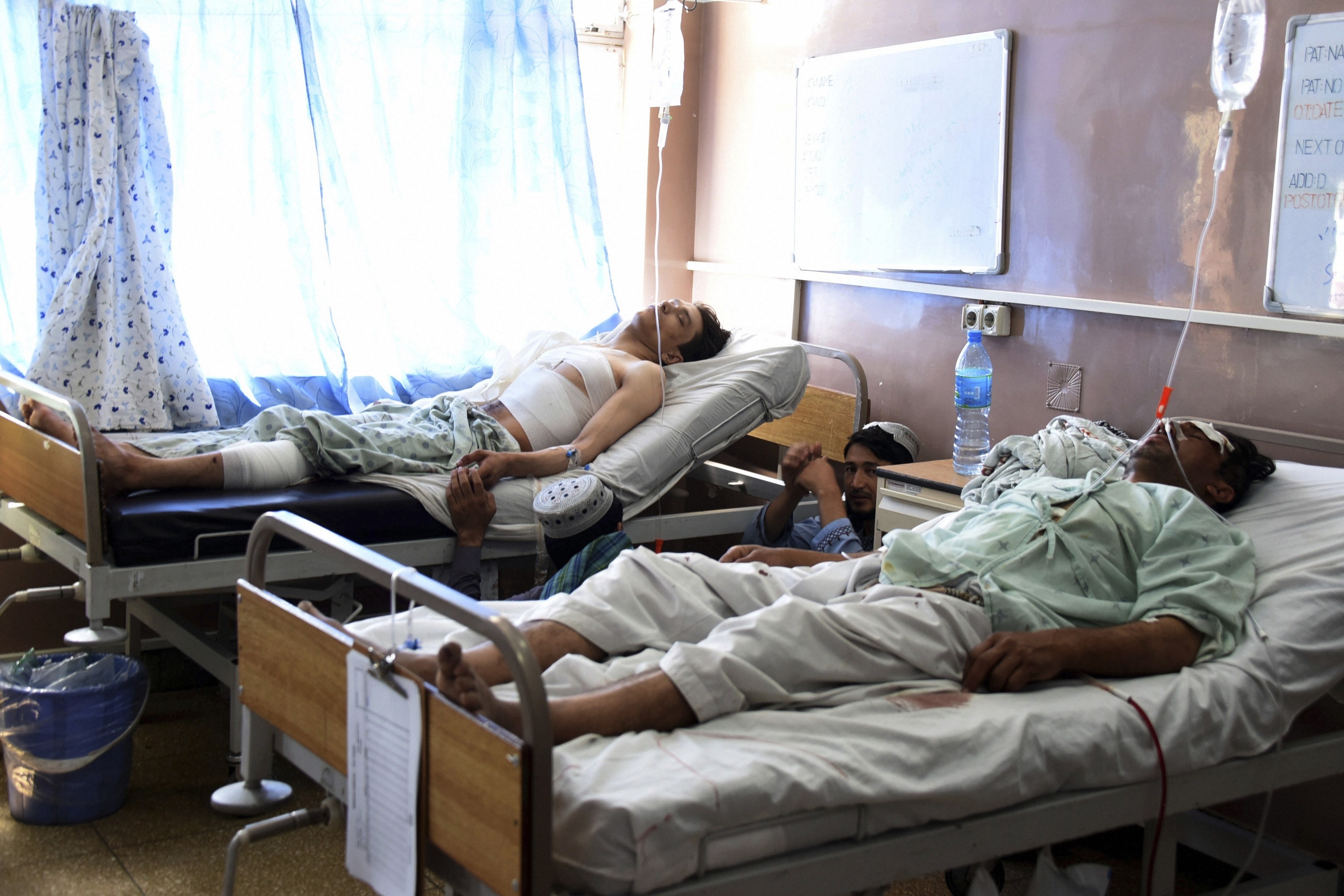
Kandahar: Wounded Afghans lie on a bed at a hospital after a bomb attack on a local mosque in Kandahar province, south of Kabul, Afghanistan, Saturday.
Let the Truth be known. If you read VB and like VB, please be a VB Supporter and Help us deliver the Truth to one and all.
4 held for sexually assaulting woman, girl on moving bus after social media alert in UP's Agra

Agra (UP) (PTI): Four people were arrested, after a prompt response by police following a social media alert, for allegedly sexually assaulting a woman and a girl inside a moving bus here, officials said on Tuesday.
According to an official police statement, at 12:27 am on April 27, information was received on the social media platform X about an incident of sexual assault on a bus travelling from Kanpur to Ahmedabad, which was approaching Namner crossing in Agra.
Acting under the direction of Police Commissioner Deepak Kumar, the Agra Police social media team immediately alerted the Rakabganj police station within minutes and coordinated with the victims to confirm the incident and obtain the exact location, it stated.
Police teams launched intensive checking at Namner crossing and intercepted the bus as it reached the spot. The four accused involved in the incident were apprehended on the spot, and legal action was initiated against them, the statement said.
The police said the swift response and coordination between the social media team and field units ensured timely action, bringing relief to the victims and other passengers, who expressed gratitude towards the police, it added.


