Interim Prez Delcy Rodríguez held backchannel talks with US ahead of Maduro’s removal: Reports

Washington/Caracas: Senior Venezuelan leader Delcy Rodríguez and her brother Jorge Rodríguez quietly conveyed to the United States that they were willing to cooperate with Washington in the event of President Nicolás Maduro’s departure, according to a detailed report published by The Guardian, citing four sources familiar with the discussions.
The report says Delcy Rodríguez, who was sworn in as acting president on January 5 after Maduro was taken into US custody earlier this month, and her brother Jorge Rodríguez, the head of Venezuela’s National Assembly, communicated assurances to US and Qatari officials through intermediaries ahead of the operation.
According to The Guardian, these communications began in the fall of last year, when Delcy Rodríguez was still serving as Maduro’s vice-president, and continued even after a crucial phone call between US President Donald Trump and Maduro in late November. During that call, Trump reportedly insisted that Maduro step down, a demand Maduro rejected.
By December, sources told the newspaper that Delcy Rodríguez had clearly indicated to US officials that she believed Maduro needed to leave and that she was prepared to work with Washington in the aftermath. One source quoted by The Guardian said Rodríguez conveyed that she was ready to engage with “whatever is the aftermath” once Maduro was gone.
The report states that US Secretary of State and National Security Adviser Marco Rubio, initially sceptical about engaging with figures from within the Venezuelan regime, eventually came to see Delcy Rodríguez’s assurances as the most viable path to maintaining stability after Maduro’s removal.
The Guardian notes that the pledge of cooperation by Delcy and Jorge Rodríguez before the US operation against Maduro has not been previously reported. It adds that earlier attempts at mediated talks through Qatar had surfaced in October, when the Miami Herald reported that Rodríguez had offered to lead a transitional government if Maduro stepped aside. Reuters later reported that Venezuela’s Interior Minister Diosdado Cabello had also been in contact with US officials months before the operation.
According to all sources cited, the Rodríguez siblings drew a clear line in their understanding with the US. While they agreed to cooperate once Maduro was gone, they did not agree to actively assist in removing him. The sources emphasised that this was not a coup orchestrated by the Rodríguez family against Maduro.
Hours after Maduro was taken into custody, Trump appeared to confirm the existence of prior talks. He told the New York Post that Delcy Rodríguez was “onboard” and said the two sides had spoken “numerous times”.
After The Guardian story was published, the Venezuelan government dismissed the report as “fake” in a post on X, without providing further details. The White House did not respond to the newspaper’s questions.
The report also highlights that backchannel communications ran alongside official talks between Trump administration officials and Maduro’s government. Maduro himself met Trump aide Ric Grenell about 10 days after Trump’s inauguration to discuss US prisoners, who were later released.
Senior Trump aides reportedly continued regular discussions with Delcy and Jorge Rodríguez on practical matters, including coordinating deportation flights of Venezuelans from the US, handling detainees held in El Salvador, and the possible release of political prisoners.
The Guardian further notes Delcy Rodríguez’s close ties with Qatar, which played a facilitation role in some of the contacts. Sources told the newspaper that Qatar’s goodwill with the Trump administration helped open doors for discreet negotiations.
While Rodríguez publicly denied reports about transition talks last year, US officials reportedly began to reassess her role, seeing her as a pragmatic figure rather than a rigid ideologue. Sources cited her willingness to work with US oil companies and her familiarity with American energy executives as a key factor in this reassessment.
One source told The Guardian that the overriding US concern was avoiding chaos or civil conflict in Venezuela after Maduro’s removal. “The biggest thing was trying to avoid a failed state,” the source said.
According to the report, Delcy Rodríguez and her brother only began engaging in discussions without Maduro’s knowledge after it became clear, following the November phone call with Trump, that Maduro would not step down voluntarily. At the same time, sources said Rodríguez was careful not to openly betray him, out of fear for her own safety.
When US helicopters entered Caracas in early January, rumours circulated that Rodríguez had fled to Moscow. However, The Guardian reported, citing two sources, that she was instead on Margarita Island at the time.
Let the Truth be known. If you read VB and like VB, please be a VB Supporter and Help us deliver the Truth to one and all.
KMES Institutions shine in SSLC result, continue four-decade legacy of education in rural Karkala

Karkala: KMES Institutions of Education at Kukkundooru in Karkala taluk has recorded outstanding results in the 2025-26 SSLC and PUC examinations, continuing a four-decade educational journey that began with just 22 kindergarten students and no building of its own.
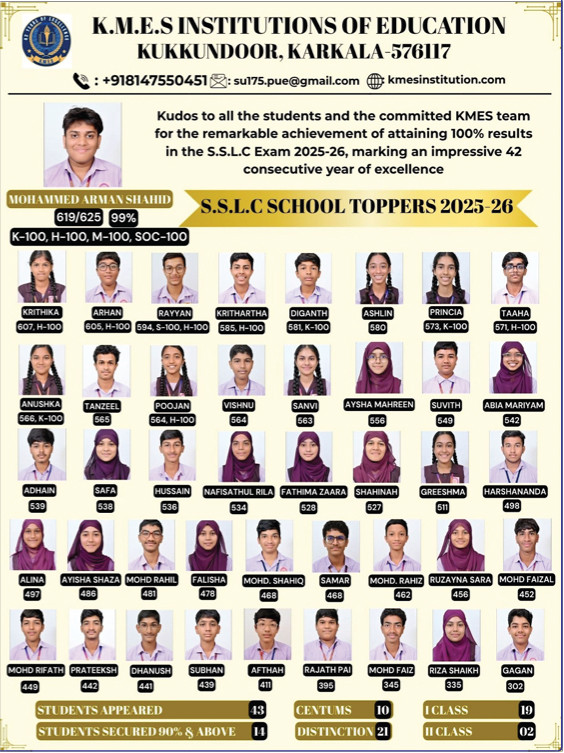
The institution secured a 100 per cent result in the SSLC examinations, with all 43 students passing the examination this year.
Muhammad Arman Shahid emerged as the school topper by scoring 619 marks out of 625, securing 99 per cent and also ranking sixth at the state level. He scored full marks in Kannada, Hindi, Mathematics and Social Science.
Krithika V. Nayak secured the second position in the school with 607 marks and 97.12 per cent, while Arhan stood third with 605 marks and 96.8 per cent.
Out of the 43 students, 21 passed with distinction, 19 secured first class, two students obtained second class and one student passed in third class. Fourteen students scored above 90 per cent.
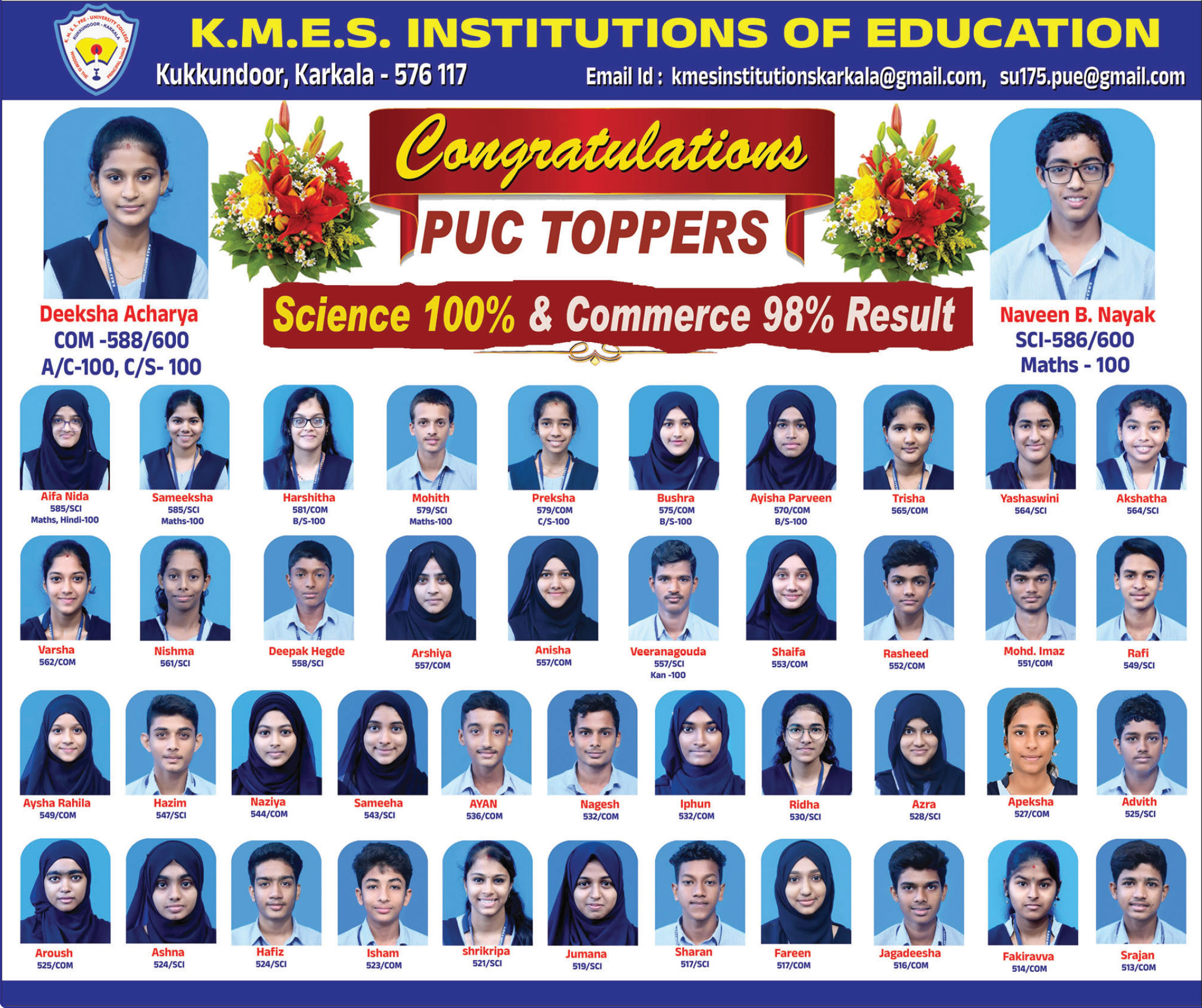
The institution also performed strongly in the PUC examinations. The Science stream recorded a 100 per cent result, with all 44 students passing, while Commerce secured a 98 per cent pass percentage.
Twelve students scored full marks in different subjects, including Mathematics.
In Commerce, Deeksha Acharya topped the college with 588 marks, while Harshitha H. Kini secured the second position with 581 marks.
In Science, Naveen B. Nayak emerged as topper with 586 marks, followed closely by Sameeksha Moily and Aifa Nidha, who both secured 585 marks.
Speaking about the achievement, High School head teacher Shrimati Patkar said the institution has always focused on supporting academically weak students through affordable education and free special classes.
“Our ambition is to provide quality education even to students who struggle in studies. The fees are very low, and free coaching classes are conducted. I have worked here for 28 years and have always found the atmosphere supportive of education,” she said.
Primary School head teacher Lolita Zeena D’Silva appreciated the dedication of the teaching staff and said the school encourages students not only to achieve high marks but also to become role models.
PU College Principal Balakrishna Rao said the institution focuses on value-based education and overall personality development.
“The aim is to help students succeed not only academically but also in cultural activities, sports and leadership. We encourage qualities such as patience, tolerance and discipline,” he said.
Rao also credited the institution’s growth to the support of founders K.S. Mohammed Masood and K.S. Nissar Ahmed, along with President K.S. Imtiaz Ahmed.
Speaking on the occasion, Imtiaz Ahmed said the institution was built on the dream of making quality education accessible to financially backward families in rural areas.
He said the guidance and encouragement of his elder brothers, Mohammed Masood and Nissar Ahmed, along with the contribution of teachers, students and parents, helped transform the institution into a model educational centre.
The KMES Institutions trace their roots back to 1984, when they were founded by senior social activists Haji P.M. Khan, K.S. Nazeer Ahmed and Haji A.S. Rashid Haider.
The institution initially functioned from the Government Urdu School premises as it did not have a building of its own. Classes began with only 22 students in lower kindergarten and two teachers.
Later, under the leadership of K.S. Mohammed Masood and with continuous financial and moral support from non-resident businessman K.S. Nissar Ahmed, the institution gradually expanded.
In 1993, the school shifted to its own building and began conducting classes from LKG to Class 5.
As student admissions increased, Nissar Ahmed personally funded the construction of three additional classrooms to address infrastructure shortages.
The institution’s new school building was completed in 1997, while the PU College building was constructed in 2001.
From humble beginnings in a borrowed building to producing state-level rank holders and consistent academic results, the KMES Institutions have grown into one of the prominent educational centres in the Karkala region.