
Jamal Khashoggi: Turkey says journalist was murdered in Saudi consulate

Mr Khashoggi, a Saudi national, went missing after visiting the Saudi consulate in Istanbul on Tuesday.
A Turkish official told the BBC that initial investigations indicated he was murdered there.
Saudi Arabia has denied the accusations, saying it is "working to search for him".
The Washington Post said it would be a "monstrous and unfathomable act" if he had been killed.
The BBC's Istanbul correspondent, Mark Lowen, said it would plunge Turkish-Saudi relations into an unprecedented crisis.
Turkish officials have opened an investigation and have been speaking to the media on condition of anonymity.
The deputy chairman of Turkey's ruling AK Party told broadcaster CNN Turk there was concrete evidence, according to Reuters news agency, but none has yet been presented.
When was he last seen?
Jamal Khashoggi is a high-profile critic of Saudi Arabia's Crown Prince Mohammed bin Salman. He has more than 1.6 million Twitter followers and has written for the Washington Post opinion section.
On Tuesday, he went to the consulate to obtain a document certifying he had divorced his ex-wife, so that he could marry his Turkish fiancée, Hatice Cengiz.
Ms Cengiz said she waited outside for 11 hours, but he did not come out.
She said Mr Khashoggi was required to surrender his mobile phone, which is standard practice in some diplomatic missions. He told her to call an adviser to Turkish President Recep Tayyip Erdogan if he did not return.
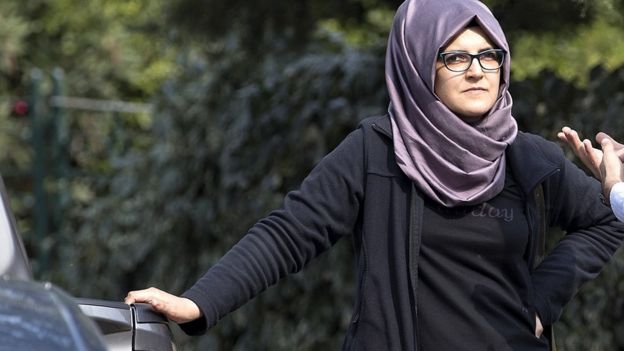
Jamal Khashoggi's fiancée Hatice waited outside the Saudi consulate on Wednesday EPA
"Jamal is not dead. I cannot believe that he has been killed...!" Ms Cengiz wrote on Twitter as the allegations circulated. She said she was waiting for official confirmation.
The head of the Turkish-Arab Media Association, Turan Kislakci, told the New York Times that Turkish police officers providing security for the consulate had checked their security cameras and did not see the journalist leave on foot. But he added that diplomatic cars had been seen moving in and out.
What have the Saudis said?
On Wednesday, Crown Prince Mohammed bin Salman told Bloomberg News that Turkish authorities were welcome to search the building because "we have nothing to hide".
The prince said the Saudis were "very keen to know what happened to him", saying his understanding was that Mr Khashoggi left "after a few minutes or one hour".
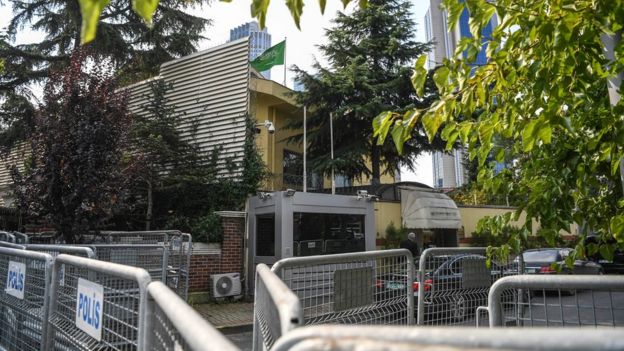
The Saudi consulate said Khashoggi left after completing paperwork AFP
When asked if Mr Khashoggi faced charges in Saudi Arabia, the crown prince said his country would need to know where he was first.
Potential crisis
Analysis by the BBC's Mark Lowen, Istanbul
This is a bombshell allegation by Turkey. And while the authorities here are so far not providing evidence to back it up, it's inconceivable that such a claim would have been made without firm grounds. Ankara's relationship with Riyadh is too important to jeopardise on the basis of unsubstantiated rumour.
That relationship is already strained over several issues, including Turkey's support for Qatar in the blockade by Saudi Arabia; its closeness to the Muslim Brotherhood - blacklisted by Riyadh as a terrorist organisation; and its rapprochement with Saudi Arabia's arch-rival Iran. But if proven, the murder of Jamal Khashoggi would be the most serious diplomatic crisis between the two in living memory.
Turkey would hope for backing from its Nato ally, the US. But Saudi Arabia has arguably become Donald Trump's closest ally in the Middle East - and Washington may be reluctant to weigh in against Riyadh at this stage.
Who is Jamal Khashoggi?
The 59-year-old journalist is one of the most prominent critics of the crown prince, who has unveiled reforms praised by the West while carrying out an apparent crackdown on dissent. Human and women's rights activists, intellectuals and clerics have been arrested - meanwhile, Saudi Arabia is waging a war in Yemen that has triggered a humanitarian crisis.
A former editor of the al-Watan newspaper and a short-lived Saudi TV news channel, Mr Khashoggi was for years seen as close to the Saudi royal family. He served as an adviser to senior Saudi officials.
After several of his friends were arrested, his column was cancelled by the al-Hayat newspaper and he was allegedly warned to stop tweeting, Mr Khashoggi left Saudi Arabia for the US, from where he wrote opinion pieces for the Washington Post and continued to appear on Arab and Western TV channels.
"I have left my home, my family and my job, and I am raising my voice," he wrote in September 2017. "To do otherwise would betray those who languish in prison. I can speak when so many cannot."
The Washington Post on Friday blanked out his column in support.
Courtesy: www.bbc.com
Let the Truth be known. If you read VB and like VB, please be a VB Supporter and Help us deliver the Truth to one and all.
'Ab kya hoga, ye rab jane...': Tharoor takes dig at failed US-Iran talks in Pakistan
 (3)_vb_24.jpeg)
New Delhi (PTI): Senior Congress leader Shashi Tharoor on Monday took a swipe at the "failed" US-Iran peace talks in Pakistan with an Urdu couplet, saying only god knows now what will happen.
"Ab kya hoga, ye rab jane; Na woh mane, na ye mane (only god knows what will happen now as both sides did not agree)," Tharoor said on X, tagging a post-talks video clip of US Vice President J D Vance, who led the American delegation at the negotiations in Islamabad.
The United States and Iran failed to reach a peace deal at their historic 21-hour talks in Pakistan, leaving the fate of a tenuous two-week ceasefire in doubt, with both sides attempting to hold each other responsible for the collapse of the negotiations.
अब क्या होगा, ये रब जाने
— Shashi Tharoor (@ShashiTharoor) April 13, 2026
ना वो माने, ना ये माने https://t.co/DYrXpa7C8h
Vance said the Iranian side did not accept Washington's terms for ending the war even as the US presented its "final and best offer".
Hours after the talks collapsed, US President Donald Trump said on social media that the negotiations with Tehran failed as "Iran is unwilling to give up its nuclear ambitions".
Trump said the US Navy will actively interdict any vessel in international waters found to have paid tolls to Iran for transiting through the Strait of Hormuz, a critical shipping route that handles roughly 20 per cent of global oil and LNG (Liquefied Natural Gas).
Iranian Parliament Speaker Mohammad Bagher Ghalibaf, the head of the Iranian negotiation team, said it is for the US to decide whether it can "earn our trust or not".
The Iranian foreign ministry, without elaborating, said the US side resorted to "excessive" and "illegal demands".
The failure to reach an agreement has dimmed the prospect of reopening the Strait of Hormuz to stabilise the global energy marke


