
Survivor found 2 days after Tanzania ferry capsize, toll hits 170

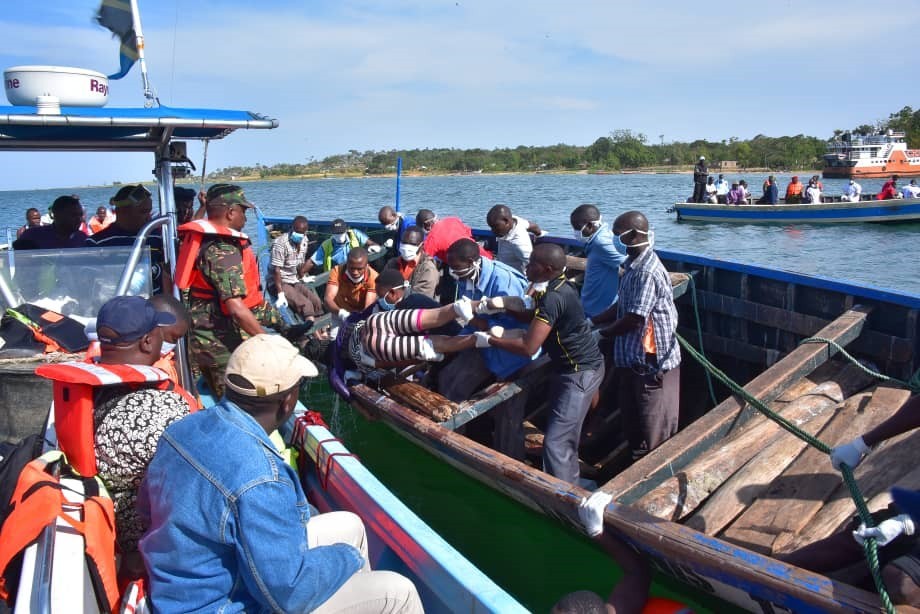
Dar Es Salaam, Sep 22: Rescuers working to retrieve bodies from a ferry that sank in Lake Victoria in Tanzania found a survivor on Saturday, two days after the tragedy took place, although the death toll rose to 170.
According to Tanzanian news outlet The Citizen, a man was found alive in an air pocket in the upturned vessel on the same day when another 24 bodies were recovered from the scene of the accident.
MV Nyerere sunk between the islands of Ukerewe and Ukara on Thursday with around 400 passengers onboard -- nearly four times the legal capacity. So far rescuers have confirmed only around 40 survivors.
President John Magufuli declared three days of national mourning and ordered the vessel's crew and managers from the state company that operates the ferry service arrested for questioning, Efe news reported.
Preliminary investigations showed that the state-owned ferry was overloaded and was being manned by someone who was not the authorized captain of the vessel. The vessel capsized just 50 meters (164 feet) from the shore.
Victoria, Africa's largest lake, is shared by Kenya, Tanzania and Uganda.
The Tanzanian portion of the lake was the scene in 1996 of one of the worst shipwrecks of the 20th century, the sinking of the ferry MV Bukoba, which left an estimated 615 people dead.
There has been public outrage over the decision made by regional authorities of Mwanza Region, whose north borders Lake Victoria, to call off the search and rescue operation after dark on Thursday.

Let the Truth be known. If you read VB and like VB, please be a VB Supporter and Help us deliver the Truth to one and all.
Kharge has put 'full stop' to leadership speculation in Karnataka: Minister Parameshwara

Bengaluru (PTI): Karnataka Home Minister G Parameshwara on Friday said AICC chief Mallikarjun Kharge has put a "full stop" on the issue of leadership change in the state.
Kharge's statement has a lot of significance and there ends the matter for now. Everyone in the party should respect and accept this, he said.
Parameshwara was referring to Kharge's statement on Thursday that there was no chief minister change in Karnataka "for now" and that the leadership issue in the state will be resolved soon.
Kharge's statement came amid speculation within the party and political circles about a possible decision on leadership change and cabinet reshuffle after May 4, once the results for assembly elections in four states and one union territory, along with bypolls to two assembly segments in Karnataka, are announced.
"Mallikarjun Kharge is our party's national president. He has a lot of experience. Several people, including me, have said that in the case of change (in leadership), if he (Kharge) comes (as CM), no one could speak in front of his experience and everyone would accept it. While replying to it, Kharge said that there is a chief minister now, and there is no question of change as of now," Parameshwara said.
Speaking to reporters here, he said, "I welcome his (Kharge) statement because I feel he has expressed his opinion after a discussion involving him, Rahul Gandhi, Sonia Gandhi, K C Venugopal and Randeep Singh Surjewala (both AICC general secretaries). I may be right or wrong. I feel that his statement has a lot of significance. So that matter ends there for now."
Responding to a question on repeated statements by several party leaders regarding leadership change, the home minister said, what the AICC chief has said on the matter is final. It should be respected and accepted by all in the party. There is no meaning in interpreting it further.
"I cannot respond to what others say, but I can say my opinion. In my opinion, the AICC chief is the supreme authority in the party. He, along with Rahul Gandhi and Sonia Gandhi, are our high command. If the high command has said something, we should both respect and accept it. There ends the matter," he said.
Kharge has put a "full stop" on the issue, he further said, adding that, "When he has said there is no change. It is a full stop."
Responding to a question on Parameshwara's recent statement about Kharge becoming chief minister, the AICC chief on Thursday said, "You (media), he (Parameshwara), and people at the top say that it is better if I become CM. But more than fate, as per my ideology and my service to the party so far, Sonia Gandhi makes decisions regarding me."
He had further said, "But that question does not arise now. There is already a CM here. If Sonia Gandhi, Rahul Gandhi, and I together have to take any decision in that direction, it will take some time. Let's wait and see."
Kharge on Friday too said no date has been fixed yet to discuss a possible leadership change in Karnataka.
Supporters of Deputy Chief Minister D K Shivakumar have been insisting on his elevation in line with a reported power-sharing agreement with Chief Minister Siddaramaiah when the party won the 2023 Assembly elections. Some have even claimed that "sweet news" is expected by May 15, which is Shivakumar's birthday.
The leadership tussle within the ruling party has intensified amid speculation about a possible change of chief minister after the Congress government completed the halfway mark of its five-year term on November 20, 2025.
The speculation has been fuelled by a reported "power-sharing" arrangement between Siddaramaiah and Shivakumar at the time of government formation in 2023.


