US charges billionaire Gautam Adani with defrauding investors, hiding plan to bribe Indian officials

New York (AP/PTI): Indian businessman Gautam Adani who is one of the world's richest people has been indicted in the US on charges he duped investors by concealing that his company's huge solar energy project on the subcontinent was being facilitated by an alleged bribery scheme.
Adani, 62, was charged in an indictment unsealed Wednesday with securities fraud and conspiracy to commit securities and wire fraud. The case involves a lucrative arrangement for Adani Green Energy Ltd. and another firm to sell 12 gigawatts of solar power to the Indian government — enough to light millions of homes and businesses.
The indictment paints Adani and his co-defendants as playing two sides of the deal.
It accuses them of portraying it as rosy and above-board to Wall Street investors who poured several billion dollars into the project over the last five years while, back in India, they were paying or planning to pay about USD 265 million in bribes to government officials to help secure billions of dollars' worth of contracts and financing.
Adani and his co-defendants sought to “obtain and finance massive state energy supply contracts through corruption and fraud at the expense of US investors,” Deputy Assistant Attorney General Lisa Miller said.
US Attorney Breon Peace said the defendants “orchestrated an elaborate scheme” and sought to "enrich themselves at the expense of the integrity of our financial markets.”
In a parallel civil action, the US Securities and Exchange Commission accused Adani and two co-defendants of violating antifraud provisions of US securities laws. The regulator is seeking monetary penalties and other sanctions.
Both cases were filed in federal court in Brooklyn.
Adani's co-defendants include his nephew Sagar Adani, the executive director of Adani Green Energy's board, and Vneet Jaain, who was the company's chief executive from 2020 to 2023 and remains managing director of its board.
Online court records did not list a lawyer who could speak on Adani's behalf. An email message seeking comment was left with an arm of his conglomerate, the Adani Group. Emails were also sent to lawyers representing his co-defendants. Sagar Adani's lawyer, Sean Hecker, declined the comment. The others did not immediately respond.
Sanjay Wadhwa, acting director of the SEC's Enforcement Division, said Gautam and Sagar Adani are accused of persuading investors to buy their company's bonds by misrepresenting "not only that Adani Green had a robust anti-bribery compliance programme but also that the company's senior management had not and would not pay or promise to pay bribes.”
Adani is a power player in the world's most populous nation. He built his fortune in the coal business in the 1990s. The Adani Group grew to involve many aspects of Indian life, from making defence equipment to building roads to selling cooking oil.
In recent years, the Adani Group has made big moves into renewable energy, embracing a philosophy of sustainable growth reflected in its slogan: “Growth with Goodness."
The company has a clean energy portfolio of over 20 gigawatts, including one of the world's largest solar power plants in the southern state of Tamil Nadu. Adani Group has stated its goal of becoming the country's biggest player in the space by 2030. In 2022, Gautam Adani said the company would invest USD 70 billion in clean energy projects by 2032.
Last year, a US-based financial research firm accused Adani and his company of “brazen stock manipulation” and “accounting fraud.” The Adani Group called the claims “a malicious combination of selective misinformation and stale, baseless and discredited allegations.”
The firm in question is known as a short-seller, a Wall Street term for traders that essentially bet on the prices of certain stocks to fall, and it had made such investments in relation to the Adani Group.
The company's stock plunged as a result and dipped again in August when the firm, Hindenburg Research, levied more corruption allegations.
Jaain told The Associated Press last year that Hindenburg's allegations had little impact on its ongoing projects, including work building 20 gigawatts of a solar and wind energy project in the northwest Indian village of Khavda.
Prosecutors allege that Adani and his co-defendants started plotting the bribery scheme in 2020 or 2021 to guarantee demand for the energy that Adani Green and another firm were under contract to produce for the national government's Solar Energy Corporation of India.
Adani Green and the other firm's high prices turned off India's state-run electricity distributors, which buy power from the national government and provide it to homes and businesses. But the companies needed those deals to make the project worthwhile and keep revenues high, so they offered bribes to get them done, prosecutors said.
After the defendants started promising bribes to government officials, in 2021 and 2022, electricity distributors in five Indian states or regions entered into agreements to purchase their energy, prosecutors said. Adani's company issued a statement in which he touted his deals as the “world's largest” power purchase agreement.
At the same time, prosecutors said, the Adanis and Jaain were attesting to global investors that Adani Green was and would never be involved in bribery. Those claims enabled them to secure billions of dollars in financing for the project at terms that “did not account for the true risk” involved, prosecutors said.
Let the Truth be known. If you read VB and like VB, please be a VB Supporter and Help us deliver the Truth to one and all.
KMES Institutions shine in SSLC result, continue four-decade legacy of education in rural Karkala

Karkala: KMES Institutions of Education at Kukkundooru in Karkala taluk has recorded outstanding results in the 2025-26 SSLC and PUC examinations, continuing a four-decade educational journey that began with just 22 kindergarten students and no building of its own.
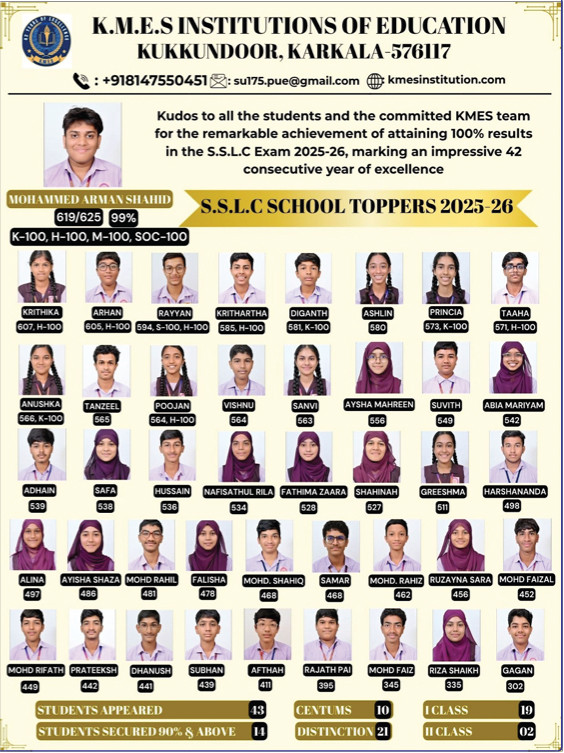
The institution secured a 100 per cent result in the SSLC examinations, with all 43 students passing the examination this year.
Muhammad Arman Shahid emerged as the school topper by scoring 619 marks out of 625, securing 99 per cent and also ranking sixth at the state level. He scored full marks in Kannada, Hindi, Mathematics and Social Science.
Krithika V. Nayak secured the second position in the school with 607 marks and 97.12 per cent, while Arhan stood third with 605 marks and 96.8 per cent.
Out of the 43 students, 21 passed with distinction, 19 secured first class, two students obtained second class and one student passed in third class. Fourteen students scored above 90 per cent.
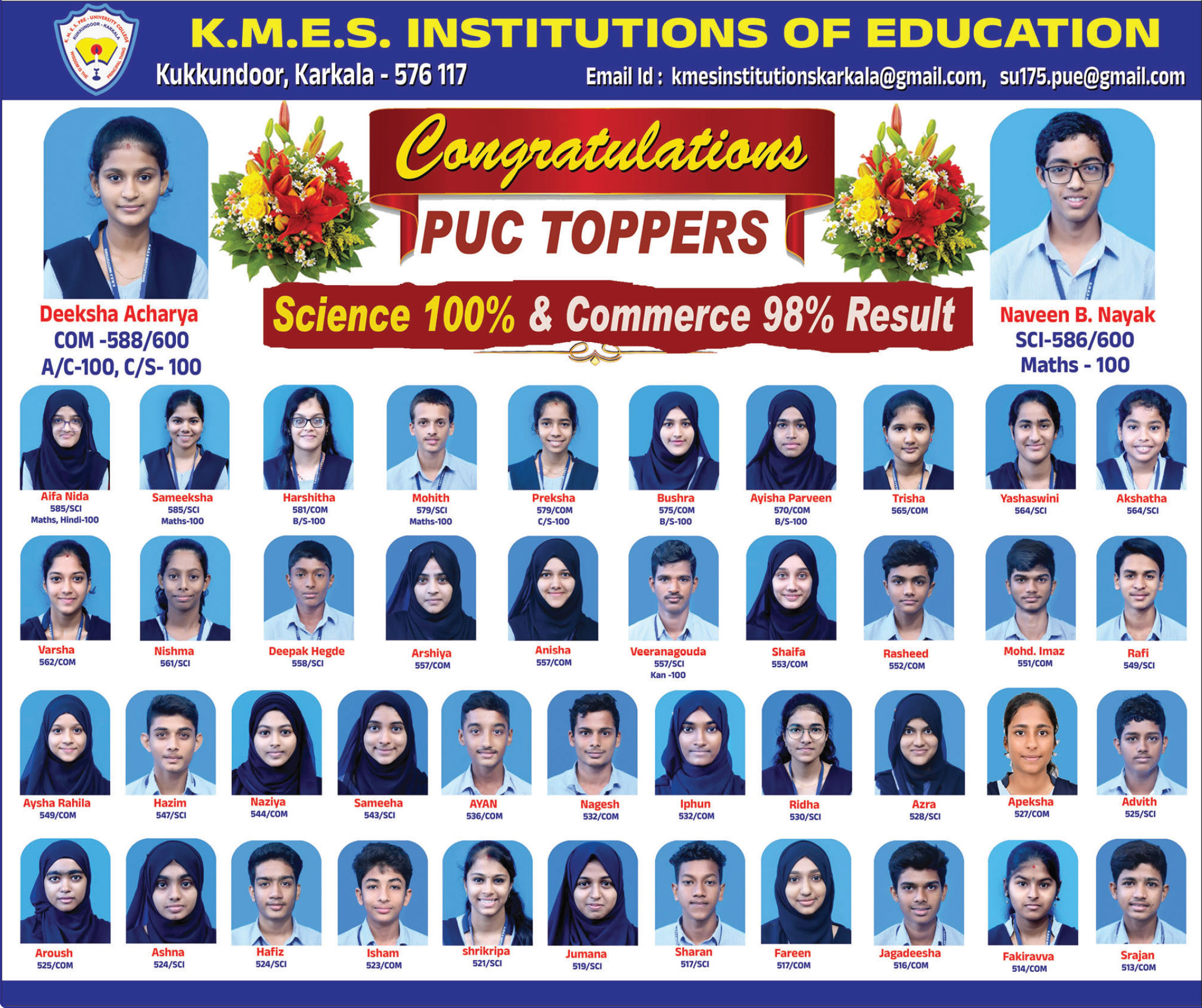
The institution also performed strongly in the PUC examinations. The Science stream recorded a 100 per cent result, with all 44 students passing, while Commerce secured a 98 per cent pass percentage.
Twelve students scored full marks in different subjects, including Mathematics.
In Commerce, Deeksha Acharya topped the college with 588 marks, while Harshitha H. Kini secured the second position with 581 marks.
In Science, Naveen B. Nayak emerged as topper with 586 marks, followed closely by Sameeksha Moily and Aifa Nidha, who both secured 585 marks.
Speaking about the achievement, High School head teacher Shrimati Patkar said the institution has always focused on supporting academically weak students through affordable education and free special classes.
“Our ambition is to provide quality education even to students who struggle in studies. The fees are very low, and free coaching classes are conducted. I have worked here for 28 years and have always found the atmosphere supportive of education,” she said.
Primary School head teacher Lolita Zeena D’Silva appreciated the dedication of the teaching staff and said the school encourages students not only to achieve high marks but also to become role models.
PU College Principal Balakrishna Rao said the institution focuses on value-based education and overall personality development.
“The aim is to help students succeed not only academically but also in cultural activities, sports and leadership. We encourage qualities such as patience, tolerance and discipline,” he said.
Rao also credited the institution’s growth to the support of founders K.S. Mohammed Masood and K.S. Nissar Ahmed, along with President K.S. Imtiaz Ahmed.
Speaking on the occasion, Imtiaz Ahmed said the institution was built on the dream of making quality education accessible to financially backward families in rural areas.
He said the guidance and encouragement of his elder brothers, Mohammed Masood and Nissar Ahmed, along with the contribution of teachers, students and parents, helped transform the institution into a model educational centre.
The KMES Institutions trace their roots back to 1984, when they were founded by senior social activists Haji P.M. Khan, K.S. Nazeer Ahmed and Haji A.S. Rashid Haider.
The institution initially functioned from the Government Urdu School premises as it did not have a building of its own. Classes began with only 22 students in lower kindergarten and two teachers.
Later, under the leadership of K.S. Mohammed Masood and with continuous financial and moral support from non-resident businessman K.S. Nissar Ahmed, the institution gradually expanded.
In 1993, the school shifted to its own building and began conducting classes from LKG to Class 5.
As student admissions increased, Nissar Ahmed personally funded the construction of three additional classrooms to address infrastructure shortages.
The institution’s new school building was completed in 1997, while the PU College building was constructed in 2001.
From humble beginnings in a borrowed building to producing state-level rank holders and consistent academic results, the KMES Institutions have grown into one of the prominent educational centres in the Karkala region.