
Wildfires rage in Amazon rainforest, 84% increase from last year

Brasilia, Aug 22: The Amazon rainforest in Brazil is experiencing a record amount of fires this year more than 74,000 outbreaks so far which is an 84 per cent increase from the same period in 2018, according to data from the country''s space agency.
The National Institute for Space Research (IPNE) said it detected more than 74,000 fires between January 1 and August 20 -- the highest number since records began in 2013. According to the agency, it observed more than 9,500 forest fires since last Thursday, mostly in the Amazon region.
In comparison, there were slightly more than 40,000 in the same period of 2018, IPNE said. However, the worst recent year was 2016, with more than 68,000 fires in that period.
The head of Brazil''s space agency was fired in July after President Jair Bolsonaro disputed the official deforestation data from satellites.
Greenpeace said that the wildfires were so intense that smoke loomed over the city of Sao Paulo, more than a thousand miles away.
The satellite images showed Brazil''s most northern state, Roraima, covered in dark smoke, while neighbouring Amazonas state declared an emergency over the fires. The hashtags #PrayforAmazonas and #AmazonRainforest were trending on Twitter on Wednesday.
US space agency NASA said: "Although it is not unusual to see fires in Brazil at this time of year due to high temperatures and low humidity it seems this year the number of fires may be record setting."
NASA satellite images showed that the wildfires in the Brazilian rainforest are creating cross country smoke.
The largest rainforest in the world, the Amazon is a vital carbon store that slows down the pace of global warming. It is also home to about three million species of plants and animals, and one million indigenous people.
Environmental activists blamed President Bolsonaro for the current situation, saying he encouraged loggers and farmers to clear the land. Scientists say the rainforest has suffered losses at an accelerated rate since he took office in January.
Bolsonaro, however, brushed off the latest data. He instead accused environmental groups of setting fires in the Amazon in a bid to deflect growing international criticism of his failure to protect the world''s biggest rainforest.
According to reports, there was a sharp spike in deforestation during July, which was followed by extensive burning in August.
Local newspapers said farmers in some regions were organizing "fire days" to take advantage of weaker enforcement by the authorities.
Since Bolsonaro took power the environment agency issued fewer penalties and Ministers made clear that their sympathies were with loggers rather than the indigenous groups who live in the forest, reports say.
An international outcry prompted Norway and Germany to halt donations to Brazil''s Amazon Fund, which supports many environmental NGOs as well as government agencies. There have also been calls for Europe to block a trade deal with Brazil and other South American nations.
Environmental activists said Bolsonaro's comments were an absurd attempt to deflect attention from the problem of poor oversight and tacit encouragement to illegal forest clearance.
Bolivia is also experiencing unusually large wildfires that have reportedly destroyed 5,180 sq km (2,000 sq miles) of forest.
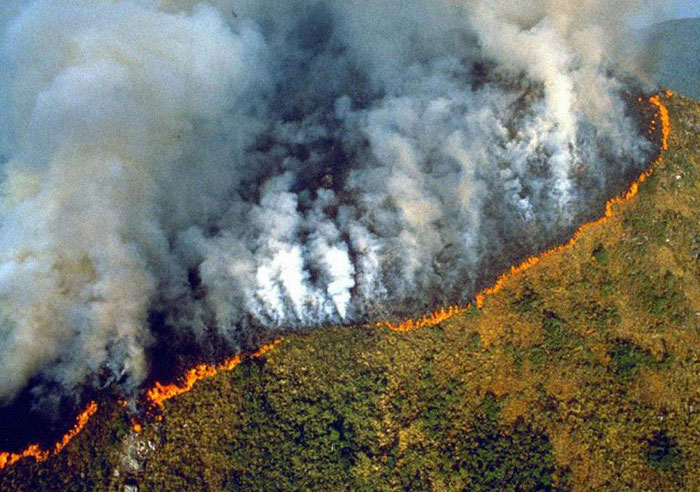
(This photo was taken during Amazon rainforest fires in 1989)
This photo has been going viral in the social media as Amazon Rainforest fire rages, this image was taken by a photographer for Sipa Press, later acquired by Rex Features and published by The Guardian in 2007 for a report on deforestation in the Amazon.
Let the Truth be known. If you read VB and like VB, please be a VB Supporter and Help us deliver the Truth to one and all.
Karnataka School Edu Dept prohibits children from being made to dance to obscene songs

Bengaluru (PTI): The Karnataka School Education Department has issued a circular strictly prohibiting children from being made to dance to obscene songs in educational and cultural programmes.
It stated that such dances would negatively impact students' mental health and moral values. It will create indiscipline and harm the sanctity of education.
"All the Deputy Directors (Administration) of the state's School Education Department have been asked to take strict measures to prevent children or students from dancing to obscene songs in all government, aided and unaided schools in the state," the office of the commissioner of the School Education Department said in a recent circular.
"If it is found that children are being made to dance to obscene songs, appropriate action will be taken against the headmaster or management of such school," it added.
The department also listed certain measures in this regard, which include: strictly prohibiting children from being made to dance to obscene songs during educational and cultural programmes; selecting songs that are inspiring, positive, instilling national pride in children and reflecting the greatness, dignity, values, culture, and morality of the state.
Stating that the school headmaster and management are responsible for selecting songs and dances for cultural programmes, it said, they should also ensure that students wear decent clothes in dance or cultural programmes.


