1 in next 5 years will breach 1.5 degrees Celsius climate threshold: WMO
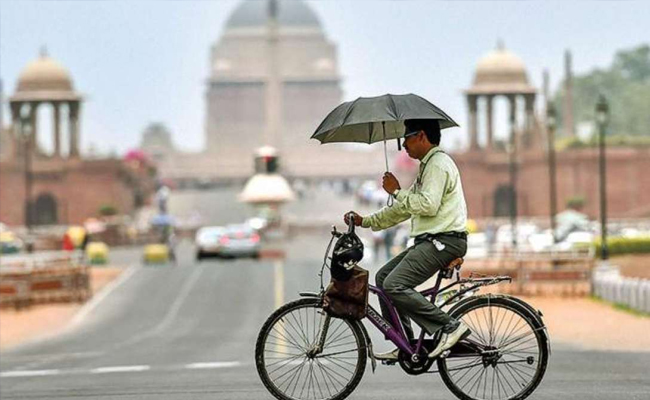
New Delhi (PTI): There is an 80 per cent chance that one of the next five years will be at least 1.5 degrees Celsius warmer than it was at the start of the industrial age, the World Meteorological Organization (WMO) said on Wednesday.
It also said there is an 86 per cent chance that at least one of these years will set a new temperature record, beating 2023 which is currently the warmest year.
There is a 47 per cent likelihood that the global temperature averaged over the entire five-year 2024-2028 period will exceed 1.5 degrees Celsius above the pre-industrial era, said the WMO Global Annual to Decadal Update.
Last year's report said there was a per cent chance of this happening during the 2023-2027 period.
The WMO said the global mean near-surface temperature for each year between 2024 and 2028 is predicted to be between 1.1 degrees Celsius and 1.9 degrees Celsius higher than the 1850-1900 baseline.
Countries in 2015 agreed to limit global average temperature rise to 'well below' 2 degrees Celsius and 'preferably' to 1.5 degrees Celsius to prevent further worsening of climate impacts such as droughts, extreme rain, floods, sea level rise, cyclones, heat waves etc.
According to the Intergovernmental Panel on Climate Change, a group of leading climate scientists, the world needs to reduce greenhouse gas emissions by at least 43 percent by 2030 (compared to 2019 levels) and at least 60 per cent by 2035 to limit warming to 1.5 degrees Celsius.
Earth’s global surface temperature has already increased by around 1.15 degrees Celsius compared to the average in 1850-1900 due to the rapidly increasing concentration of greenhouse gases - primarily carbon dioxide and methane - in the atmosphere.
According to European climate agency Copernicus, the global average temperature breached the 1.5 degrees Celsius threshold for an entire year for the first time in January.
A permanent breach of the 1.5 degrees Celsius limit specified in the Paris Agreement, however, refers to long-term warming over many years.
According to a recent study by scientists at Germany's Potsdam Institute for Climate Impact Research, climate impacts could cost the global economy around USD 38 trillion a year by 2049, with countries least responsible for the problem and having minimum resources to adapt to impacts suffering the most.
The WMO said the chance (80 per cent) of at least one of the next five years exceeding 1.5 degrees Celsius has risen steadily since 2015, when such a chance was close to zero.
For the years between 2017 and 2021, there was a 20 per cent chance of exceedance, and this increased to a 66 per cent chance between 2023 and 2027.
The world experienced the warmest April ever and the eleventh consecutive month of record-high temperatures, the WMO said last month.
Sea surface temperatures have been record high for the past 13 months, it said.
The WMO said this is happening due to naturally occurring El Nino -- unusual warming of waters in the central and eastern Pacific Ocean -- and the additional energy trapped in the atmosphere and ocean by greenhouse gases from human activities.
A new WMO Update predicts the development of a La Nina and a return to cooler conditions in the tropical Pacific in the near-term, but the higher global temperatures in the next five years reflect the continued warming from greenhouse gases.
United Nations Secretary-General Antonio Guterres said: "We are playing Russian roulette with our planet."
"We need an exit ramp off the highway to climate hell. And the good news is that we have control of the wheel. The battle to limit temperature rise to 1.5 degrees will be won or lost in the 2020s - under the watch of leaders today."
The European Union-funded Copernicus Climate Change Service on Wednesday said that each of the past 12 months has set a new global temperature record for the time of year.
Given these 12 monthly records, the global average temperature for the last 12 months (June 2023 - May 2024) is also the highest on record, at 1.63 degrees Celsius above the 1850-1900 pre-industrial average, according to the Copernicus Climate Change ERA5 dataset.
"Behind these statistics lies the bleak reality that we are way off track to meet the goals set in the Paris Agreement," said WMO Deputy Secretary-General Ko Barrett.
"We must urgently do more to cut greenhouse gas emissions, or we will pay an increasingly heavy price in terms of trillions of dollars in economic costs, millions of lives affected by more extreme weather and extensive damage to the environment and biodiversity."
"WMO is sounding the alarm that we will be exceeding the 1.5°C level on a temporary basis with increasing frequency. We have already temporarily surpassed this level for individual months - and indeed as averaged over the most recent 12-month period. However, it is important to stress that temporary breaches do not mean that the 1.5 °C goal is permanently lost because this refers to long-term warming over decades," said Ko Barrett.
Let the Truth be known. If you read VB and like VB, please be a VB Supporter and Help us deliver the Truth to one and all.
AIITA welcomes Karnataka’s ban on obscene songs in school events

Bhatkal: The Karnataka unit of the All India Ideal Teachers Association (AIITA) has welcomed the Karnataka government’s decision to strictly ban school children from dancing to obscene songs during educational and cultural programmes in government, aided, and private schools across the state.
AIITA Karnataka State President M. R. Manvi congratulated the government for taking what he termed an important step to preserve the sanctity of education.
“Such decisions to safeguard the dignity of school children and uphold the values of education are the need of the hour. This rule should not be limited to government schools alone but must be strictly implemented in all private educational institutions as well,” he said.
He further urged the government to address other concerns within school programmes.
“The government should not only prohibit obscene dances in the name of school anniversaries, but also ensure that plays and dialogues that incite religious hatred are avoided. Schools should be centres of harmony, not platforms for spreading hatred,” he added.
According to a recent circular issued by the Department of School Education and Literacy, obscene dances are adversely affecting the mental health and moral values of students.
In this regard, schools have been advised to use songs that promote nationalism, positive thinking, the greatness of Kannada culture, and value-based traditions instead of inappropriate content during programmes.
The circular also emphasises that students should be dressed in decent attire.
AIITA also backed the department’s warning that disciplinary action would be taken against head teachers if such guidelines are violated. The association has further demanded that district Deputy Directors of Public Instruction strictly monitor the implementation of these rules.