106 deaths per lakh population in Delhi attributable to PM2.5 pollution: Report
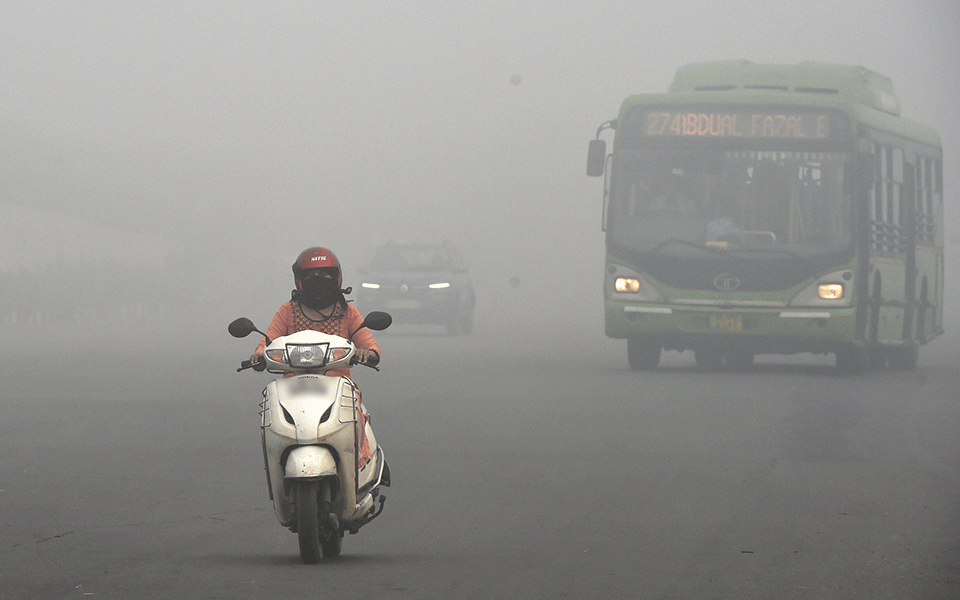
New Delhi(PTI): Delhi and Kolkata reported 106 and 99 deaths per 1 lakh population in 2019 which could be attributed to PM2.5 pollution, according to a new report published by US-based Health Effects Institute on Wednesday.
In 2019, Delhi recorded an annual average PM2.5 concentration of 110 microgram per cubic metre, the highest among the most-populous cities in the world, followed by Kolkata (84 microgram per cubic metre), said the report "Air Quality and Health in Cities" by the State of Global Air Initiative, a collaboration between the Health Effects Institute and the Institute for Health Metrics and Evaluation's Global Burden of Disease project.
The report summarizes data on air pollution exposures and associated health impacts in 7,239 cities (with minimum population of 50,000) from 2010 to 2019. It combines ground-based air quality data with satellites and models to produce air quality estimates for cities around the world.
PM2.5 refers to fine particles (measuring 2.5 m or less in diameter) that penetrate deep into the body and fuel inflammation in the lungs and respiratory tract, leading to the risk of having cardiovascular and respiratory problems, including a weak immune system.
Beijing in China had the highest PM2.5-attributable death rate of 124 in 2019. Delhi and Kolkata ranked sixth and eighth, respectively.
The report said the burden on health of PM2.5 has grown rapidly in cities in Southeast Asia.
"Of 7,239 cities analysed, all the 20 cities with the largest increase in PM2.5-attributable death rates from 2010 to 2019 are located in Southeast Asia, including 19 cities in Indonesia and one in Malaysia. All 20 cities reported increase of more than 10 microgram per cubic metre in PM2.5 exposures in 2019 compared with 2010," it said.
In 2019, 1.7 million deaths linked to PM2.5 exposure occurred in the 7,239 cities, with cities in Asia, Africa, and Eastern and Central Europe seeing the greatest health impacts.
The report said geographic patterns of nitrogen dioxide (NO2) pollution are strikingly different from the patterns seen for PM2.5 pollution.
PM2.5 pollution tends to be highest in cities in low and middle-income countries, whereas NO2 levels are high in large cities across countries of all income levels.
Almost all of the most populous cities (81 out of 103 cities) reported NO2 exposures higher than the global average of 15.5 microgram per cubic metre.
At 41.6 microgram per cubic metre, Shanghai in China had the highest population-weighted annual average NO2 exposures in 2019, it said.
NO2 comes mainly from the burning of fuels often in older vehicles, power plants, industrial facilities, and residential cooking and heating. As city residents tend to live closer to busy roads with dense traffic, they are often exposed to higher NO2 pollution than residents of rural areas.
In 2019, 86 per cent of the 7,239 cities included in the report exceeded the WHO's 10 microgram per cubic metre guideline for NO2, impacting about 2.6 billion people.
Dr. Susan Anenberg of George Washington University, one of the project collaborators, said, "Since most cities around the world have no ground-based air quality monitoring in place, estimates of particulate and gas pollution levels can be used to plan air quality management approaches that ensure the air is clean and safe to breathe."
The report also highlighted data gaps in low- and middle-income nations, a key aspect to understanding and addressing the health effects of air pollution.
According to the WHO's Air Quality Database, only 117 nations currently have ground-level monitoring systems to track PM2.5, and only 74 nations are monitoring NO2 levels.
Strategic investments in ground-level air quality monitoring systems and expanded use of satellites and other emerging technologies in targeted regions can provide critical first steps toward cleaner air.
Let the Truth be known. If you read VB and like VB, please be a VB Supporter and Help us deliver the Truth to one and all.
Rahul Gandhi joins Haryana Congress leader's 'Sadbhav Yatra' in Gurugram

Gurugram (PTI): Congress leader Rahul Gandhi on Friday joined the 'Sadbhav Yatra' of Haryana Congress leader Brijendra Singh here.
Gandhi, who is the Leader of Opposition in the Lok Sabha, reached Gurugram in the evening and joined the yatra. He also walked some distance with Brijendra, state Congress chief Rao Narender Singh and other leaders.
Huge crowds had turned up for the occasion.
Later, Gandhi proceeded to the venue where he addressed a public gathering.
Leader of Opposition in Haryana Bhupinder Singh Hooda and other Congress leaders, including Randeep Singh Surjewala, B K Hariprasad, state Congress chief Rao Narender Singh, were also present.
Brijendra Singh had on Thursday said it is a matter of joy for them that Gandhi was joining the 'Sadbhav Yatra' in Gurugram-Badshahpur, "thereby strengthening the Indian National Congress' campaign for brotherhood and harmony".
The 'Sadbhav Yatra' began from Danoda village at Narwana in Jind on October 5, 2025, and has covered 85 of the 90 assembly segments in the state.
The foot march was started by Brijendra Singh, son of Congress veteran Birender Singh, to highlight several national and regional issues.
State Congress chief Rao Narender Singh had asked all party leaders to take part in Friday's event.
Days before his yatra began in October, Brijendra Singh, who narrowly lost the 2024 assembly polls from Jind's Uchana Kalan, accused the ruling BJP of playing "divisive politics" and said that "sadbhav" (harmony) has come under stress in the last decade.
Brijendra Singh was a sitting MP from Hisar for the BJP when he resigned ahead of the 2024 general election and switched over to the Congress. He also alleged that the saffron party creates a wedge in society to achieve its political purpose.
The 'padyatra' has so far covered 85 assembly constituencies in Haryana, traversing more than 2,700 kilometres.
Addressing the public gathering, Brijendra Singh said the yatra is inspired by Rahul Gandhi's Bharat Jodo Yatra, where he took the party's vision and values directly to the people of the country.
Singh said the yatra has highlighted issues like "Vote Chori" (vote theft), unemployment, poor law and order situation, agrarian distress, and issues related to government employees, labourers and traders.
"Sadbhav (harmony) and bhaichara (brotherhood), which the BJP is attempting to weaken, are the messages of this yatra," he said, adding that its slogan is "Congress ka haath bhaichara ka saath".
"This yatra is a natural extension of the Bharat Jodo Yatra," Brijendra Singh said.