10th century Kannada inscription found in south Goa
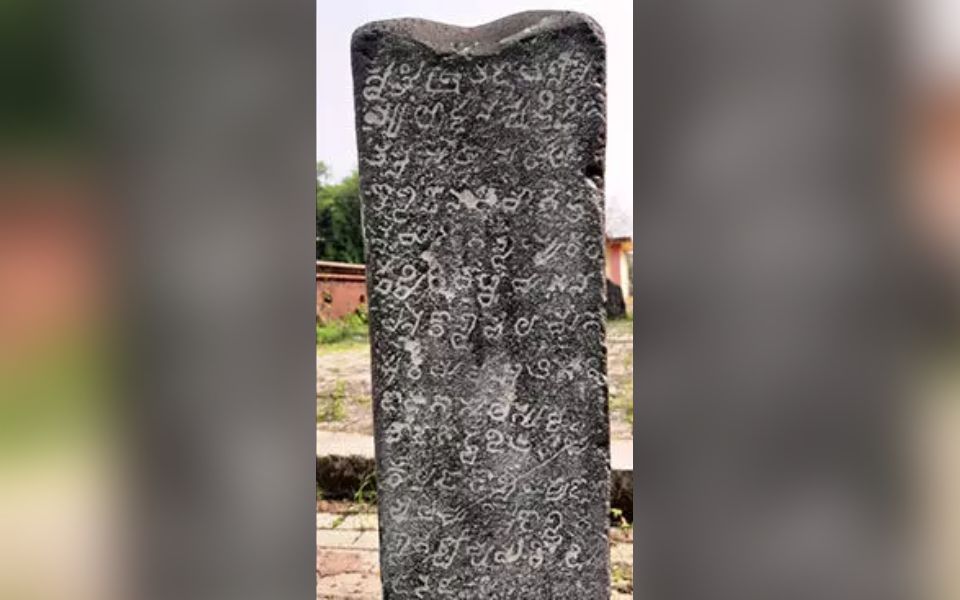
Udupi, Jan 5: A rare inscription written in Kannada and Sanskrit has been discovered on the premises of Mahadeva temple at Cacoda in Southern Goa, according to a former history professor from Udupi.
In the release issued on Thursday, Prof T Murugeshi, former associate professor of ancient history and archaeology from Udupi who studied the inscription, said the epigraph is engraved in Kannada and Nagari characters of 10th century AD, and belongs to the Kadambas of Goa.
The inscription opens with an auspicious word Be it well' (Swasthi Shri) and records that when Talara Nevayya was administering the mandala, his son Gundayya, who had taken a vow to fulfil his father's desire of capturing a Gopura, the port of Goa, fought and died after fulfilling his father's wish.
The record is composed as a vocal statement on the death of his son from the mouth of a lamenting father. It is in the literary style of the Talangre inscription of Jayasimha I of the same period, Murugeshi said.
Kadambas of Goa were the subordinates of Chalukyas of Kalyana. Chalukyan emperor Tailapa II was appointed Kadamba Shasthadeva as Mahamandaleshwara of Goa, for his help in dethroning the Rashtrakutas.
Kadamba Shasthadeva conquered the city of Chandavara from the Shilaharas in 960 AD. Later on, he conquered the port of Gopakapattana (present day Goa). Perhaps in this battle, Gundayya, the son of Talara Nevayya, participated and won the port at the cost of his life. His father, on the heroic fight of his son, erected a memorial stone with the inscription on the temple premises of Mahadev in Cacoda, Murugeshi said in the release.
Let the Truth be known. If you read VB and like VB, please be a VB Supporter and Help us deliver the Truth to one and all.
ED cracks down on suspected interstate liquor racket, raids 9 sites in Arunachal
Itanagar (PTI): The Enforcement Directorate has carried out coordinated searches at nine locations across Arunachal Pradesh in connection with a suspected large-scale interstate liquor smuggling and money laundering network, officials said on Monday.
The action, taken under the Prevention of Money Laundering Act (PMLA), is part of an expanding probe that points to a syndicate exploiting tax differentials among states.
Officials said liquor designated for sale within Arunachal Pradesh was allegedly diverted and supplied illegally to markets in Assam and other states.
The searches, conducted earlier this week, spanned multiple towns such as Itanagar, Naharlagun, Seppa, Ziro, Daporijo, Namsai and Roing, targeting wholesale liquor businesses suspected of being linked to the network.
According to officials, the investigation stems from a series of FIRs registered by Assam Police over the illegal transportation of liquor from Arunachal Pradesh into Assam.
Inputs from the Assam Excise Department further strengthened the case. An Enforcement Case Information Report (ECIR) was registered on October 17, 2024, and later widened through an addendum incorporating 173 additional FIRs.
Earlier searches conducted on February 4 last year, at premises linked to three alleged key operators, believed to be major liquor manufacturers, had revealed indications of a well-coordinated operation.
Investigators suspect that the network functioned through a chain of manufacturers, bonded warehouses and wholesalers, while masking real ownership using proxy arrangements such as tribal partnerships and dummy licence holders.
During the latest ED operations, the agency found that several wholesale units were operating under proxy licences issued in the names of local individuals, while actual control remained with the suspected masterminds.
Financial scrutiny revealed that between 51 and 90 per cent of total credits in certain bank accounts comprised unexplained cash deposits.
Investigators also flagged a pattern of invoice splitting, with transactions deliberately kept below Rs 2 lakh to avoid scrutiny. In one instance, more than 200 invoices of identical value of Rs 1,99,554 were generated within a single month at one location.
On-ground staff reportedly confirmed that records, including stock registers and daily cash collections, were being routed to offices associated with the alleged controllers.
The ED said it seized approximately Rs 40 lakh in unaccounted cash during the searches.
In a significant finding, 14 seals, some purportedly belonging to the Excise Department of the Arunachal Pradesh government, were recovered from one of the premises. These are suspected to have been used to create fake transport permits to facilitate the unauthorised movement of liquor.
Further investigation is underway, officials added.