144 minors were detained since August 5, after Article 370 abrogation in J-K: Report
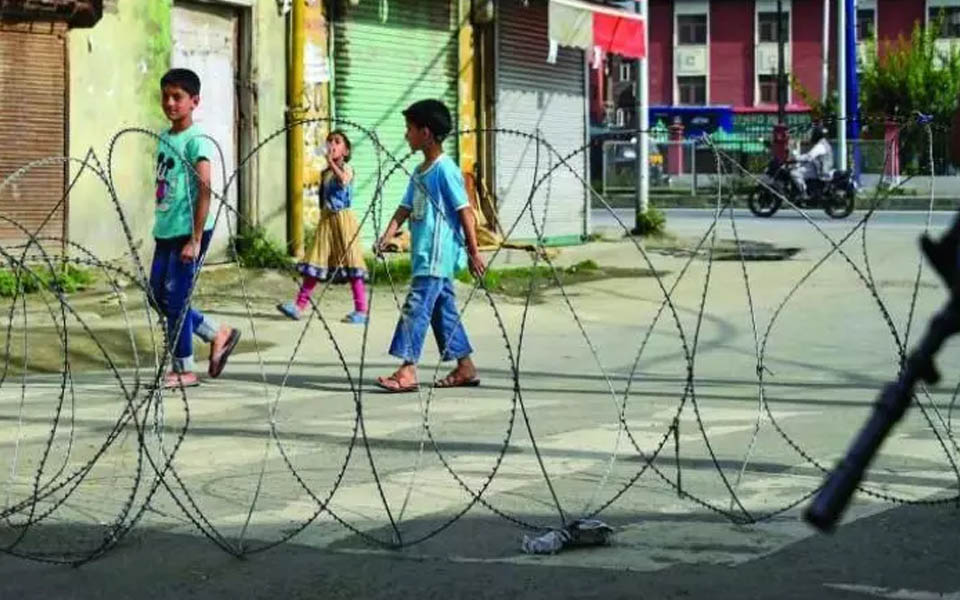
New Delhi, Oct 2: The Juvenile Justice Committee of the Jammu and Kashmir High Court has told the Supreme Court that 144 juveniles were detained in the state after the Centre abrogated provisions of Article 370, but 142 minors were later released.
The committee, in its report filed in the apex court, said the remaining two were sent to juvenile homes.
When the matter came up for hearing before the top court on Tuesday, a bench of justices N V Ramana, M R Shah and B R Gavai told senior advocate Huzefa Ahmadi, appearing for child rights activists Enakshi Ganguly and Shanta Sinha, that it has received a report from the Juvenile Justice Committee of the high court, in which the averments regarding alleged detention of minors have been denied.
Ahmadi said he would like to file a reply to the report of the committee. The bench allowed Ahmadi to file a reply to the report and listed the matter for hearing after two weeks.
On September 20, the apex court had asked the committee to undertake an exercise with regard to the facts stated in a petition filed by the two child right activists, who have alleged that minors were illegally detained in Jammu and Kashmir after the Centre scrapped the special status of the state under Article 370.
The four-member Juvenile Justice Committee of the Jammu and Kashmir High Court, headed by Justice Ali Mohammad Magrey, said in its report that when the September 23 order of the apex court was brought to its notice, a meeting was immediately convened to ascertain the facts from the agencies concerned.
"The committee also decided to obtain data from the courts subordinate to the High Court of J&K, and the registrars judicial of the two wings of the high court about the bail applications or Habeas Corpus petitions, if any, moved on behalf of juveniles or where it was claimed that the arrested persons or the detainees were juveniles," the committee said in its report to the top court.
Citing information provided by police and other agencies, the committee gave details of the cases under which these juveniles were detained.
It said pursuant to the direction, the Jammu and Kashmir DGP filed a report on September 25 in which he categorically refuted the assertions and allegations made in the media and the petition.
"It is pertinent to state that no child has been kept or taken into illegal detention by police authorities as strict adherence is placed on the provisions of the Juvenile Justice (Care and Protection of Children) Act," the DGP's report to the committee said.
"However, in connection with the children, whosoever was found in conflict with law, same was strictly dealt in consonance with provisions of the Juvenile Justice (Care and Protection of Children Act and strict directions have been provided from time to time to deal with the provisions of the relevant Act," it said.
"The averments hence surfaced in the petition have been wrongly reflected in the petition and stand devoid of merits," it added.
Quoting the DGP's report, the committee told the top court that he has categorically denied the allegations made in the petition.
Citing one instance which the petition has referred to that in violation of law the juveniles have been picked up by police and lodged in the jail, the DGP report said the averment does not corroborate with information received from the field formations.
"It is nothing but facts having been imagined from thin air submitted before the court," the report said.
The DGP report to the committee also referred to a reported incident of an 11-year-old being detained and said it was not factually correct.
"It seems that this report has been generated with the intention to malign the police and to create the story which may have element of sensationalism," the DGP's report to the committee said.
Similarly, the DGP report also referred to various reported incidents which appeared in the print and online media, including some foreign publications, and the averments made in the petition and categorically denied them.
The committee, in its report to the top court, has also said that two observation homes have been established in the state -- one at Harwan in Srinagar and other at R S Pora in Jammu.
Thirty-six juveniles were lodged in Harwan's observation home since August 5, out of which 21 were bailed out while enquiry regarding 15 was going on, it said.
Ten juveniles were lodged at R S Pora observation home from August 5 till September 23, out of which six were bailed out while enquiry against remaining four was going on, it added.
Let the Truth be known. If you read VB and like VB, please be a VB Supporter and Help us deliver the Truth to one and all.
Man arrested with Rs 2.54-crore heroin in Mumbai

Mumbai (PTI): Police have arrested a man and seized over 500 grams of heroin worth Rs 2.54 crore in the illicit market from him in Mumbai, officials said on Friday.
The police's Anti-Narcotics Cell (ANC) made the drug seizure in Santacruz in the western suburbs. The operation was conducted by the Kandivali unit of the ANC on Thursday as part of a special crackdown against drug trafficking in the area, they said.
Acting on specific inputs, an ANC team conducted a raid in Santacruz (East) and intercepted a man. During a search, the team recovered 508 grams of high-grade heroin from his possession, an official said.
The seized contraband, a highly addictive, opioid drug derived from morphine, is estimated to be worth Rs 2.54 crore in the international market, he informed.
Following the seizure, a case was registered against the man under relevant sections of the Narcotic Drugs and Psychotropic Substances (NDPS) Act, 1985, and he was formally placed under arrest in the early hours of Friday.
The police are currently investigating the source of the drug and trying to identify the intended recipients of the consignment, he said.