15-member NC delegation meets Farooq, Omar Abdullah
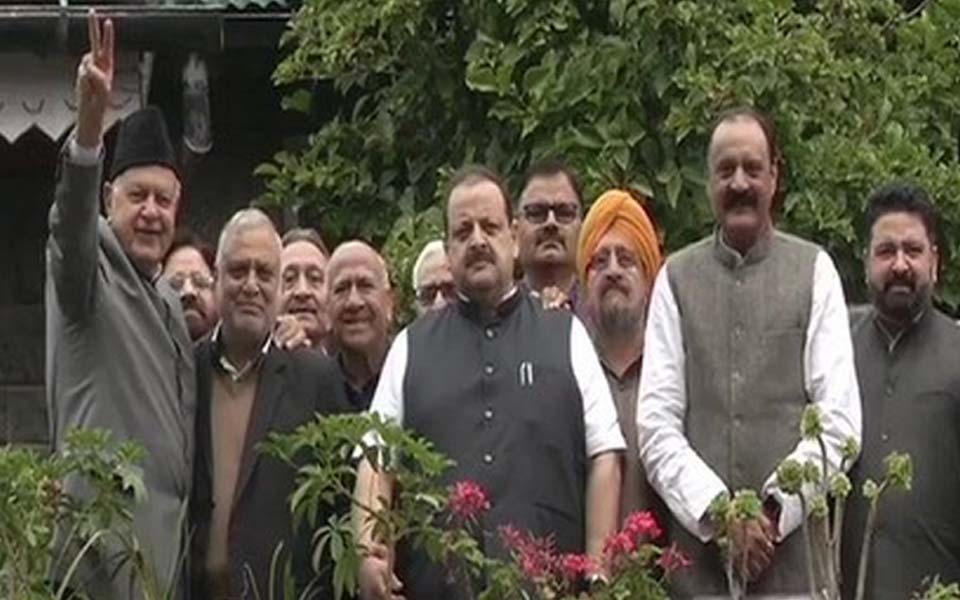
Srinagar, Oct 6: In the first major political development post withdrawal of special status to Jammu and Kashmir, a 15-member National Conference delegation on Sunday met detained party leaders Farooq Abdullah and Omar Abdullah here.
The delegation discussed developments in the state and upcoming local body polls during the separate meetings with the two leaders. The Jammu and Kashmir government had given permission to the delegation to meet the leaders.
The delegation led by Jammu's provincial chief of the party Davinder Singh Rana met former chief Minister Omar Abdullah at Hari Nivas for little over 30 minutes.
This was the first meeting of Omar with a party delegation after he was detained on August 5, a day when the Centre announced abrogation of special status to the state under Article 370.
Omar, who was sporting a beard, was seen clicking a selfie with party leaders.
The delegation then drove to Farooq Abdullah's residence.
Emerging after the meeting, Rana told reporters that for any political process to begin, the leaders of the party need to be released.
There is "anguish about developments particularly about lockdown of the people and we, as a party, appeal that the political process to start and democracy to revive in Jammu and Kashmir political detenues anywhere and everywhere, whether from mainstream political parties or otherwise who have no criminal record, may be released to initiate the process and the hearts and minds of the people of Jammu and Kashmir are won," he said.
He said the party, which has a legacy, history and a chequered track record, was of unanimous view that it would continue to strive for the welfare of the people and shall continue to work for communal harmony, brotherhood, togetherness and keep the secular fabric of the state shining.
On a question about the party's participation in block development committee elections, he said, "See there is a complete lockdown. If the political process has to start then these members have to be released.
Rana said,"After restrictions on political leaders in Jammu were removed, we held a meeting in which it was decided that we will approach governor (S P Malik) to seek his permission to have an audience with the president and the vice president of the party".
We are happy they are both well and in high spirits. Of course, they are pained and anguished about developments, particularly lockdown of the people," he said.
Asked about the party's stand on the upcoming Block Development Council (BDC) elections, Rana said for any political process to start in the state, the mainstream political leaders should be released first.
In case of NC, even if we want to contest the BDC elections, the 380 panchayats that exist, the mandate has to be signed by the party president who has been unfortunately detained under the PSA, he said.
The NC leader said the party's working committee would decide on the future course of action whenever the party leaders including the NC president and vice-president would be released.
Let them be released, then the working committee of the party will meet and discuss and then we will formulate a strategy for the future, Rana said when questioned about the party's future strategy.
Let the Truth be known. If you read VB and like VB, please be a VB Supporter and Help us deliver the Truth to one and all.
Man arrested with Rs 2.54-crore heroin in Mumbai

Mumbai (PTI): Police have arrested a man and seized over 500 grams of heroin worth Rs 2.54 crore in the illicit market from him in Mumbai, officials said on Friday.
The police's Anti-Narcotics Cell (ANC) made the drug seizure in Santacruz in the western suburbs. The operation was conducted by the Kandivali unit of the ANC on Thursday as part of a special crackdown against drug trafficking in the area, they said.
Acting on specific inputs, an ANC team conducted a raid in Santacruz (East) and intercepted a man. During a search, the team recovered 508 grams of high-grade heroin from his possession, an official said.
The seized contraband, a highly addictive, opioid drug derived from morphine, is estimated to be worth Rs 2.54 crore in the international market, he informed.
Following the seizure, a case was registered against the man under relevant sections of the Narcotic Drugs and Psychotropic Substances (NDPS) Act, 1985, and he was formally placed under arrest in the early hours of Friday.
The police are currently investigating the source of the drug and trying to identify the intended recipients of the consignment, he said.