162 cases of Covid sub-variant JN.1 detected in India; highest from Kerala, Gujarat: INSACOG
New Delhi (PTI): A total of 162 cases of COVID-19 sub-variant JN.1 have been detected in the country, with Kerala reporting the highest number of 83, followed by Gujarat 34, according to the INSACOG's data updated on Friday.
Several states have been reporting an uptick in the number of Covid cases over the last few weeks and nine states and Union territories have so far detected the presence of the JN.1 sub-variant of the virus.
These states are -- Kerala (83), Gujarat (34), Goa (18), Karnataka (eight), Maharashtra (seven), Rajasthan (five), Tamil Nadu (four), Telangana (two) and Delhi (one), according to the Indian SARS-CoV-2 Genomics Consortium (INSACOG).
The INSACOG's data showed 145 Covid cases recorded in the country in December had the presence of JN.1, while 17 such cases were detected in November.
The World Health Organization (WHO) has classified JN.1 as a separate "variant of interest" given its rapidly-increasing spread, but said it poses a "low" global public health risk.
The JN.1 sub-variant of the coronavirus was previously classified as a variant of interest (VOI) as part of the BA.2.86 sub-lineages, the parent lineage that is classified as a VOI, the world body said.
However, in recent weeks, JN.1 cases continued to be reported from multiple countries and its prevalence has rapidly increased globally.
The Centre has asked the states and Union territories to maintain a constant vigil amid an uptick in the number of Covid cases and the detection of the JN.1 sub-variant in the country.
Let the Truth be known. If you read VB and like VB, please be a VB Supporter and Help us deliver the Truth to one and all.
It's govt's responsibility to support youth who dare to dream: Omar Abdullah
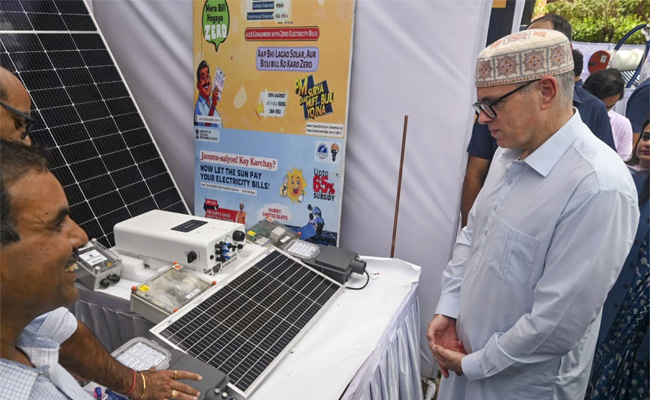
Jammu (PTI): Jammu and Kashmir Chief Minister Omar Abdullah on Monday said the government may not be able to provide jobs to everyone, but it can create an ecosystem for youngsters to become entrepreneurs and innovators.
It is the responsibility of the government to support youth who dare to dream, he said.
After inaugurating the 11th National Conference and Exhibition on Emerging and Innovative Trends in Engineering Technology (NCEEITET) at the Government College of Engineering and Technology (GCET) in Jammu, Abdullah said, “We may not be able to provide jobs to everyone, but we can certainly create an environment where our youngsters become entrepreneurs and innovators.”
The two-day conference is being organised by the GCET in collaboration with the Indian Institute of Technology-Kharagpur and the World University Consortium (WUC).
Addressing the gathering, Abdullah assured that all necessary steps would be taken to strengthen infrastructure and support systems at the GCET, ensuring that it continues to evolve as a premier institution.
The chief minister also inaugurated a new building for the School of Architecture in the college, built at Rs 19.71 crore.
Stressing the need to balance modernity with the region’s cultural and historical identity, Abdullah said, “Not every building needs to be made of glass and steel. Our structures must reflect our heritage and preserve our cultural ethos.”
Highlighting the role of emerging technologies such as artificial intelligence and machine learning, Abdullah said they could significantly improve tourism management, visitor experience and service delivery in Jammu and Kashmir.
However, he cautioned that technological advancement should complement human effort rather than replace jobs, especially in a region where unemployment remains a concern.
The chief minister said that attracting tourists to Jammu and Kashmir was not difficult, but ensuring repeat visits required consistently enriching experiences and better infrastructure across tourism segments, including pilgrimage, border and leisure tourism.
To address the infrastructure gaps in the college, Abdullah announced that funds would be provided this year for the construction of an auditorium.
He also assured support for setting up an incubation centre in GCET.
During the event, Abdullah also released the e-proceedings of the conference, comprising 28 shortlisted research papers.