17 Opposition parties to ask poll panel to use ballot papers for 2019 elections
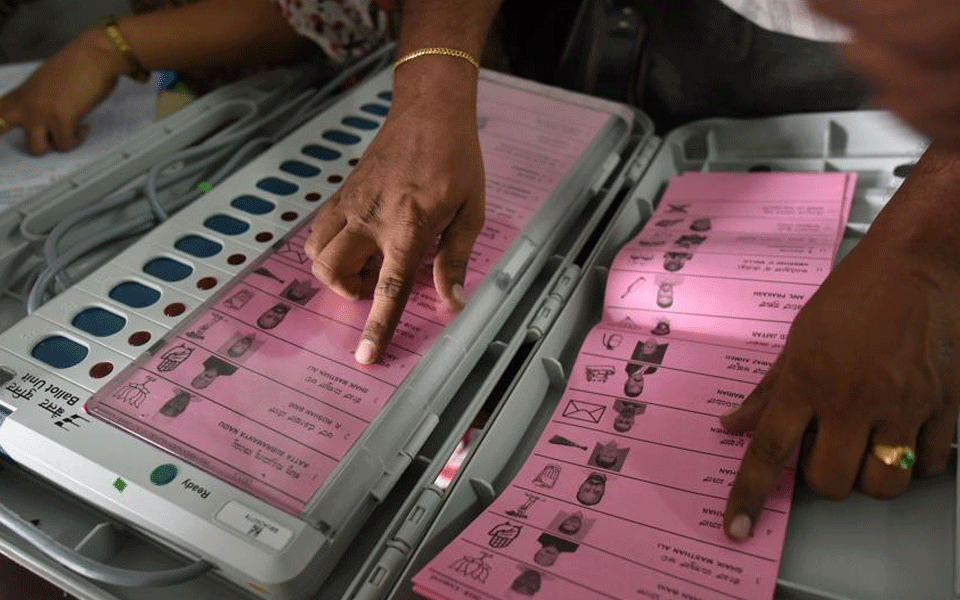
New Delhi, 03: Seventeen opposition parties have come together to make a fresh, concerted demand that voters in the 2019 Lok Sabha elections exercise their franchise by stamping the ballot paper, not pressing the button, according to leaders of several parties familiar with the developments.
Contending that electronic voting machines (EVMs), even those with voter verifiable paper audit trail (VVPATs), would not be acceptable, the parties , led by the Congress, will first hold a joint meeting on Monday, then push a discussion on the issue in Parliament, followed by a fresh appeal to the Election Commission of India (EC) over the next week, the leaders added.
ECI has maintained that EVMs are tamper proof, and that VVPATs provide an additional layer to guarantee that voting is accurately captured. It has also repeatedly urged parties to refrain from expressing doubts about their efficacy.
The latest demand to scrap EVMs underlines the aggressive mood of the Opposition camp, which has over the past year often attributed the Bharatiya Janata Party’s (BJP) victories in state assembly elections to EVMs. The demand for ballot boxes has also brought an unlikely set of parties together, even those warring against each other – the Trinamool Congress (TMC) and the Left, the Nationalist Congress Party and the ruling National Democratic Alliance’s (NDA) partner Shiv Sena, and the Telugu Desam Party and the YSR Congress, among others. Among non-NDA parties, only the AIADMK, Telangana Rashtra Samithi and the Biju Janata Dal are not supporting the demand.
“EVM is the next big issue for us. We want to revert to the ballot system,” TMC’s floor leader in the Rajya Sabha Derek O’Brien announced on Thursday. “This is not an issue of just one party. All like-minded parties are playing as a team to make this happen,” he added.
“The Congress passed a resolution in the plenary session in which it expressed preference for ballot papers because of the concerns about the EVMs. It is imperative to ensure full faith in the electoral process,” said the party’s spokesperson Rajeev Gowda.
In the political resolution adopted at its 84th plenary session this March, the Congress urged EC to revert to ballot papers instead of EVMs, which have come under scrutiny following allegations of tampering. “There are apprehensions among the political parties and people over the misuse of EVMs to manipulate the outcome contrary to the popular verdict. To ensure the credibility of the electoral process, EC should revert to the old practice of paper ballot, as most major democracies have done,” it said.
A senior Congress leader, who asked not to be named, said a a “broad understanding has already been reached between different opposition parties on what exactly the united group will demand from the government and EC”. The demand will specifically focus on reverting to the ballot, and relaying to EC that VVPAT is not a sufficient guarantor for transparency.
The opposition parties will meet on Monday to chalk out the strategy and demand a debate in the House, followed by a meeting with the election commissioner.
Aam Aadmi Party leader Sanjay Singh has been asked to draft the points of contention with the help of TMC MP Subrata Bakshi. “These two leaders have in-depth knowledge of the problems of EVMs,” said an opposition leader. The AAP was among the first parties to cast doubts about EVMs after the Punjab Assembly elections of 2017.
A TMC leader said that during her recent trip to Delhi, West Bengal chief minister Mamata Banerjee told “each and every opposition leader she met” to raise the demand for ballots in the upcoming election. Earlier, Sena chief Uddhav Thackeray too demanded that the 2019 Lok Sabha election be conducted using ballot papers instead of EVMs.
In July 2017, during an all-party meeting, the election commission said that all future elections would be conducted with EVMs coupled with VVPATs.
Chief election commissioner OP Rawat has made public statements ruling out reverting to ballot papers in elections, asserting that the new EVMs have been designed with more stringent checks to rule out tampering or manipulation. An EC official, who asked not to be named, said the body has also communicated to the political parties to refrain from raising doubts about the efficacy and safety of EVMs and VVPAT machines when the poll outcome is different from what they expect.
Rajya Sabha MP and head of BJP’s media cell Anil Baluni said opposition parties only complain about EVMs when they lose elections. “They do not make a hue and cry when they win an election conducted through EVMs. These parties did not appear before the election commission when it invited them to appear before it and prove that EVMs can be tampered with. The problem, actually, is not with the EVM but with the intention of these parties.”
Experts suggested that EC should work towards increasing voter confidence in EVMs. “ EC needs to be more proactive in increasing voter confidence. There is no problem with the machines, but there may be some concerns over the process, so EC must address those,” said Jagdeep Chhokar of the election watchdog Association for Democratic Reform. “There were some concerns about the functioning of the VVPats in the recent by polls; so EC should improve on the technology,” he added.
Courtesy: www.hindustantimes.com
Let the Truth be known. If you read VB and like VB, please be a VB Supporter and Help us deliver the Truth to one and all.
Raghuvanshi, spinners fire KKR to seven-wicket win over SRH
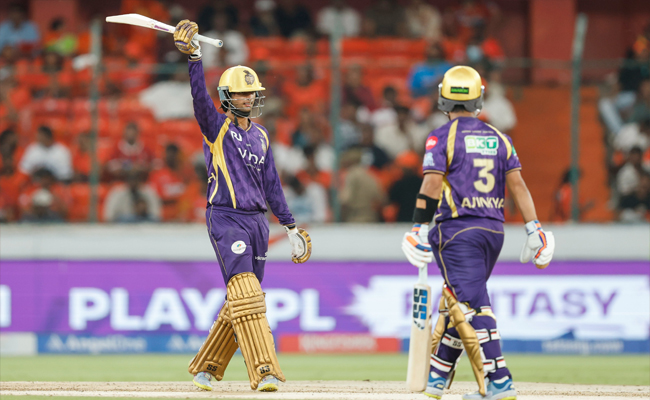
Hyderabad (PTI): The promising Angkrish Raghuvanshi (59) made a well-paced fifty as Kolkata Knight Riders defeated Sunrisers Hyderabad by seven wickets in their IPL match here on Sunday.
Skipper Ajinkya Rahane (43) and Raghuvanshi added 84 runs for the second wicket as KKR overhauled SRH’s under-par 165 all out with ease.
Finn Allen made an aggressive 29 off 13 balls upfront to give KKR a brisk start.
Earlier, Travis Head made a belligerent 61 off 28 balls but KKR's spinners bowled well to restrict SRH to 165.
Mystery spinners Varun Chakravarthy (3/36) and Sunil Narine (2/31) wrecked SRH middle-order with controlled spells.
Along the way of his two-wicket burst in his fourth-over, Narine also completed 200 IPL wickets.
The spinner was the third bowler to achieve the feat after Yuzvendra Chahal and Bhuvneshwar Kumar.
Ishan Kishan made 42 off 29 balls.
Brief Scores:
Sunrisers Hyderabad: 165 all out in 19 overs (Travis Head 61, Ishan Kishan 42; Varun Chakravarthy 3/36, Sunil Narine 2/31).
Kolkata Knight Riders: 169/3 in 18.2 overs (Angkrish Raghuvanshi 59, Ajinkya Rahane 43).