1984 anti-Sikh riots case: Sajjan Kumar surrenders in court, to be lodged in Mandoli jail
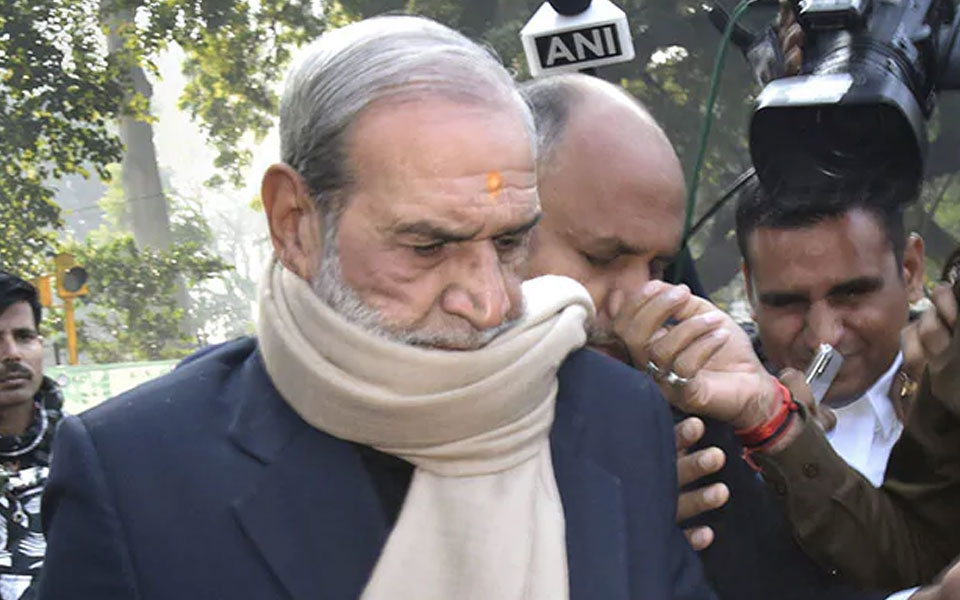
New Delhi, Dec 31: Former Congress leader Sajjan Kumar on Monday surrendered before a court here to serve the life sentence awarded to him by the Delhi High Court in connection with a 1984 anti-Sikh riots case.
He surrendered before Metropolitan Magistrate Aditi Garg who directed that Kumar be lodged in Mandoli jail in northeast Delhi.
The court rejected Kumar's petition to be lodged in the high-security Tihar jail, but allowed his plea for security and directed the police to take him to the prison in a separate vehicle.
A lawyer present in the courtroom said the court considered Kumar's plea for security since there was a threat as he was also facing prosecution in another anti-Sikh riots case.
While declining his plea to be sent to Tihar jail, the court said he was being sent to Mandoli jail in accordance with the rule.
The HC had set a deadline of December 31 for Kumar to surrender and on December 21 declined his plea to extend the time by a month.
The 73-year former Congress leader has filed a petition in the Supreme Court challenging the conviction and life sentence awarded by the HC.
The high court on December 17 convicted and sentenced Kumar to life imprisonment for the "remainder of his natural life". After his conviction, Kumar resigned from the Congress party.
The case in which Kumar was convicted and sentenced relates to the killing of five Sikhs in Raj Nagar Part-I area in Palam Colony of south west Delhi on November 1-2, 1984 and burning down of a Gurdwara in Raj Nagar Part-II.
The riots had broken out after the assassination of then prime minister Indira Gandhi on October 31, 1984, by her two Sikh bodyguards.
Earlier in the day, former MLAs Kishan Khokhar and Mahender Yadav, who were also convicted in the same case, surrendered before the court to serve their 10-year jail term.
Besides Kumar, the others convicted in the case were former Congress councillor Balwan Khokhar, retired naval officer Captain Bhagmal and Girdhari Lal.
In its judgment, the high court had noted that over 2,700 Sikhs were killed in the national capital during the 1984 riots which was indeed a "carnage of unbelievable proportions".
It also said the riots were a "crime against humanity" perpetrated by those who enjoyed "political patronage" and aided by an "indifferent" law enforcement agency.
The high court had further said there has been a familiar pattern of mass killings since Partition, like in Mumbai in 1993, Gujarat in 2002 and Muzaffarnagar, Uttar Pradesh in 2013, and the "common" feature of each was the "targeting of minorities" with the attacks being "spearheaded by the dominant political actors, facilitated by law enforcement agencies".
The high court had set aside the trial court's 2010 verdict which had acquitted Kumar in the case.
Let the Truth be known. If you read VB and like VB, please be a VB Supporter and Help us deliver the Truth to one and all.
AIITA welcomes Karnataka’s ban on obscene songs in school events

Bhatkal: The Karnataka unit of the All India Ideal Teachers Association (AIITA) has welcomed the Karnataka government’s decision to strictly ban school children from dancing to obscene songs during educational and cultural programmes in government, aided, and private schools across the state.
AIITA Karnataka State President M. R. Manvi congratulated the government for taking what he termed an important step to preserve the sanctity of education.
“Such decisions to safeguard the dignity of school children and uphold the values of education are the need of the hour. This rule should not be limited to government schools alone but must be strictly implemented in all private educational institutions as well,” he said.
He further urged the government to address other concerns within school programmes.
“The government should not only prohibit obscene dances in the name of school anniversaries, but also ensure that plays and dialogues that incite religious hatred are avoided. Schools should be centres of harmony, not platforms for spreading hatred,” he added.
According to a recent circular issued by the Department of School Education and Literacy, obscene dances are adversely affecting the mental health and moral values of students.
In this regard, schools have been advised to use songs that promote nationalism, positive thinking, the greatness of Kannada culture, and value-based traditions instead of inappropriate content during programmes.
The circular also emphasises that students should be dressed in decent attire.
AIITA also backed the department’s warning that disciplinary action would be taken against head teachers if such guidelines are violated. The association has further demanded that district Deputy Directors of Public Instruction strictly monitor the implementation of these rules.