2 BJP CMs from Northeast oppose citizenship bill; urge Rajnath to ensure it doesn't pass in RS
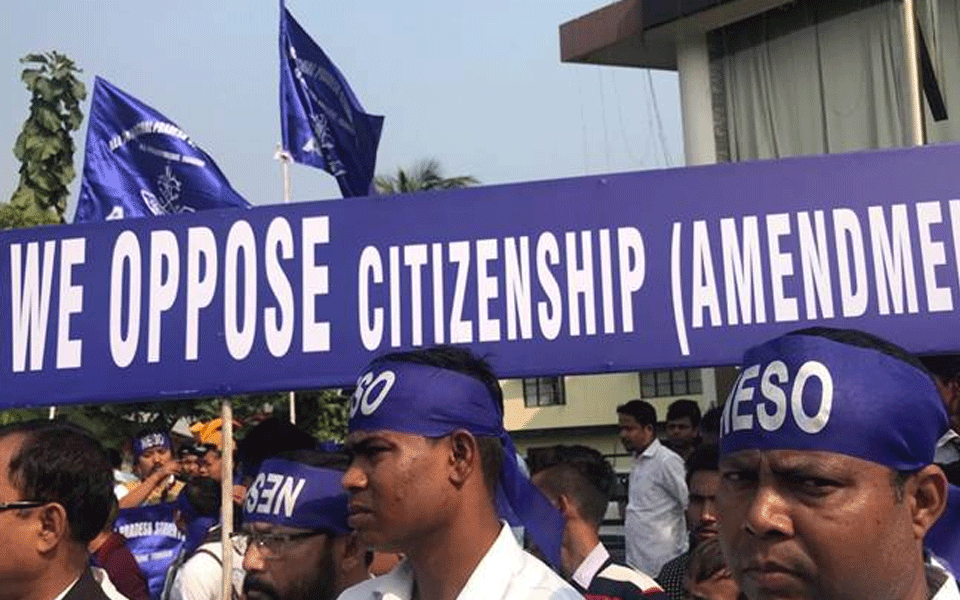
New Delhi : The chief ministers of two northeast states, Arunachal Pradesh's Pema Khandu and Manipur's N Biren Singh, Monday voiced their opposition to the contentious Citizenship Amendment Bill and urged Home Minister Rajnath Singh to ensure it was not passed in Rajya Sabha, officials said.
During a 30-minute meeting, the two BJP CMs apprised the home minister about the prevailing situation in the Northeast, which has been witnessing continuous protests against the Bill, that seeks to provide Indian nationality to non-Muslims from Pakistan, Bangladesh and Afghanistan.
The two chief minister requested the home minister not to pass the Citizenship Amendment Bill before convincing the people of the Northeast and sought protection of their cultural and linguistic identity, an official said.
The home minister asked the chief ministers not to worry and assured that the rights of the indigenous people of the Northeast would not be diluted, the official said.
The bill provides for according Indian citizenship to Hindus, Jains, Christians, Sikhs, Buddhists and Parsis from Bangladesh, Pakistan and Afghanistan after seven years of residence in India instead of 12 years, which is the norm currently, even if they do not possess any document.
The legislation was passed by the Lok Sabha during the Winter Session on January 8 and has been awaiting Rajya Sabha nod.
There has been strong opposition in Assam and other Northeastern states against the bill.
Political parties have been protesting on the grounds that the bill seeks to grant nationality to non-Muslims who have come up to December 31, 2014, thereby, increasing the deadline from 1971 as per the Assam Accord.
Also, according to the Assam Accord, all illegal immigrants who have come after 1971, irrespective of their religion, have to be deported and this bill violates that.
Prime Minister Narendra Modi had announced that the bill is an "atonement of the wrong that was done during India's Partition. India will safeguard all who had been victims of the Partition".
On Saturday, addressing a rally in Assam, Modi said the citizenship bill won't harm the interests of the people of the region but will provide succour to those who have "embraced the idea and ethos of Mother India".
Let the Truth be known. If you read VB and like VB, please be a VB Supporter and Help us deliver the Truth to one and all.
Man arrested with Rs 2.54-crore heroin in Mumbai

Mumbai (PTI): Police have arrested a man and seized over 500 grams of heroin worth Rs 2.54 crore in the illicit market from him in Mumbai, officials said on Friday.
The police's Anti-Narcotics Cell (ANC) made the drug seizure in Santacruz in the western suburbs. The operation was conducted by the Kandivali unit of the ANC on Thursday as part of a special crackdown against drug trafficking in the area, they said.
Acting on specific inputs, an ANC team conducted a raid in Santacruz (East) and intercepted a man. During a search, the team recovered 508 grams of high-grade heroin from his possession, an official said.
The seized contraband, a highly addictive, opioid drug derived from morphine, is estimated to be worth Rs 2.54 crore in the international market, he informed.
Following the seizure, a case was registered against the man under relevant sections of the Narcotic Drugs and Psychotropic Substances (NDPS) Act, 1985, and he was formally placed under arrest in the early hours of Friday.
The police are currently investigating the source of the drug and trying to identify the intended recipients of the consignment, he said.