2 more children die of hypoglycemia in Bihar's Muzaffarpur; toll now 43
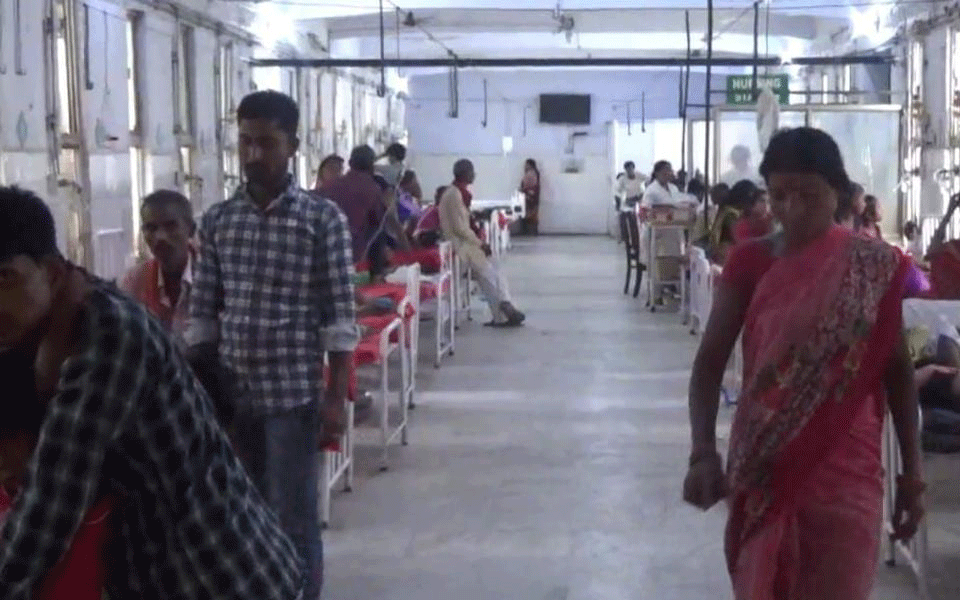
Muzaffarpur: Two children died Wednesday in Bihar's Muzaffarpur district, which is reeling under an outbreak of brain fever, taking the toll this month to 43, although a top state health official maintained that the casualties were not related to the outbreak but were caused by hypoglycemia.
Hypoglycemia causes abnormally low level of sugar in the blood or deficiency of sodium or potassium in the body, the official said.
According to a release issued by the Muzaffarpur district administration, two children died at the SKMCH hospital here where a total of 117 cases of Acute Encephalitis Syndrome (AES) have been reported since June 1.
Out of the reported cases, 36 have died till date, while 24 have been discharged and among those undergoing treatment, six were said to be in a critical condition, it said.
In the private Kejriwal hospital, the total number of reported cases is 55 and seven of the children admitted since June 1 have died so far though there was no death on Wednesday, the release said.
Among the patients undergoing treatment, the condition of four is stated to be critical.
Meanwhile, the state's Director-in-Chief (disease control) R D Ranjan visited the town, heading a team of Health Department officials sent from the Bihar capital, to take stock of the situation.
Talking to reporters, he said, "We can confirm the data as on June 10. Till that date, 34 deaths had taken place and 109 cases of chamki bukhar (brain fever) reported. More data is being updated. None of the deaths, so far, has been caused by AES. The casualties were a result of hypoglycemia - abnormally low level of sugar in the blood or deficiency of sodium and/or potassium - caused by intense heat and humidity."
In Patna, Principal Secretary (Health) Sanjay Kumar said, "We have received instructions from the chief minister to ensure that preventive measures were taken in the 12 affected districts, though deaths have so far been reported from only Muzaffarpur."
"Stern action will be taken against officials who are found to be lax in ensuring distribution of oral rehydration solution and spreading of awareness regarding preventive steps," he added.
Let the Truth be known. If you read VB and like VB, please be a VB Supporter and Help us deliver the Truth to one and all.
Massive turnout in assembly polls across states, women voters outnumber men: EC data
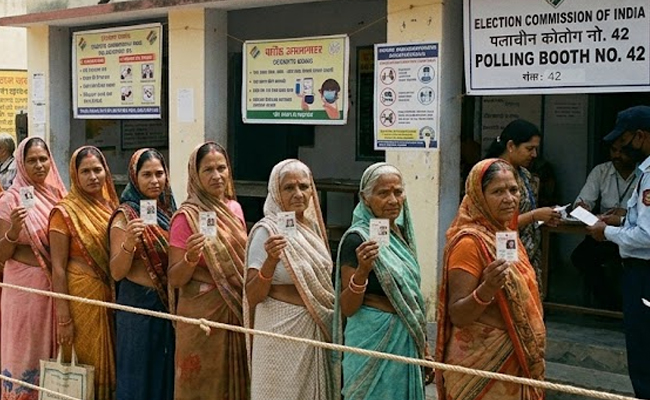
New Delhi (PTI): The recently-concluded assembly elections witnessed exceptionally high voter participation across states, with women voters outnumbering men in turnout percentages, according to Election Commission data.
West Bengal recorded the highest voter turnout among states, with 93.71 per cent polling in 293 constituencies where counting has been completed. The state saw over 6.38 crore votes cast, including postal ballots, against a total of more than 6.81 crore electors.
Women voters recorded a turnout of 93.8 per cent in the West Bengal Assembly polls, slightly higher than the 92.06 per cent participation among men.
The data for West Bengal does not include the figures for the Falta assembly constituency, which is scheduled for repolling.
Tamil Nadu registered an 85.01 per cent turnout, with nearly 4.8 crore votes polled from an electorate of 5.74 crore. Women voters recorded a turnout of 86.2 per cent, higher than the 83.77 per cent among men.
Assam also witnessed robust participation, with the final turnout touching 85.74 per cent. More than 2.15 crore votes were cast in the state, while female turnout at 86.53 per cent marginally exceeded the 84.95 per cent recorded among male voters.
Kerala registered a turnout of 78.11 per cent, with over 2.12 crore votes polled. Female voter participation stood at 81.17 per cent against 74.9 per cent among men.
Puducherry recorded a turnout of 89.82 per cent, with women voters again leading participation at 91.39 per cent. More than 8.5 lakh votes were polled in the Union territory.
Yet, women's representation among elected candidates remained modest.
Tamil Nadu elected 23 women MLAs (9.83 per cent) out of 234 members, West Bengal elected 37 women legislators (12.62 per cent) out of 293, while Kerala returned only 11 women MLAs (7.85 per cent) in the 140-member House.
Only two third-gender candidates contested the elections - one each from Tamil Nadu and Kerala, and both lost, forfeiting their deposits.
The elections also reflected extensive electoral mobilisation infrastructure. West Bengal had the highest number of polling stations at 85,092, followed by Tamil Nadu with 75,064 and Assam with 31,490.
In terms of candidates, Tamil Nadu saw the largest contest with 4,023 candidates in the fray across 234 constituencies, averaging 17 candidates per seat and peaking at 79 contestants in one constituency.
West Bengal pitted 2,920 candidates for 293 constituencies, while Kerala had the fewest contestants among the major states, with 883 candidates for 140 seats.
The data also showed relatively low NOTA votes across states. Tamil Nadu recorded the lowest NOTA share at 0.4 per cent of total votes polled, while Assam recorded the highest at 1.23 per cent. In West Bengal, 0.78 per cent of the total votes polled were NOTA, while it 0.77 per cent and 0.57 per cent of the electorate opted for None of the Above (NOTA) in Puducherry and Kerala, respectively.