2,000 people from Myanmar cross over to India as intense gunfight rock Chin state
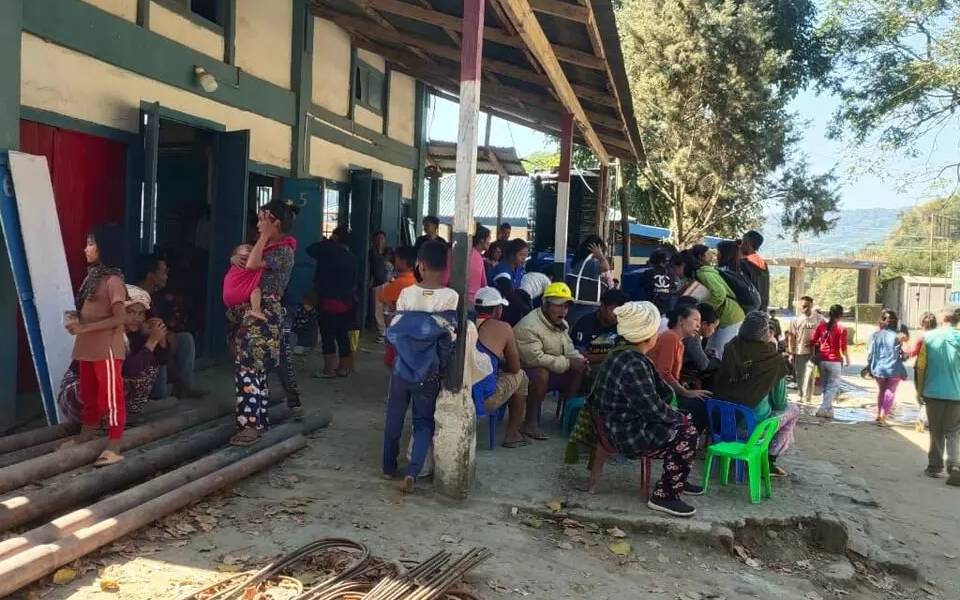
Aizawl, Nov 13: Over 2,000 Myanmar nationals entered India through the international border in Mizoram over the last 24 hours after airstrikes following an intense gunfight in the neighbouring country's Chin state, an official said on Monday.
James Lalrinchhana, the deputy commissioner (DC) of Champhai district which shares a border with Myanmar's Chin state, told PTI that an intense gunfight broke out between Myanmar's ruling junta-backed forces and militia group People's Defence Force (PDF) on Sunday evening.
The fighting started after the PDF attacked two military bases at Khawmawi and Rihkhawdar in Chin state near the Indian border, he said, adding that the fighting continued till Monday.
Over 2,000 people from Khawmawi, Rihkhawdar and the neighbouring villages in Chin crossed over to India and took shelter in Zokhawthar in Champhai district due to the gunfight, Lalrinchhana said.
The Myanmar military base at Rihkhawdar was taken over by the militia in the early hours of Monday, and the base at Khawmawi was also taken over by them in the afternoon, he said.
In retaliation, the Myanmar army launched airstrikes on Khawimawi and Rihkhawdar villages on Monday, he said.
At least 17 people injured in the gunfight were brought to Champhai for treatment, Lalrinchhana said.
A 51-year-old civilian from Myanmar who was already living in Zokhawthar died when the gunfight was happening on the other side of the border, the DC said.
Local sources said he was allegedly hit by a stray bullet from across the border.
Zokhawthar Village Council president Lalmuanpuia told PTI that five personnel of the Chin National Army (CNA), which was a part of the PDF, were killed in the gunfight.
Lalmuanpuia said that more than 6,000 people from Myanmar were already living in Zokhawthar before the gunfight started.
Six districts of the state -- Champhai, Siaha, Lawngtlai, Serchhip, Hnahthial and Saitual -- share a 510-km-long border with Myanmar's Chin state.
The first influx from the neighbouring country happened in February 2021 when the junta seized power. Since then, thousands of people from Myanmar have taken shelter in the northeastern state.
According to the state Home Department, 31,364 Myanmar nationals are currently living in different parts of the state. The majority of them live in relief camps, while others are accommodated by their local relatives and some live in rented houses.
The Myanmar nationals taking shelter in Mizoram are from the Chin community, who share ethnic ties with the Mizos.
Let the Truth be known. If you read VB and like VB, please be a VB Supporter and Help us deliver the Truth to one and all.
Several Gurugram schools receive hoax bomb threats

Gurugram (PTI): Several Gurugram schools received another hoax bomb threat emails on Wednesday morning, prompting police to launch searches on the premises.
Police said the email was sent by the 'Khalistan National Army', with threats issued to Haryana Chief Minister Nayab Singh Saini to declare April 29 as the "40th Khalistan Declaration Day". It also threatened to bomb the Red Fort in Delhi.
Police said it was a hoax as no suspicious items were found after an intensive search.
Several schools, including Shri Ram, Amity, and the HDFC school, received threatening emails at 8.33 am, when classes had already begun, police said.
The school administrations became aware of the threats around 9 am and immediately informed the police, a senior police officer said.
The schools immediately implemented emergency protocols, with many declaring a holiday and asking parents to take their children home safely, the officer said.
A large number of anxious parents gathered outside the schools, as police and bomb squad teams reached the spots and started checks.
"Around 10 schools have approached the police from morning until now over bomb threats. Police teams are alert, and searches are underway on all the premises", the officer said.
As soon as the information about this email was received, police in Gurugram and Delhi swung into action and started investigation.
Schools immediately implemented emergency protocols upon receiving the mail. Many schools declared a holiday and sent messages to parents, asking them to take their children home. Large crowds of parents gathered outside the schools.
The schools were sanitised by sending a bomb disposal squad as well as a dog squad.
A senior police officer said that police teams thoroughly searched the school premises, classrooms, buildings, and surrounding areas. No suspicious objects or explosive materials were found during the investigation.
"Police teams are seriously investigating the entire matter. Cyber experts are being consulted to determine the authenticity of the email, its source, and the identity of the sender", added the officer.
This is the third time since January that schools have received fake bomb threats.
In March, at least a dozen schools in the city received bomb threat emails, which later turned out to be hoaxes.
Similarly, on January 28, as many as 13 schools received hoax bomb threats via email, forcing authorities to evacuate campuses and suspend classes.
Last month, police arrested a Bangladeshi national whose email ID was allegedly used to make a bomb threat for some payment.