2020 Delhi riots case: Court frames charges of rioting, arson against 9 accused
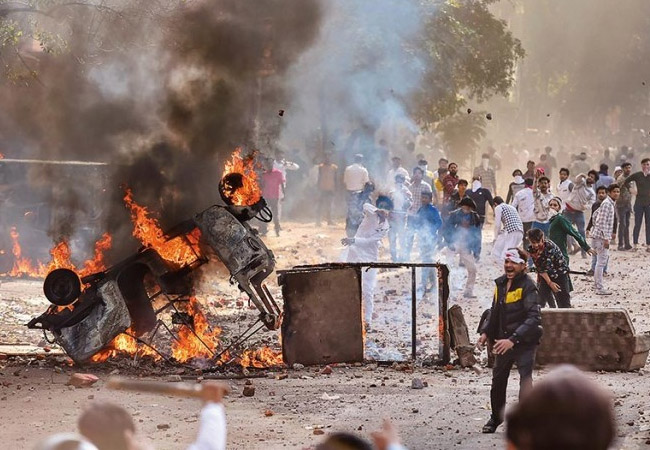
New Delhi, (PTI): A court here has framed charges of rioting, arson and house trespass against nine accused in a 2020 Delhi riots case, saying the "probative value" of evidence at this stage was not to be considered.
Additional Sessions Judge Pulastya Pramachala was hearing a case against Shah Alam, Rashid Saifi, Mohammed Shadab, Habib, Irfan, Suhail, Salim, Irshad and Azhar, who were accused of being part of a riotous mob that engaged in assault, vandalism and arson across seven separate incidents on February 24, 2020, in Dayalpur.
Noting the statements of eyewitnesses, the judge said there was a mob which indulged in vandalism and arson in several properties from around 11 AM to 5 PM and all the accused persons were identified to be part of this mob.
ASJ Pramachala said according to the prosecution's site plan, the incidents reported by seven complainants occurred in close vicinity. He said CCTV footage was used to identify the rioters.
"Thus, it is apparent that all these incidents took place when this riotous mob was on a rampage," he said in an order passed on Tuesday.
Rejecting the defence's argument about the credibility of evidence, the court said at the stage of framing charges, the "probative value" of evidence was not to be considered.
"If the evidence on the record satisfies the ingredients of the alleged offences and raises serious suspicion against the accused persons, to connect them with the alleged incidents, then the court is supposed to conduct the trial in the case, by framing the charges," it said.
Underlining that being a police official did not make a person a "less credible witness," the court said at the present stage it could not any statement of the witness as false or incredible.
"Thus, on the basis of allegations made by complainants and the evidence available on the record, I find the accused persons liable to be tried for offences punishable under IPC sections 148 (rioting, armed with a deadly weapon), 323 (voluntarily causing hurt), 326 (voluntarily causing grievous hurt), 379 (theft) and 341 (wrongful restraint)...," the court said.
It said all accused were also liable to be tried for the offences of house trespass, causing mischief by fire or explosive substance, unlawful assembly and disobedience to order duly promulgated by public servant.
Let the Truth be known. If you read VB and like VB, please be a VB Supporter and Help us deliver the Truth to one and all.
AIITA welcomes Karnataka’s ban on obscene songs in school events

Bhatkal: The Karnataka unit of the All India Ideal Teachers Association (AIITA) has welcomed the Karnataka government’s decision to strictly ban school children from dancing to obscene songs during educational and cultural programmes in government, aided, and private schools across the state.
AIITA Karnataka State President M. R. Manvi congratulated the government for taking what he termed an important step to preserve the sanctity of education.
“Such decisions to safeguard the dignity of school children and uphold the values of education are the need of the hour. This rule should not be limited to government schools alone but must be strictly implemented in all private educational institutions as well,” he said.
He further urged the government to address other concerns within school programmes.
“The government should not only prohibit obscene dances in the name of school anniversaries, but also ensure that plays and dialogues that incite religious hatred are avoided. Schools should be centres of harmony, not platforms for spreading hatred,” he added.
According to a recent circular issued by the Department of School Education and Literacy, obscene dances are adversely affecting the mental health and moral values of students.
In this regard, schools have been advised to use songs that promote nationalism, positive thinking, the greatness of Kannada culture, and value-based traditions instead of inappropriate content during programmes.
The circular also emphasises that students should be dressed in decent attire.
AIITA also backed the department’s warning that disciplinary action would be taken against head teachers if such guidelines are violated. The association has further demanded that district Deputy Directors of Public Instruction strictly monitor the implementation of these rules.