2022 PM security breach: Arrest warrants issued against 25 farmers, says BKU (Krantikari)
Ferozepur (Punjab) (PTI): The Bharti Kisan Union (Krantikari) Thursday slammed the Punjab government for the arrest warrants issued against 25 farmers and insertion of an attempt to murder charge in the FIR in connection with the 2022 prime minister security breach matter in the state.
Leaders of the farmers' body said they came to know about the insertion of Section 307 (attempt to murder charge) of the Indian Penal Code in the FIR after the bail plea of one of the protesting farmers was rejected by a court in Ferozepur.
On January 5, 2022, Prime Minister Narendra Modi's convoy was stranded on a flyover due to a blockade by protesters in Punajb's Ferozepur after which he returned from the state without attending any event, including a rally.
Later, the Supreme Court appointed a five-member committee, headed by former apex court judge Indu Malhotra to probe the security breach incident.
Police had then lodged an FIR in the matter. Initially, police had registered an FIR against 150 unidentified people at Kulgarhi police station under Section 283 (danger or obstruction in public way) of the IPC.
Farmers said following a probe by a three-member Special Investigation Team (SIT), additional charges -- Sections 307 (attempt to murder), 353 (assault on a public servant), 186 (obstruction of duty), 149 (unlawful assembly), 341 (wrongful restraint) and Section 8-B of the National Highway Act -- were inserted in the FIR by the police.
Police have pressed these charges against 25 farmers by name.
Bharti Kisan Union (Krantikari) president Baldev Singh Zira said the bail plea of one of the protesters Kanwaljit Singh was rejected by Sessions Court on Tuesday.
"The state government is apparently working under the pressure of the Union government. It has been three years since the incident. The farmers were actually going towards the district administrative complex to hold a protest, however, the police blocked their way near the bridge," he claimed.
Zira claimed the farmers had no idea that the prime minister was coming via the same road.
"Since the farmers were not allowed to move forward, they squatted there, and started a protest near the bridge", Zira said, adding the prime minister's cavalcade was at a distance of around one km from the protesting site during which no protesters went there."
"The police had earlier booked unidentified people under section 283 of IPC, but later due to some kind of pressure, they added serious sections like 307 of IPC in that FIR," he said.
The Bharti Kisan Union (Krantikari) president said, "Police booked 25 people, including me, by name. But no information was shared with us, neither did we receive any notices or summons."
"Now, the court is issuing non-bailable warrants for non-appearance. This is just a conspiracy to demoralise and weaken 'Kissan Morcha 2.0'. But we will not let that happen," Zira added.
Farmer leader Surjit Singh Phul, who is part of the ongoing protest at Shambhu and Khanauri border points, strongly condemned the Punjab Police for pressing the attempt to murder charge against farmers.
"Arrest warrants have been issued against 25 farmers. The Punjab government is working under pressure from the Centre," he said.
On January 5, 2022, Prime Minister Narendra Modi was scheduled to lay the foundation stones of development projects worth over Rs 42,750 crore, including the Delhi-Amritsar-Katra expressway and a PGIMER satellite centre.
When his convoy reached close to the Piareana village on the Ferozepur-Moga road, around 30 km from the National Martyrs Memorial in Hussainiwala, some protestors blocked the road following which the cavalcade was halted for almost 15-20 minutes.
The PM had returned without dedicating developmental projects and addressing a rally.
The incident had triggered a major political row with the BJP alleging that the then ruling Congress in Punjab "tried to physically harm" the prime minister, while other parties too attacked the state government over the law and order issue.
Let the Truth be known. If you read VB and like VB, please be a VB Supporter and Help us deliver the Truth to one and all.
Massive turnout in assembly polls across states, women voters outnumber men: EC data
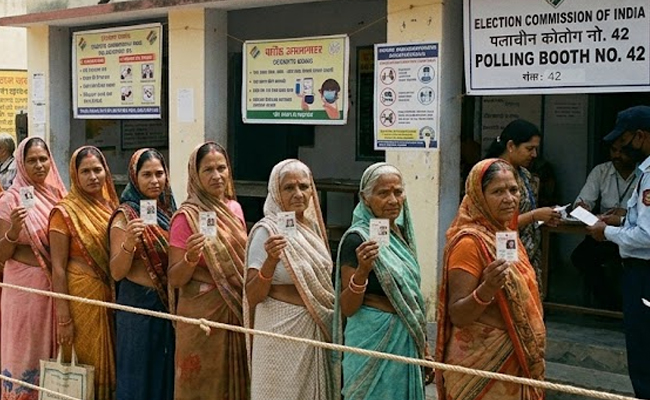
New Delhi (PTI): The recently-concluded assembly elections witnessed exceptionally high voter participation across states, with women voters outnumbering men in turnout percentages, according to Election Commission data.
West Bengal recorded the highest voter turnout among states, with 93.71 per cent polling in 293 constituencies where counting has been completed. The state saw over 6.38 crore votes cast, including postal ballots, against a total of more than 6.81 crore electors.
Women voters recorded a turnout of 93.8 per cent in the West Bengal Assembly polls, slightly higher than the 92.06 per cent participation among men.
The data for West Bengal does not include the figures for the Falta assembly constituency, which is scheduled for repolling.
Tamil Nadu registered an 85.01 per cent turnout, with nearly 4.8 crore votes polled from an electorate of 5.74 crore. Women voters recorded a turnout of 86.2 per cent, higher than the 83.77 per cent among men.
Assam also witnessed robust participation, with the final turnout touching 85.74 per cent. More than 2.15 crore votes were cast in the state, while female turnout at 86.53 per cent marginally exceeded the 84.95 per cent recorded among male voters.
Kerala registered a turnout of 78.11 per cent, with over 2.12 crore votes polled. Female voter participation stood at 81.17 per cent against 74.9 per cent among men.
Puducherry recorded a turnout of 89.82 per cent, with women voters again leading participation at 91.39 per cent. More than 8.5 lakh votes were polled in the Union territory.
Yet, women's representation among elected candidates remained modest.
Tamil Nadu elected 23 women MLAs (9.83 per cent) out of 234 members, West Bengal elected 37 women legislators (12.62 per cent) out of 293, while Kerala returned only 11 women MLAs (7.85 per cent) in the 140-member House.
Only two third-gender candidates contested the elections - one each from Tamil Nadu and Kerala, and both lost, forfeiting their deposits.
The elections also reflected extensive electoral mobilisation infrastructure. West Bengal had the highest number of polling stations at 85,092, followed by Tamil Nadu with 75,064 and Assam with 31,490.
In terms of candidates, Tamil Nadu saw the largest contest with 4,023 candidates in the fray across 234 constituencies, averaging 17 candidates per seat and peaking at 79 contestants in one constituency.
West Bengal pitted 2,920 candidates for 293 constituencies, while Kerala had the fewest contestants among the major states, with 883 candidates for 140 seats.
The data also showed relatively low NOTA votes across states. Tamil Nadu recorded the lowest NOTA share at 0.4 per cent of total votes polled, while Assam recorded the highest at 1.23 per cent. In West Bengal, 0.78 per cent of the total votes polled were NOTA, while it 0.77 per cent and 0.57 per cent of the electorate opted for None of the Above (NOTA) in Puducherry and Kerala, respectively.