26-year-old man held for killing 5 members of family in Delhi's Bhajanpura

New Delhi: The Delhi Police arrested a 26-year-old man on Thursday for allegedly killing five members of a family, including three children, in northeast Delhi's Bhajanpura because he did not want to repay Rs 30,000 that he had borrowed from them.
The accused Prabhu Nath, a resident of the area, is a relative of the family and killed four of the family within a span of around four hours, police said.
Decomposed bodies of e-rickshaw driver Shambhu Chaudhary (43), his wife Sunita (37) and their children -- Shivam (17), Sachin (14) and Komal (12) -- were found inside their rented house on Wednesday morning.
The bodies were in a putrefied state and it seemed that the murder had been committed around one week ago, Deputy Commissioner of Police (Northeast) Ved Prakash Surya said.
On contacting schools of the children, it was learnt that they were absent since February 4. Call records of Shambhu showed that his phone was active till late evening of February 3, the officer said.
In one of the CCTV footage obtained from the area, Prabhu Nath was seen entering the victims' house around 3.30 pm on February 3. Following this, he was arrested and during interrogation he confessed to the crime, police said.
"He said that he worked in a coaching institute at Laxmi Nagar and also used to work as a collection agent of some money lender. He had borrowed Rs 30,000 from Shambhu and had loaned the same to some people for obtaining interest," the DCP said.
At 3.30 pm on the day of incident, Prabhu Nath called Shambhu asking him to come to Laxmi Nagar. When Shambhu went to Laxmi Nagar, Nath went to his house where Sunita was alone and an altercation took place between them on the issue of returning the money, Surya said.
The accused throttled Sunita's neck and hit her on the head with an iron rod. When her daughter Komal returned from tuition, she too was killed in the same manner. Shivam and Sachin were killed upon their return from school by hitting them on the head with the iron rod, the DCP said.
He then locked the house from outside and went to meet Shambhu. They both had liquor. Later, they both returned to the house and Shambhu was hit on the head with the iron rod in the darkness, causing his death, Surya said.
The keys of the house have been recovered from Prabhu Nath's possession and a search is on for the iron rod used in the crime, police said.
Let the Truth be known. If you read VB and like VB, please be a VB Supporter and Help us deliver the Truth to one and all.
How Indian AI Is Booming with GEOX AI Leading the Next Wave of Geolocation Intelligence
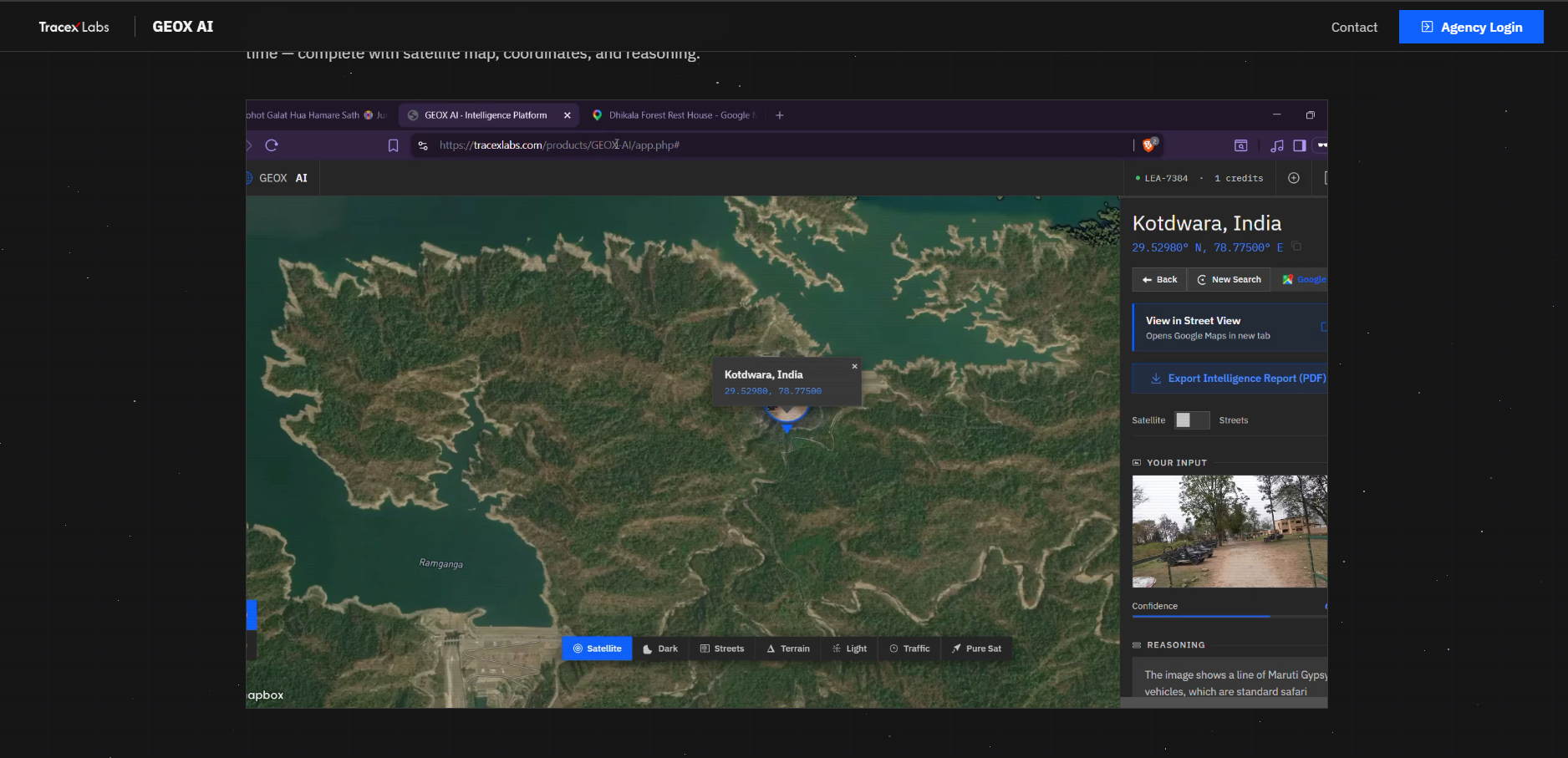
TraceX Labs has announced the launch of GEOX AI, an advanced artificial intelligence platform capable of identifying the real-world location where a photograph or video was taken using only the visual content within the media.
Positioned as an enterprise-grade intelligence solution, GEOX AI leverages advanced computer vision and multi-agent AI to analyze pixel-level details such as architecture, road patterns, vegetation, signage, lighting, and environmental context. By interpreting these visual clues, the system can estimate—and in many cases precisely determine—the origin of an image or video.
AI-Powered Geolocation Intelligence
Marketed under the concept of “Locate Anywhere From Any Image,” GEOX AI is designed for intelligence operations where speed, accuracy, and reliability are critical. The platform currently supports:
- 400+ analyses available
- <10 seconds average response time
- Up to 99% accuracy on landmark-based identification
- Global coverage across diverse terrains and environments
Core Capabilities
GEOX AI integrates multiple intelligence features into a single platform:
- Precise Geolocation:
Identifies exact geographic coordinates using visual landmarks, architecture, vegetation, and cultural indicators. - Satellite Map View:
Results are plotted on live satellite imagery with 2D/3D viewing options and multiple map styles for deeper analysis. - AI Reasoning Analysis:
Provides a detailed explanation of how the system arrived at a conclusion, including confidence scoring. - Multi-Result Analysis:
Returns multiple possible locations ranked by confidence, enabling cross-verification. - Intelligence PDF Export:
Allows one-click generation of professional reports containing maps, coordinates, analysis, and structured findings. - Credit-Based Access:
Agencies are allocated credits, with each analysis consuming one credit. Additional credits can be requested directly.
Speed Meets Intelligence
GEOX AI is designed to balance rapid processing with analytical depth:
- Fast Mode: Delivers results within seconds for clear and high-context images
- Advanced Mode: Performs deeper multi-step analysis for complex or ambiguous visuals
- Built for real-time decision-making in high-pressure environments
How GEOX AI Works
The platform follows a simple and efficient workflow:
- Upload any image or video frame
- AI analyzes visual clues such as structures, terrain, and environment
- The system identifies location with coordinates, confidence score, and reasoning
- Results are displayed on an interactive satellite map
- Export a professional intelligence report in one click
A Breakthrough for Investigations
GEOX AI is expected to have wide-ranging applications across multiple domains:
- Tracking the origin of images from social media and open sources
- Supporting digital forensics and cyber investigations
- Assisting law enforcement and intelligence operations
- Helping journalists and OSINT analysts verify visual content
- Providing support in missing person cases and threat intelligence scenarios
Enterprise Access and Deployment
GEOX AI is available to verified law enforcement agencies, intelligence organizations, and authorized enterprises. Access is provided through a structured system where organizations can request credentials and define their operational use cases.
Interested users can request access via tracexlabs.com or contact contact@tracexlabs.com, with response times typically within 24–48 hours.
Privacy Debate Intensifies
The launch of GEOX AI has also sparked renewed discussion around digital privacy. By demonstrating how location data can be extracted purely from visible elements within images, the platform highlights the potential risks associated with sharing photos online without considering what those visuals may reveal.
Conclusion
With GEOX AI, TraceX Labs is entering the rapidly evolving geolocation intelligence space with a platform that combines speed, precision, and real-world usability. As artificial intelligence continues to advance, tools like GEOX AI are expected to play a critical role in shaping the future of investigations, security, and digital intelligence.