3-day ISRO space exhibition at Rajasthan Technical University draws high student turnout
Kota (Raj) (PTI): Models of Chandrayaan and Mangalyaan, replicas of rockets and rovers, along with ISRO’s signature Space Science Bus, are drawing students in large numbers to a three-day space exhibition at the Rajasthan Technical University (RTU) here, officials said on Tuesday.
The Vikram Sarabhai Space Exhibition from December 1-3 is being organised in collaboration with ISRO’s Space Applications Centre (SAC), Ahmedabad. Visitors can get insights into India's technological capabilities, with film screenings, mission displays and direct interactions with ISRO scientists making the event an immersive learning experience, they said.
The exhibition is drawing school students in large numbers, officials said, adding that 688 students from 14 schools visited on the opening day.
According to officials, ISRO’s Space Science Bus, models of Chandrayaan, Mangalyaan, launch pads, radar systems and various satellite technologies are some of the key attractions.
Additionally, multiple halls are showcasing replicas of rockets, rovers and mission components, while screening rooms are showing documentaries on India’s space capabilities. Students are also getting an opportunity to interact directly with ISRO scientists.
Kota South MLA Sandeep Sharma inaugurated the event on Monday. RTU Vice Chancellor Prof. Nimit Chaudhary presided over the ceremony, with ISRO scientists Neha Gaur Mishra and Dr S P Vyas, Prof. Dinesh Birla and Registrar Bhavna Sharma present as Guests of Honour.
Sharma highlighted India's growing global stature in space research and said that space remains one of the most intriguing frontiers of science. "India's recent lunar landing has positioned the country prominently on the world stage," he said.
Vyas outlined ISRO's journey -- from the early days of carrying rocket parts on a bicycle to Chandrayaan-3 and the ongoing preparations for Chandrayaan-4 and the Gaganyaan human spaceflight mission scheduled for 2028.
Highlighting India's cost-effective scientific progress, he noted that ISRO's 10-year budget equals NASA's single-year budget, yet India continues to achieve landmark successes.
Vyas emphasised that ISRO's contributions extend far beyond its lunar and Mars missions and pointed out that the organisation's satellites support critical applications in agriculture, mineral discovery, disaster management, water resource mapping, and environmental monitoring -- all of which were showcased at the exhibition.
RTU Vice Chancellor Chaudhary said the university aims to inspire young students and expose them to India’s expanding space research landscape
Let the Truth be known. If you read VB and like VB, please be a VB Supporter and Help us deliver the Truth to one and all.
CM Siddaramaiah alleges ‘criminal conspiracy’ in Sringeri recount, vows legal action
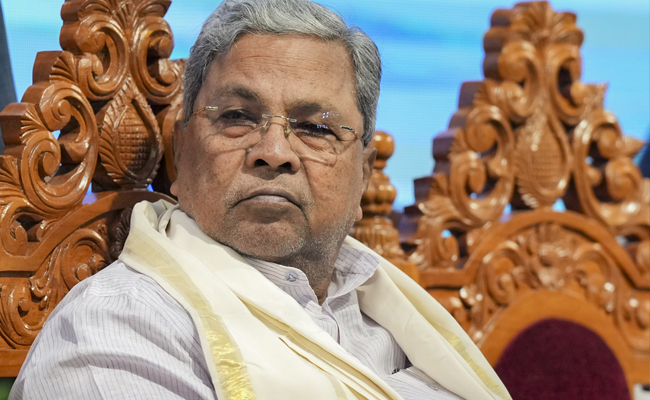
Bengaluru (PTI): Alleging a “criminal conspiracy” by BJP candidate D N Jeevaraj in the Sringeri Assembly poll recounting, Karnataka CM Siddaramaiah on Tuesday said the outcome was manipulated after valid postal ballot votes in favour of Congress leader T D Raje Gowda were tampered with during the recounting process.
Following a Karnataka High Court order on an election petition filed by Jeevaraj, challenging Raje Gowda’s election, the reverification and recounting were conducted on Saturday.
After the reverification and recount of postal ballots for the Sringeri Assembly constituency, votes polled in favour of Raje Gowda were reduced by 255, the returning officer said.
A report on the matter has been submitted to the Election Commission of India for further action, the officer added.
Congress leader Raje Gowda had won the 2023 Assembly polls from Sringeri by 201 votes, defeating his nearest rival Jeevaraj.
Addressing a press conference in Bengaluru, Siddaramaiah said the High Court had directed the recounting of postal ballots and that irregularities were noticed during the exercise conducted on May 2.
“This is a clear case of criminal conspiracy,” Siddaramaiah said, alleging that valid votes cast in favour of Raje Gowda were altered after being accepted by counting agents of all parties, including Congress, BJP, and JD(S).
He claimed that during the recounting of postal ballots, 255 votes were initially accepted as valid by all agents but were later tampered with by subordinate officials.
“There is a second mark on the votes polled in favour of Raje Gowda. They had accepted these as valid votes. Subsequently, another mark was made by officials. This is a clear case of criminal conspiracy,” he said.
When asked who was behind the alleged conspiracy, the CM replied, “It was hatched by Jeevaraj and others. It is planned.”
Siddaramaiah further alleged that the returning officer acted improperly by declaring the result despite the presence of an Election Commission observer during the recounting.
“Immediately after the counting, the returning officer announced the result. He should not have done so; this is against the law,” he said.
He pointed out that Raje Gowda had originally won by 201 votes, but after the recounting, the BJP candidate was declared the winner by 52 votes.
“The BJP has committed a criminal act of conspiracy. This is not vote chori but vote dacoity,” he alleged.
The CM said a police complaint had already been filed by Raje Gowda’s election agent, Sudhir Kumar, and emphasised the need for electoral integrity.
“We want transparency and free and fair elections. That is what our Constitution mandates,” he added.
Stating that the government would pursue legal remedies, Siddaramaiah said, “We are preparing an appeal challenging the returning officer’s announcement in a court of law.”
Responding to a separate query on elections in other states, the CM said there appeared to be an anti-incumbency factor in West Bengal, while results in Tamil Nadu were “surprising,” adding that Vijay’s party was emerging as the largest there.
Following the victory of party candidates in Bagalkote and Davanagere South, Siddaramaiah expressed confidence about future electoral prospects in Karnataka.
“Even in 2028, we will win the Assembly elections. We will come back,” the CM said.
Siddaramaiah added that he would order a forensic examination into the alleged tampering of postal ballots.