36 suicides in CAPF in 2019, 433 in six years: NCRB

New Delhi: Thirty-six security personnel under the command of the Union Home Ministry died by suicide in 2019, taking the number of such cases to 433 in six years, according to the latest National Crime Records Bureau (NCRB) data.
Of the 433 suicide deaths among the Central Armed Police Forces (CAPF) personnel during the six-year period, the least (28) number of cases was reported in 2018 and the maximum (175) in 2014, the data showed.
The number stood at 60 in 2017, 74 in 2016 and 60 in 2015, the NCRB data for the respective year showed.
The CAPF refers to seven central security forces of the country under the administrative control of the Ministry of Home Affairs.
It consists the Border Security Force (BSF), the Central Reserve Police Force (CRPF), the Central Industrial Security Force (CISF), the Indo-Tibetan Border Police (ITBP), the Sashastra Seema Bal (SSB), besides the Assam Rifles (AR) and the National Security Guard (NSG).
As on January 1, 2019, the CAPF had an actual strength of 9,23,800 personnel, who play a vital role in guarding the borders and assisting the Centre and state governments in maintaining internal security and in curbing other illegal or unlawful activities, the NCRB stated.
However, the NCRB data did not give a force-wise break up of suicide cases within the CAPF.
A total of 36 CAPF personnel killed themselves during 2019, with 14 of them (38.9 per cent) due to family problems and three due to service-related issues , the NCRB, which also functions under the Union Home Ministry, stated.
The reason for suicide was not known in eight cases, while it was other causes in nine. Fall in social reputation and marriage-related issues led to one suicide each during the year, the data records.
As per state and UT-wise pattern, five suicides were reported in Rajasthan followed by Tamil Nadu (4) and Arunachal Pradesh, Chhattisgarh, Jammu and Kashmir, Nagaland, Tripura & Delhi UT (3 each) during 2019, the data stated.
These eight states together accounted for 75 per cent (27 out of 36) of total suicides in CAPFs in the country. Out of five suicides reported in Rajasthan, four were due to family problems , it added.
Let the Truth be known. If you read VB and like VB, please be a VB Supporter and Help us deliver the Truth to one and all.
SC asks Centre to consider amending law on terminating pregnancy of rape survivors
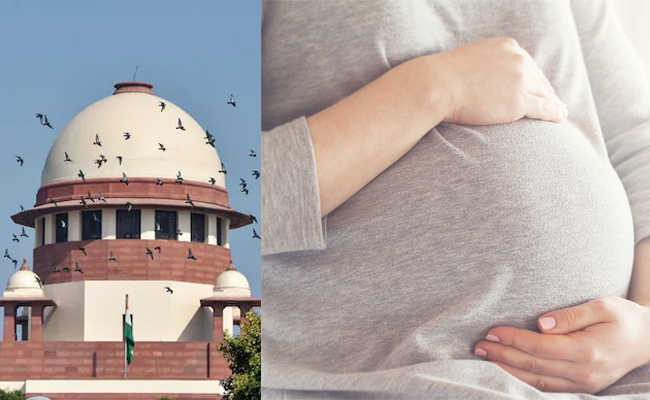
New Delhi (PTI): The Supreme Court on Thursday took strong exception to a plea by AIIMS seeking to set aside its order allowing a 15-year-old girl to medically terminate her 30-week pregnancy, and asked the Centre to consider amending the law to permit rape survivors to terminate unwanted pregnancies even beyond 20 weeks.
The top court said when there is pregnancy due to rape, there should not be a time limit.
Law needs to be organic and in sync with evolving time, it stressed.
A bench of Chief Justice Surya Kant and Justice Joymalya Bagchi said this is a case of child rape and the survivor will have a lifelong scar and trauma if termination is not allowed.
The top court said if the mother does not have permanent disability then it should be carried out.
ALSO READ: Chlorine gas leaks at defunct water purification plant in Pune; 24 persons hospitalised
It asked AIIMS to counsel parents of the survivor over the issue and said the decision has to be of the person concerned.
"There are children for adoption. In this country we have lot of sympathies...There are deserted, abandoned children on the streets and even mafias on it. We have to look at them. This is an unwanted pregnancy of a 15-year-old child.
"This is a curative petition. Unwanted pregnancy cannot be thrusted on a person. Imagine she is a child. She should be studying now. But we want to make her a mother. Imagine the pain, the humiliation the child has suffered in this," the bench said.
Additional Solicitor General Aishwarya Bhati, appearing for AIIMS, mentioned the curative plea, and said the termination of pregnancy is not possible.
"It will be a live baby with severe deformities. Minor mother will have lifelong health issues and cannot reproduce. Minor mother will have lifelong health issues. This child can be given for adoption. It has been 30 weeks now. It is a viable life now," she said.
The top court said the decision on termination has to choice of the survivor and her parents and AIIMS may help them take an informed decision.
On April 24, a bench of Justices B V Nagarathna and Ujjal Bhuyan had allowed the girl to medically terminate her pregnancy of 30 weeks.