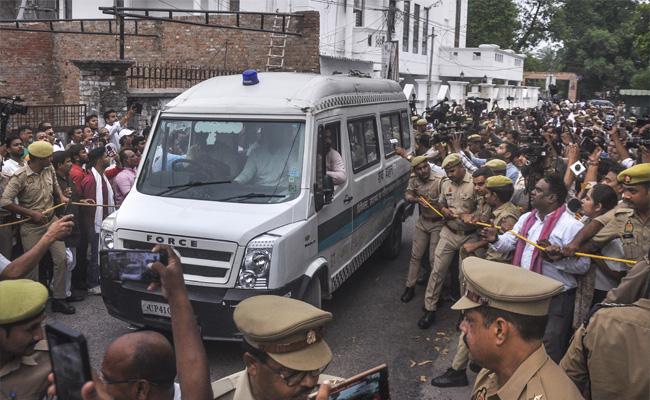
38 convicts deserve death as allowing them in society akin to releasing man-eater leopard,says court
Ahmedabad blasts

Ahmedabad(PTI): The 38 convicts in the 2008 Ahmedabad serial blasts case deserve the death sentence as allowing them to remain in society is akin to releasing a "man-eater leopard" in public that consumes innocents, the special court has said in its order.
In the judgement, a copy of which was made available on Saturday, the court also said that in its opinion, the death sentence will be reasonable as the case falls in the "rarest of the rare" category.
The special court had on Friday sentenced to death 38 members of the terror outfit Indian Mujahideen (IM) for the Ahmedabad bombings which killed 56 people and injured over 200 on July 26, 2008. The court also gave life terms to 11 other IM convicts in the case.
It was for the first time in the country that the maximum number of death sentences were handed down by a court in one go.
"The convicts created unrest in a peaceful society and carried out anti-national activities while living here. They have no respect for the constitutionally-elected government at the Centre and in Gujarat, and a few believe only in Allah and not in the government or the judiciary," special judge A R Patel said in the order.
There is no need for the government to keep the convicts in jail, especially those who said they believed only in their God and none others, the court said, adding there is no jail in the country that can keep them lodged forever.
"If such people are allowed to remain in the society, it will be like releasing a man-eater leopard in public. Such convicts are like a man-eater leopard that eats innocents in society, including children, youth, elderly, women, men, newborns, and people of different caste and communities," the judge said in the order.
The prosecution had sought death sentence for all the 49 convicts in the blasts case, including those who hatched the conspiracy and those who planted the bombs.
"For the people carrying out such terrorist activities, death sentence is the only option, for the sake of peace and safety of the country and its people," the court said about the 38 convicts.
Handing down life sentences to 11 other convicts till the end of their natural life, the court said their crime was less severe compared to the main conspirators.
"They took part in the conspiracy along with the main conspirators, and took part in terror training camps in the jungles in Halol-Pavagadh in Gujarat and Vaghmon in Kerala on their own accord, but their role in the crime does not involve death sentence," the court observed.
"But, if they get anything less than imprisonment till their last breath, then these convicts will again commit similar crimes and will help others, is also certain," it said.
Responding to arguments of some convicts that they were framed because they were Muslims, the court said it cannot accept this, because in India, there are crores of Muslims who live as law-abiding citizens.
"Why did the investigating officers arrest only these people? Others should have been arrested had they also been involved in the case. The investigating officers are responsible people," the court said.
Let the Truth be known. If you read VB and like VB, please be a VB Supporter and Help us deliver the Truth to one and all.
Congress using hijab issue to pacify minority anger, alleges Karnataka LoP R Ashoka

Bengaluru: Leader of Opposition in the Assembly R. Ashoka has accused the Congress government of using the hijab issue to placate what he described as discontent among minority voters after the Davanagere by-election.
In a post on X on Wednesday, Ashoka alleged that the state government, instead of addressing issues such as price rise, corruption, farmers’ distress and law and order, was attempting to retain its minority vote base by reviving the hijab issue.
Referring to the 2022 dress code introduced by the BJP government, which prohibited hijab in schools and colleges, Ashoka said the Karnataka High Court had upheld the policy and emphasised the importance of discipline in educational institutions.
He questioned the Congress government’s move to revisit the issue and asked whether setting aside the court-backed policy to benefit one community could be described as secularism.
Ashoka further alleged that while the government was willing to permit hijab, it continued to prohibit saffron shawls.
He accused the government of dividing students on religious lines rather than treating schools and colleges as spaces of equality.
Drawing a comparison with Mamata Banerjee’s government in West Bengal, Ashoka claimed that excessive appeasement politics had harmed the state and warned that the Congress in Karnataka could face a similar political response.
He said voters in Karnataka would teach the Congress a lesson for what he termed “vote-bank politics” and for compromising constitutional and judicial principles.