41 Maoists surrender to Telangana police
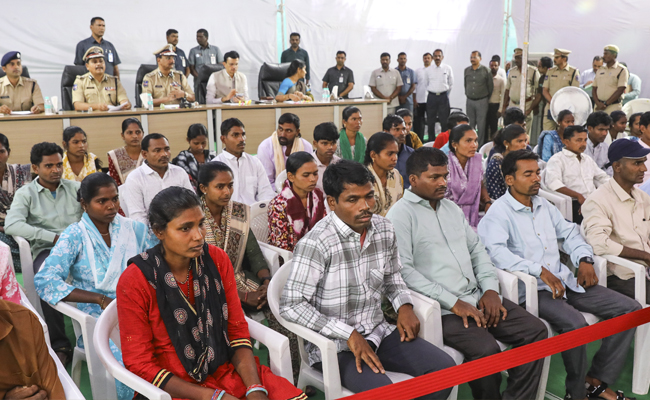
Hyderabad (PTI): In a major setback to the banned CPI (Maoist) organisation, 41 underground cadres, including six senior functionaries at the Company Platoon Committee and Divisional Committee levels, surrendered to Telangana police, officials said.
The cadres formally renounced violence and joined the mainstream of society, Telangana Director General of Police B Shivadhar Reddy said in a press release on Friday.
The surrendered ultras handed over 24 firearms, including one INSAS LMG, three AK-47 rifles, and five SLR rifles, along with 733 live rounds of ammunition of various calibres, to the police.
"The surrender represents a significant erosion of organisational strength, morale, and leadership credibility of the CPI (Maoist)," the release said.
Police said the cadres decided to surrender as the CPI (Maoist) leadership had been arbitrarily deploying members to unfamiliar and distant areas without their consent, often to regions where they lacked basic geographical knowledge and local support.
ALSO READ: Doctor whose naqab was removed by Nitish Kumar will join duty in Bihar: Official
The total eligible reward of Rs 1.46 crore will be disbursed to the surrendered cadres under the state and central relief and rehabilitation policy after completion of documentation and opening of bank accounts, the release added.
In 2025 alone, 509 underground CPI (Maoist) cadres—including two Central Committee members, 11 State Committee members, and three Divisional Committee secretaries—have surrendered to Telangana police, underscoring the steady decline of the organisation, it said.
Reddy said the CPI (Maoist) leadership has instructed its cadres to move out of Chhattisgarh and disperse to other areas until March 2026, the deadline set by the Centre for eliminating the menace.
The leadership has told cadres that security operations will be scaled down after this date, allowing them to resume underground activities.
However, the police described this assurance as misleading and a false promise.
The DGP said arbitrary deployments to unfamiliar and distant areas had caused serious mobility constraints and acute logistical difficulties, including shortages of essential day-to-day necessities.
Such conditions created growing frustration and hardship among the cadres, compelling many to disengage from the CPI (Maoist) organisation and return to the mainstream of society, he added.
Let the Truth be known. If you read VB and like VB, please be a VB Supporter and Help us deliver the Truth to one and all.
Maharashtra sets up state vaccination task force to strengthen immunisation programme

Mumbai (PTI): The Maharashtra government has set up a State Vaccination Task Force to strengthen the regular immunisation programme and review the progress of related campaigns, a health department official said on Monday.
The State Vaccination Task Force will comprise at least 29 members and will be headed by the administrative head of the health department, he informed.
The government has also constituted separate district-level and municipal vaccination task forces to improve implementation and address challenges at the grassroots level, he said.
Municipal task forces, chaired by respective civic commissioners, have been constituted in view of the vast urban population in Maharashtra and the role of civic bodies in implementing different health programmes.
The district-level task forces will function under the chairmanship of collectors.
"Complete immunisation of children at the appropriate age is an extremely simple, cost-effective and highly effective measure to reduce child mortality and the prevalence of diseases among kids. Immunisation is a powerful tool for reducing illness in children," maintained the official.
To ensure full vaccination of all children, the state government implements various campaigns from time to time as per the central government guidelines, he pointed out.
"Active participation and cooperation of other relevant government departments are essential (in making these campaigns successful)," according to the official.
The state-level body will review the regular immunisation programme, associated campaigns and vaccine-preventable diseases in detail. It will also conduct focused assessments of high-risk districts and municipal corporations, including vacancies at district, municipal and sub-district levels, availability of cold chain equipment, resource gaps and training requirements, he noted.
The state task force will review allocation and utilisation of funds for immunisation and ensure timely action by officers concerned based on reports from district and municipal task forces and state-level monitoring mechanisms, the official said.
It will also ensure active coordination and participation of other government departments in immunisation drives, while district and municipal task forces will carry out similar functions at their respective levels, the official added.