7 dead, over 35 injured in fire after gas tanker collides with other vehicles on Jaipur highway
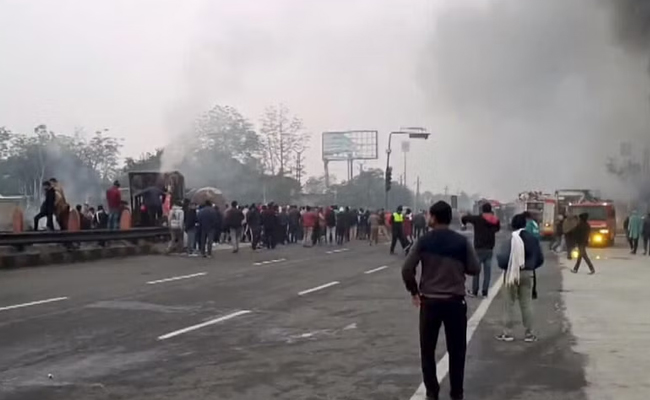
Jaipur (PTI): A deadly collision involving a gas tanker and multiple vehicles turned a stretch of the Jaipur-Ajmer highway here into an inferno on Friday morning, killing seven people, injuring more than 35 and engulfing over 30 vehicles in flames as thick black smoke filled the sky.
Eyewitnesses reported spotting the flames from nearly a kilometre away as ambulances and fire brigade vehicles rushed towards the crash zone. A school van driver on his way to pick up students recounted with horror the sight of a man engulfed in flames.
Rajasthan health department officials told PTI that seven people died in the crash while more than 35 were injured.
Police said there are chances that some people could not get out of their vehicles and got burnt inside. The situation will become clear once all the vehicles are thoroughly checked, they said.
Rajasthan Chief Minister Bhajanlal Sharma and Health Minister Gajendra Singh Khimsar rushed to the SMS Hospital, where the injured were admitted. Sharma spoke to administration officials and doctors and issued directions to ensure proper treatment was facilitated. He also visited the accident site and spoke to police officials.
In a post in Hindi on X, the chief minister said, "Deeply saddened to hear the news of casualties in the gas tanker fire incident on the Jaipur-Ajmer National Highway. As soon as the information about the incident came, I went to the SMS Hospital and directed the doctors there to provide immediate necessary medical facilities and take proper care of the injured."
Jaipur Police Commissioner Biju George Joseph and other officials of the department were at the spot on the highway.
Khimsar told reporters that nearly half of the injured brought to the hospital were in very critical condition.
"All doctors, resident doctors and nursing staff were called in to manage the situation. Another ward has been opened so that patients can be accommodated. Some people got primary treatment in nearby hospitals," he said.
The health minister said a 'green corridor' has been set up from the accident site to the SMS hospital.
An official said a sleeper bus headed for Jaipur from Rajsamand was behind the gas tanker when the accident occurred. Efforts were underway to find the details about the passengers on board.
The burnt vehicles are being removed from the highway so that traffic movement can be resumed.
CM Sharma, Governor Haribhau Bagade, and former chief minister Ashok Gehlot expressed their condolences for the loss of lives in the crash.
The station house officer of Bhankrota Manish Gupta said it was difficult to bring the fire under control initially.
"Fire brigade teams initially were unable to reach the vehicles that were burning. There are three petrol pumps in the area but fortunately, they are safe," he added.
More than 25 ambulances were used to shift the victims to the hospital.
A nearly 300-metre busy stretch of the highway was affected by the accident, leading to a long queue of vehicles.
Police officials said the fire engulfed some establishments along the highway but details of the actual losses are not yet clear.
The school van driver told PTI that the flames were visible from a kilometre away and there was panic and chaos on the highway.
"As I got closer to the spot, I saw people running in haste and shouting for help. I saw a man engulfed in flames. It was a frightening scene. Fire brigades and ambulances were there but it was difficult for them to reach the spot initially," he said.
A team from the district administration is present at the hospital to help the family members of the victims.
The Jaipur Police has issued the helpline numbers 9166347551, 8764688431 and 7300363636 for people to get in touch for inquiries or relevant information.
Let the Truth be known. If you read VB and like VB, please be a VB Supporter and Help us deliver the Truth to one and all.
Rajnath to top commanders: Outmaneuver adversaries with strategic surprise
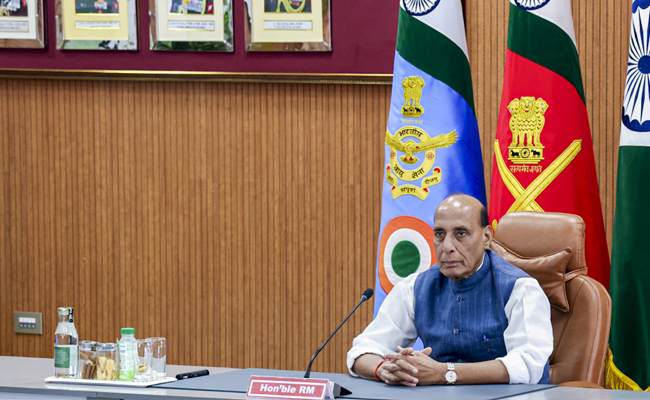
Jaipur/New Delhi (PTI): Defence Minister Rajnath Singh on Friday directed the top military commanders of the three services to integrate an "element of surprise" into modern warfare to outmaneuver India's adversaries and bolster strategic posture.
In his address at the joint commanders conference in Jaipur, Singh also described the Operation Sindoor as a testament to the "swift, precise, and joint response" of the Indian armed forces to safeguard national interests and called upon the military to remain ready to deal with any security challenges.
In their two-day deliberations, the commanders carried out a comprehensive review of the combat preparedness of the military in the wake of the evolving regional security situation.
Operation Sindoor was a demonstration of India's growing capabilities and a symbol of the nation's collective resolve and new military ethos, Singh said, a day after the first anniversary of Operation Sindoor.
He also unveiled a 'Joint Doctrine for Integrated Communication Architecture' that is aimed at strengthening doctrinal clarity, interoperability and integrated communications across the armed forces in future multidomain operations.
The joint commanders' conference, themed 'Military Capability in New Domains', brought together the top leadership of the defence ministry and the three services to deliberate on emerging security challenges and future readiness.
Comprehensive deliberations were held on future warfare, multidomain operations, technological transformation and joint capability development.
The conference witnessed extensive discussions on cognitive warfare, cyber resilience against evolving quantum and AI-enabled threats, military capability development in emerging domains, indigenous innovation and AI-enabled warfighting concepts.
It was attended by Chief of Defence Staff Gen Anil Chauhan, Chief of the Naval Staff Admiral Dinesh Kumar Tripathi, Chief of the Army Staff Gen Upendra Dwivedi, Chief of the Air Staff Air Chief Marshal AP Singh and Defence Secretary Rajesh Kumar Singh among others.
In his remarks, Singh asked the commanders to remain "future-ready" by learning from the operation as well as the current global security landscape.
He underscored the need to strengthen capabilities in artificial intelligence, autonomous systems, data analytics and secure communication networks to stay prepared in the rapidly evolving geopolitical security scenario. He emphasised that future conflicts will increasingly be shaped by hybrid threats, information dominance and operations conducted simultaneously across cyber, space, electromagnetic and cognitive domains, according to an official readout.
Highlighting the transformative impact of emerging technologies, Singh stressed on the importance of ensuring integrated national preparedness across all spectrums of conflict, it said.
Singh's remarks at the conference came a day after the first anniversary of Operation Sindoor.
The defence minister appreciated the progress achieved in enhancing jointness, integration and technological adoption across the three services, the readout noted.
Singh said that jointness constitutes a pivotal dimension within the transformative changes sweeping across the global defence sector.
"Future wars will not be won solely through weaponry, but through innovative thinking and enhanced synergy," he said.
The defence minister exhorted the commanders to cultivate the "element of surprise" to remain unpredictable to the nation's adversaries and secure a strategic edge in any given situation.
He, however, urged them to remain vigilant of the element of surprise of the enemy and always stay two steps ahead.
Singh also reiterated the Narendra Modi government's commitment to enhancing the capabilities of the defence forces through state-of-the-art weapons and platforms. He added that special focus is being laid on research in niche domains.
During the conference, he released a documentary film on Operation Sindoor.
The film reaffirms the nation's and defence forces' commitment to operational preparedness and decisive national response capabilities.
Demonstrations of advanced systems and platforms developed for intelligence fusion, operational planning and information management were also showcased during the conference reflecting growing integration of cutting-edge technologies into joint operational structures, according to the defence ministry.
The discussions will contribute significantly towards shaping India's future military transformation and integrated operational preparedness, it said.