5G mobile services to start soon, says PM Modi
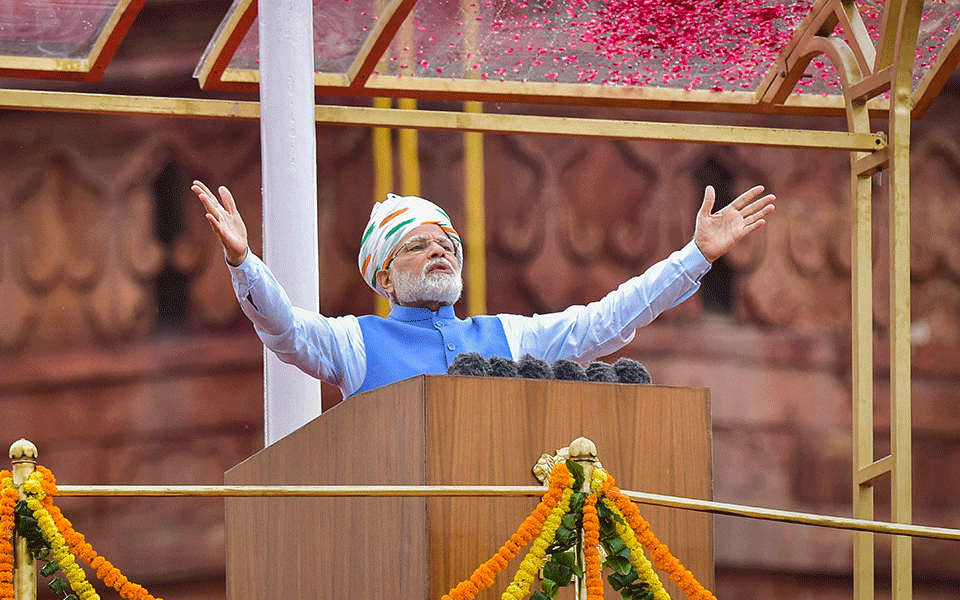
New Delhi (PTI): 5G mobile telephony, which holds the promise of offering 10 times faster speeds and lag-free connectivity, will soon start in India, Prime Minister Narendra Modi said on Monday.
The Prime Minister touched upon all-round development of technology in the country from 5G to push for electronic chips, laying of optical fibre cable (OFC) network across villages and enablement of digital entrepreneurship in villages through Common Services Centres making the present decade as "techade" for India.
"Now we are stepping towards the era of 5G... won't have to wait for long. We are taking optical fibre to every village. I have full knowledge that the dream of Digital India will pass through villages.
"I am happy that India's 4 lakh common service centres are developing in villages. Country can boast of 4 lakh digital entrepreneurs getting ready in villages and people in villages becoming habitual of taking services from them," Modi said.
The government earlier this month sold 5G telecom spectrum for Rs 1.5 lakh crore to billionaire Mukesh Ambani's Jio, Sunil Mittal-led Bharti Airtel, richest Indian Gautam Adani's group and Vodafone Idea.
Besides powering ultra-low latency connections, which allow downloading full-length high-quality video or movie to a mobile device in a matter of seconds (even in crowded areas), the Fifth Generation or 5G would enable solutions such as e-health, connected vehicles, more-immersive augmented reality and metaverse experiences, life-saving use cases, and advanced mobile cloud gaming, among others.
Bharti Airtel will start rolling out 5G services this month and cover all towns and key rural areas of the country by March 2024. Country's largest telecom player Jio has completed 5G coverage planning in top 1,000 cities and conducted field trials of its home-grown 5G telecom gears.
Modi said that the country frequently remembers former Prime Minister Lal Bahadur Shastri and his mantra of "Jai Jawan Jai Kisan" which is an inspiration for the country.
"Later Atal Bihari Vajpayee added a link by saying "Jai Vigyan (Science)" and the country had given priority to it. But now for Amritkaal there is one more necessity and that is "Jai Anusandahan (research)"- Jai Jawan, Jai Kisan, Jai Vigyan, Jai Anusandhan"- Innovation. I have faith in my young generation," Modi said.
He said that the power of innovation is visible in the form UPI (Unified Payment Interface) BHIM, digital payment, India's global rank in fintech space and 40 per cent share globally.
Modi said that the Digital India movement where the government is taking steps towards 5G, treading towards semiconductors, laying a network of optical fibre, is not only a sign of modernisation but there are three big powers embedded in it.
"Complete revolution in education is going to come through the digital medium. Revolution in health services is going to come from the digital medium. Any big revolution in life is going to come through the digital medium. A new world is getting ready. This decade is the time of 'techade' for the human race. It is a decade of technology," he said.
Modi said that the Atal Innovation Mission, incubation centres and the country's startups are developing new areas, bringing new opportunities for youth of the country.
He called for becoming self-reliant in the energy sector with the adoption of solar energy to Mission Hydrogen to adoption to electric vehicles. "We need to take these initiatives to the next level for energy independence," Modi said.
He said that India's industrial growth will come from the grassroots.
"Our Micro, Small and Medium Enterprises (MSMEs), street vendors & those working in the organised sectors need to be strengthened," he said.
Modi vowed to fight against corruption with full vigour.
"We have to fight against corruption with all our strength. In the last eight years, use of Aadhaar, Direct Benefit Transfer (DBT) and mobiles were used to find Rs 2 lakh crore of black money," he said.
Modi said that people from across the world are trying their luck under the production linked incentive (PLI) scheme.
"Be it electronics, good manufacturing, mobile manufacturing, our nation is progressing at a rapid pace," he said.
Let the Truth be known. If you read VB and like VB, please be a VB Supporter and Help us deliver the Truth to one and all.
Rajnath to top commanders: Outmaneuver adversaries with strategic surprise
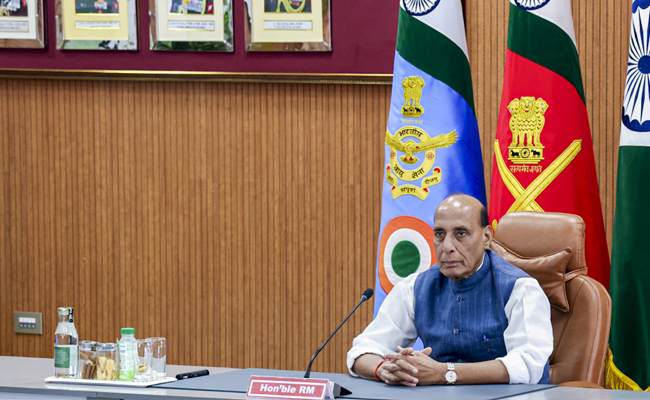
Jaipur/New Delhi (PTI): Defence Minister Rajnath Singh on Friday directed the top military commanders of the three services to integrate an "element of surprise" into modern warfare to outmaneuver India's adversaries and bolster strategic posture.
In his address at the joint commanders conference in Jaipur, Singh also described the Operation Sindoor as a testament to the "swift, precise, and joint response" of the Indian armed forces to safeguard national interests and called upon the military to remain ready to deal with any security challenges.
In their two-day deliberations, the commanders carried out a comprehensive review of the combat preparedness of the military in the wake of the evolving regional security situation.
Operation Sindoor was a demonstration of India's growing capabilities and a symbol of the nation's collective resolve and new military ethos, Singh said, a day after the first anniversary of Operation Sindoor.
He also unveiled a 'Joint Doctrine for Integrated Communication Architecture' that is aimed at strengthening doctrinal clarity, interoperability and integrated communications across the armed forces in future multidomain operations.
The joint commanders' conference, themed 'Military Capability in New Domains', brought together the top leadership of the defence ministry and the three services to deliberate on emerging security challenges and future readiness.
Comprehensive deliberations were held on future warfare, multidomain operations, technological transformation and joint capability development.
The conference witnessed extensive discussions on cognitive warfare, cyber resilience against evolving quantum and AI-enabled threats, military capability development in emerging domains, indigenous innovation and AI-enabled warfighting concepts.
It was attended by Chief of Defence Staff Gen Anil Chauhan, Chief of the Naval Staff Admiral Dinesh Kumar Tripathi, Chief of the Army Staff Gen Upendra Dwivedi, Chief of the Air Staff Air Chief Marshal AP Singh and Defence Secretary Rajesh Kumar Singh among others.
In his remarks, Singh asked the commanders to remain "future-ready" by learning from the operation as well as the current global security landscape.
He underscored the need to strengthen capabilities in artificial intelligence, autonomous systems, data analytics and secure communication networks to stay prepared in the rapidly evolving geopolitical security scenario. He emphasised that future conflicts will increasingly be shaped by hybrid threats, information dominance and operations conducted simultaneously across cyber, space, electromagnetic and cognitive domains, according to an official readout.
Highlighting the transformative impact of emerging technologies, Singh stressed on the importance of ensuring integrated national preparedness across all spectrums of conflict, it said.
Singh's remarks at the conference came a day after the first anniversary of Operation Sindoor.
The defence minister appreciated the progress achieved in enhancing jointness, integration and technological adoption across the three services, the readout noted.
Singh said that jointness constitutes a pivotal dimension within the transformative changes sweeping across the global defence sector.
"Future wars will not be won solely through weaponry, but through innovative thinking and enhanced synergy," he said.
The defence minister exhorted the commanders to cultivate the "element of surprise" to remain unpredictable to the nation's adversaries and secure a strategic edge in any given situation.
He, however, urged them to remain vigilant of the element of surprise of the enemy and always stay two steps ahead.
Singh also reiterated the Narendra Modi government's commitment to enhancing the capabilities of the defence forces through state-of-the-art weapons and platforms. He added that special focus is being laid on research in niche domains.
During the conference, he released a documentary film on Operation Sindoor.
The film reaffirms the nation's and defence forces' commitment to operational preparedness and decisive national response capabilities.
Demonstrations of advanced systems and platforms developed for intelligence fusion, operational planning and information management were also showcased during the conference reflecting growing integration of cutting-edge technologies into joint operational structures, according to the defence ministry.
The discussions will contribute significantly towards shaping India's future military transformation and integrated operational preparedness, it said.