5G will take education to next level: PM,says NEP will pull country out of English 'slave mentality'
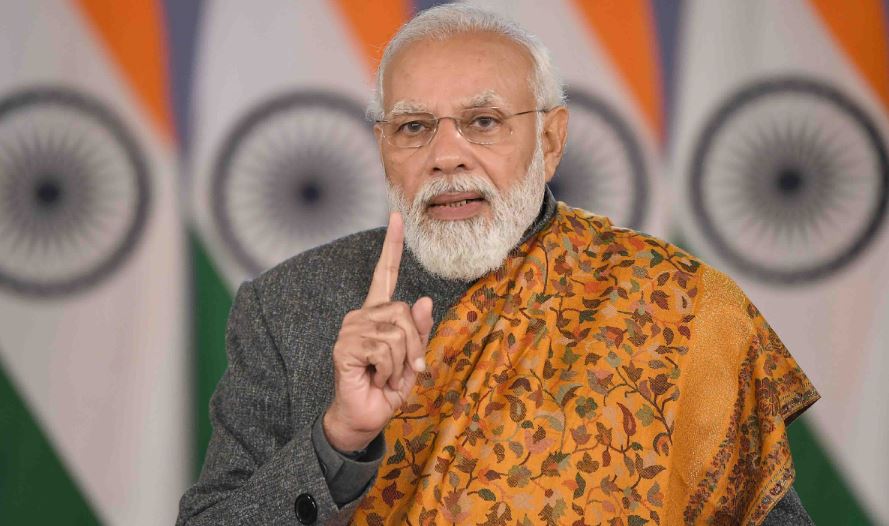
Adalaj, Oct 19: Prime Minister Narendra Modi on Wednesday said the 5G telecom service would take the education system in the country to the next level as the latest technology will go beyond "smart facilities, smart classrooms, and smart teachings".
He also asserted that the New Education Policy (NEP) will pull the country out of the "slave mentality" surrounding the English language.
The prime minister was speaking after launching the Gujarat government's Mission Schools of Excellence initiative at Adalaj town in Gandhinagar district.
He pointed out that knowledge of English was considered as the mark of being intellectual even though the English language is just a medium of communication.
The Mission will help strengthen education infrastructure in Gujarat by setting up new classrooms, smart classrooms, computer labs and overall upgradation of the infrastructure of schools in the state.
"Recently-launched 5G service will go beyond smart facilities, smart classrooms, and smart teachings. It will take our education system to the next level," the prime minister said.
He said students can now experience virtual reality, the Internet of Things, and other cutting-edge technologies in their schools with the help of the 5G service.
The PM also advocated the use of local languages to make sure that those uncomfortable with English are not left behind.
"Earlier, knowledge of the English language was considered a criterion of being intellectual. In reality, the English language is just a medium of communication. This language barrier was a hindrance. Many young talents from villages could not become doctors and engineers because they were not well-versed in English," he said.
The prime minister said youngsters now have the option to pursue studies in other languages.
"We aim to ensure that children of poor parents become doctors and engineers even if they are not educated in English (medium). We want to ensure that no one is left behind due to the lack of the English language," Modi said, adding the "New Education Policy of the Centre will pull the country out from this slave mentality surrounding the English language".
The prime minister said Gujarat has experienced a drastic change in the education scenario during the last two decades.
"During the last two decades, the Gujarat government has built 1.25 lakh new classrooms and inducted nearly 2 lakh teachers. Television sets were already installed in 15,000 classrooms a decade ago. Today, attendance of nearly one crore students and 4 lakh school teachers is being marked through online mode," said Modi, who had served as the chief minister of Gujarat before becoming the prime minister in 2014.
Under the Mission Schools of Excellence, the state government will build 50,000 new classrooms and convert nearly 1 lakh existing classrooms of government-run schools into smart classrooms using 5G technology, the prime minister said.
"Using this technology, a teacher can impart real-time education to several schools in villages through online mode. Now, the best education and content will reach everyone. Students of villages will be benefited the most because of this initiative." he said.
He said under the Mission, students will be prepared for competitive exams from a young age and also made aware of other subjects such as arts and robotics.
The PM recalled that as chief minister he had launched several schemes, such as 'Shala Praveshotsav' and 'Gunotsav'- a festival focussing on the quality of education- to improve the education scenario in Gujarat.
Ahead of his address, the prime minister interacted with some youngsters who he said were admitted to the first standard of school in his presence at a village in Gujarat many years ago during the 'Shala Praveshotsav', a state government initiative to increase the student enrollment.
Let the Truth be known. If you read VB and like VB, please be a VB Supporter and Help us deliver the Truth to one and all.
BCI urges CJI to take action against Andhra HC judge for sending young lawyer to 24-hour custody
New Delhi (PTI): The Bar Council of India on Wednesday sought the urgent intervention of Chief Justice of India Surya Kant following a "deeply disturbing" incident where a judge of the Andhra Pradesh High Court reportedly sent a young advocate to
24-hour judicial custody over a procedural lapse.
The Bar Council of India (BCI) Chairperson and senior advocate Manan Kumar Mishra, in a formal representation, termed the conduct of Justice Tarlada Rajasekhar Rao "grossly inappropriate" and "damaging to the confidence of the Bar".
“I most respectfully request your Lordship to kindly take immediate institutional cognizance of the matter and call for the video recording of the proceedings, the order passed, and the surrounding circumstances.
“I further request that appropriate administrative action may kindly be considered, including withdrawal of judicial work from the learned Judge pending review, his immediate transfer to some far off High Court, and his nomination for appropriate judicial training/orientation on court management, judicial temperament, Bar-Bench relations, and proportional exercise of contempt/judicial authority,” Mishra wrote.
This representation is made to preserve the “dignity, moral authority and public confidence of the judiciary”, he said, adding, “Judges command the highest respect not by fear, but by fairness, patience, restraint and constitutional humility”.
The communication urged the CJI to intervene at the earliest to ensure that the faith of Bar, particularly young advocates, in the protective and corrective role of the judiciary is restored.
The controversy stems from proceedings on May 5.
According to the BCI, a video circulating online shows Justice Rao rebuking a young advocate who was unable to produce a specific order copy during a hearing.
The letter said that despite the advocate "repeatedly seeking pardon and mercy" and claiming he was in physical pain, the judge remained "unmoved".
The judge allegedly told the lawyer, "now you will learn," and mocked his experience before directing the Registrar and police personnel to take him into custody for 24 hours.
The BCI chairperson said that the judge’s actions lacked proportionality and fairness.
"The dignity of the court is not enhanced when a lawyer is made to beg for grace in open court and is still sent to custody for a procedural lapse," the letter said.
"A young lawyer... is an officer of the Court, still learning, still growing, and entitled to correction without humiliation," it added.
The bar body said that such actions create a "chilling effect" on the legal fraternity, particularly among junior members, and undermine the mutual respect required between the Bench and the Bar.