76% citizens want death penalty for rapists: Survey
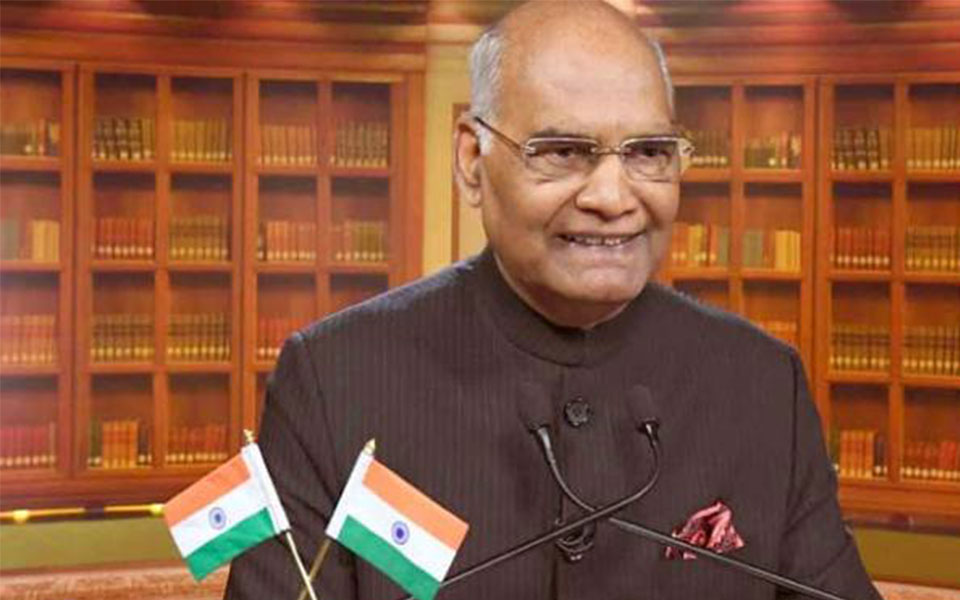
New Delhi, April 23: A day after President Ram Nath Kovind gave his nod to an ordinance on death penalty for rapists who attack children, a citizen survey shows that 76 per cent of the people agree with it.
According to the survey conducted by Local Circles, 18 per cent voted for life imprisonment without parole for convicted rapists while three per cent said it should be a seven-year jail term (which is the current law).
To catch the citizens' pulse on the Protection of Children from Sexual Offences (POCSO) Act, LocalCircles conducted six nation-wide polls which received more than 40,000 votes.
In the second poll, 89 per cent agreed that they want their states to pass a law that awards death penalty within six months. Madhya Pradesh, Rajasthan, Haryana and Arunachal Pradesh have also passed a law that awards death penalty for child rape.
In another poll, which was about engaging more women officers to register cases of sexual assault, it was found that 78 per cent citizens were in support of every district level police station to have at least one woman officer.
For the fourth poll, on maximum time taken by the police to file a charge sheet in cases of child rape, only 28 per cent said it should be done within 30 days, while 25 per cent said 45 days.
In the fifth poll, it was found that 65 per cent want POCSO judges to only handle cases which are related to child sexual abuse.
The final poll on the maximum time taken for justice in cases of child rape under POCSO act, 85 per cent citizens said it should be within six months.
Let the Truth be known. If you read VB and like VB, please be a VB Supporter and Help us deliver the Truth to one and all.
Govt in talks with social media platforms on age-based restrictions, issue of deepfakes: Vaishnaw
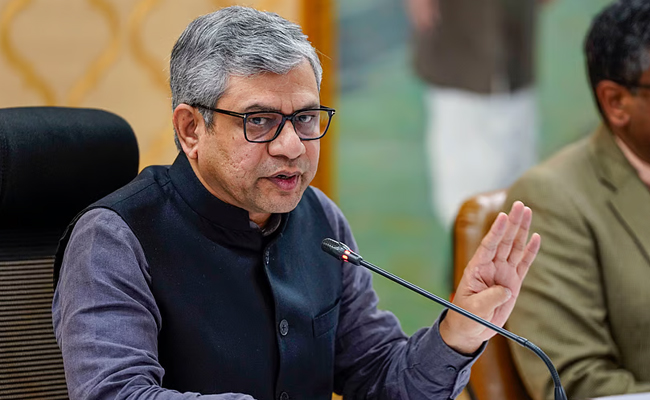
New Delhi (PTI): The government is discussing issues of age-based restriction as well as deepfakes with social media platforms to determine the way forward, Union IT Minister Ashwini Vaishnaw said on Tuesday as he advocated the need for stronger regulations to protect children, and safeguard society at large from user harms.
The minister emphasised that any company -- be it Netflix, YouTube, Meta, or X -- must abide by the legal framework and the Constitution of India. He noted that the problem of deepfakes is growing day by day and asserted that stronger regulation is needed.
The minister said discussions are underway with social media platforms on tackling deepfakes and age-based restrictions to determine the most appropriate way forward on the issue.
"... and right now, we are in conversation regarding deepfakes, regarding age-based restrictions with the various social media platforms, and what is the right way, what is the right way to go," the minister said during a briefing at the India AI Impact Summit.
He called for stronger regulations on deepfakes.
"I think we need a much stronger regulation on deepfakes. It is a problem growing day-by-day. Certainly there is a need for protecting our children and our society from these harms... we have initiated a dialogue with industry on what kind of regulation will be needed beyond what we already have," Vaishnaw, who is also the Minister for Information and Broadcasting, said.
The parliamentary committee, too, has studied the issue in depth, he pointed out.
"We need much stronger regulations on deepfakes and we must definitely create that consensus within Parliament for creating those significantly stronger restriction on deepfakes so society can be protected from these harms," the minister said.
He further pointed out that many countries have accepted the need for age-based restrictions.
"...this is something that has been accepted by many countries, that age-based regulation has to be there. It was part of our DPDP (Digital Personal Data Protection legislation)... when we created this age-based differentiation on the content which is accessible to students and to young people. So that time itself, we took that forward-looking step," he said.
Countries, including Australia, France and the United Kingdom, have either introduced or proposed age restrictions and stricter parental consent rules to limit children's access to social media platforms and enhance online safety safeguards.
Last month, Indian government's Economic Survey said age-based access to online platforms should be considered while also cutting down online teaching to avoid digital addiction.
The Survey, tabled in Parliament, had said online platforms should be made responsible for enforcing age verification, and simpler devices should be promoted for children to access educational content with safeguards to address the rising problem of digital addiction.
"Policies on age-based access limits may be considered, as younger users are more vulnerable to compulsive use and harmful content. Platforms should be made responsible for enforcing age verification and age-appropriate defaults, particularly for social media, gambling apps, auto-play features, and targeted advertising," the Survey had said.
Vaishnaw on Tuesday also highlighted that it is crucial for multinational companies to understand the cultural context of the countries in which they operate, noting that practices considered normal in one country could be prohibited in another, and vice versa. He added that while most companies strive to be sensitive to local contexts, there is always a learning curve in that journey.
He said that copyright is a complex matter, particularly as most AI models are trained on content available in the public domain. The minister stressed that content creators, especially news creators, must receive "fair remuneration" for the material they create, adding that this is government's firm belief and public policy too should be oriented towards that.
Vaishnaw further informed that discussions are underway with major platforms, many of which have shown an inclination to establish mechanisms to ensure fair remuneration for content creators, especially news creators who are part of conventional media.
He emphasised the need for fair revenue distribution when conventional media content is used by digital platforms, and said the government remains in continuous dialogue with big tech companies on the matter.
"We believe that there has to be a fair distribution of the revenue which comes out of the big efforts that the conventional media teams put. We believe in that, and we are constantly in dialogue with the big platforms on that," Vaishnaw said.