80% of Mumbai's Nariman point, Mantralaya areas will go under water by 2050, predicts civic chief
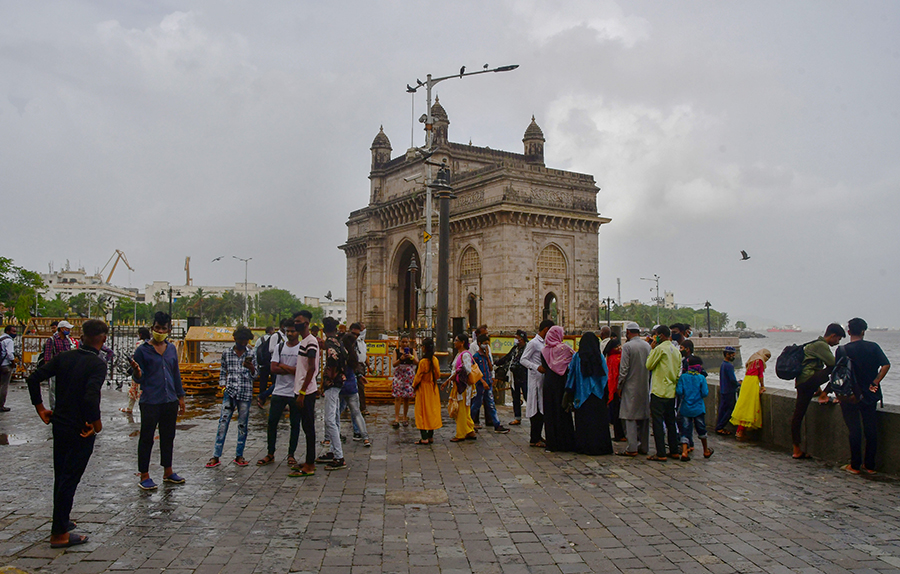
Mumbai, Aug 28: Mumbai municipal commissioner Iqbal Singh Chahal has made a sinister prediction for the city, saying that by 2050, a major portion of south Mumbai, including the business district of Nariman Point and state secretariat Mantralaya, will go under water due to the rising sea level.
Speaking at the launch of Mumbai Climate Action Plan and its website at the hands of Maharashtra Environment and Tourism Minister Aaditya Thackeray on Friday, Chahal said about 70 per cent of the city's A, B, C and D wards in south Mumbai will be under water due to climate change.
He said that nature has been giving warnings, but if people do not "wake up" then the situation would turn "dangerous".
"Eighty per cent of the areas like Cuffe Parade, Nariman Point and Mantralaya will be under water...Means going to disappear," he said.
The civic chief also said that it is a matter of just 25-30 years as 2050 is not too far.
"We are getting warnings from nature and if we do not wake up, it will be a dangerous situation for the next 25 years. And it will not only be the next generation but the current generation will also suffer," Chahal warned.
He said that Mumbai is the first city in South Asia that is preparing its climate action plan and acting on it.
"Earlier, we used to hear about climate change events like melting glaciers, but not directly affecting us. But now it has come to our doorstep," he added.
Chahal said that last year for the first time in 129 years, a cyclone (Nisarga) hit Mumbai and thereafter in the last 15 months, there have been three cyclones. After that, on August 5, 2020, about 5 to 5.5 feet water was accumulated at Nariman point.
"There was no cyclone warning that day, but considering the parameters, it was a cyclone," Chahal said.
Highlighting that the city has witnessed some extreme weather condictions recently, he said that the city faced Tauktae cyclone in Mumbai and witnessed 214 mm rain on May 17, though monsoon arrives here on June 6 or 7.
Before June 9, Mumbai recorded 84 per cent of the June rainfall and in July, 70 per cent of month's average rainfall was received in just four days from July 17 to 20, he said.
Under the Mumbai Climate Action Plan (MCAP), the data assessment has identified areas and communities most vulnerable given increasing climate uncertainty, the Brihanmumbai Municipal Corporation (BMC) said in a release.
Data from across BMC's 37 automatic weather stations (AWS) over the past 10 years suggests that on an average, Mumbai has seen six heavy, five very heavy, and four extremely heavy rainfall days per year. And for all the rainfall that occurs during the monsoon season in Mumbai, each year, approximately 10 per cent falls under the heavy category, nine per cent very heavy, and six per cent extremely heavy.
According to the India Meteorological Department's (IMD) classification, daily rainfall from 64.5 mm to 115.5 mm is considered 'heavy', 115.6 mm to 204.4mm 'very heavy' and more than 204.5mm is 'extreme'.
"The four-year period between 2017 and 2020 has seen a steady increase in the extremely heavy rainfall events. This indicates that the frequency of such extreme weather events is increasing for the city of Mumbai especially over the past four years," said Lubaina Rangwala, Associate Director, WRI India Ross Center for Sustainable Cities.
Let the Truth be known. If you read VB and like VB, please be a VB Supporter and Help us deliver the Truth to one and all.
Vijay secures majority support, set to stake claim to form Tamil Nadu govt
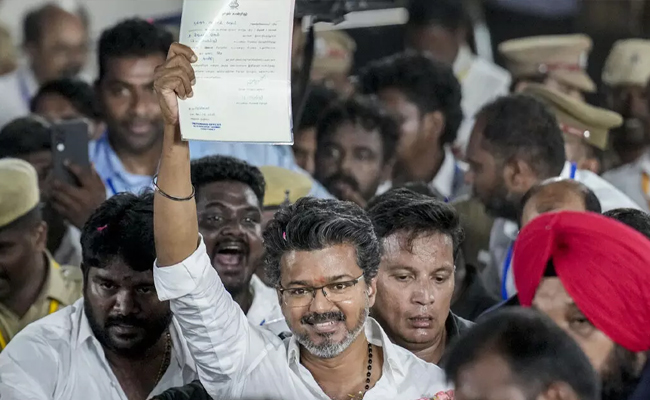
Chennai: After four days of political uncertainty and intense negotiations in Tamil Nadu, actor-politician Vijay is learnt to have secured the numbers required to form the government, sources said.
Supporters gathered outside Vijay’s residence in Chennai on Friday evening, raising slogans in support of Tamilaga Vettri Kazhagam soon after reports emerged that the party had managed to secure majority support.
Sources said Vijay is expected to meet Tamil Nadu Governor R. V. Arlekar on Friday evening to stake claim to form the government. The meeting is likely to take place around 6 pm.
In its electoral debut in the Tamil Nadu Assembly elections, TVK won 108 out of the 234 seats, dealing a major blow to the 62-year political dominance of Dravida Munnetra Kazhagam and All India Anna Dravida Munnetra Kazhagam.
However, Governor Arlekar had reportedly made it clear that the party would not be invited to form the government without proving a clear majority. Even after two rounds of discussions on Wednesday and Thursday, the Governor is learnt to have maintained his stand that letters of support from at least 118 MLAs must be submitted in the 234-member Assembly.
Apart from Vijay, TVK had the backing of 107 MLAs. Vijay had contested from Tiruchy (East) and Perambur constituencies and won both seats, meaning he would have to resign from one seat before taking oath. This increased the need for additional support.
Amid the political developments, five MLAs from the Congress party, which reportedly moved away from the DMK-led alliance, extended support to Vijay. Vijay also held discussions with leaders of Viduthalai Chiruthaigal Katchi, Communist Party of India (Marxist) and Communist Party of India.
The VCK, CPI(M) and CPI had so far been allies of the DMK. At the same time, political discussions intensified in the state over speculation that the DMK could even explore a post-poll understanding with its long-time rival AIADMK to prevent an alternative government from taking shape.
Reports had been circulating since Friday afternoon that the VCK and Left parties were likely to support Vijay. Sources later said that the VCK, CPI(M) and CPI agreed to extend the support of two MLAs each, helping TVK cross the required majority mark.
All eyes are now on the Governor’s next move and the official announcement regarding the formation of the new government in Tamil Nadu.