A road that sings Jai Ho! India gets first 'musical road' on Mumbai Coastal Road corridor
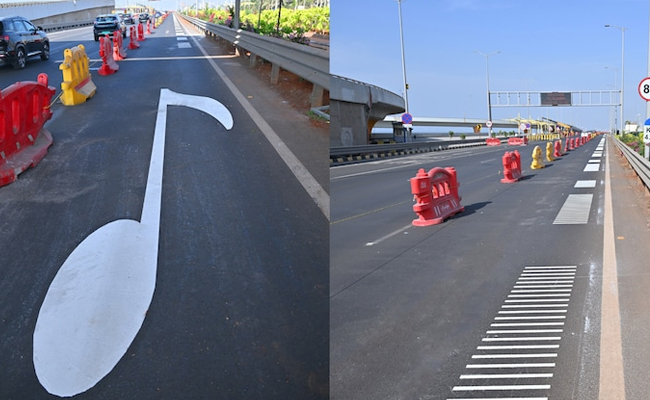
Mumbai (PTI): Motorists travelling on the Mumbai Coastal Road corridor will now hear the iconic Bollywood song "Jai Ho" when driving over specially installed grooves at a designated speed, making it India's first 'musical' or 'melody' road.
Chief Minister Devendra Fadnavis inaugurated the musical road stretch on Wednesday.
Deputy Chief Minister Eknath Shinde, former Shiv Sena MP Rahul Shewale, who conceptualised the idea, Hungary's Consul General Faren Jari, BMC's Additional Municipal Commissioner (Eastern Suburbs) Dr Avinash Dhakne, and other dignitaries were present at the event.
Fadnavis said the concept of a musical road developed along the Coastal Road is set to provide a delightful experience for motorists.
He added that the innovative concept, based on Hungarian technology, would be implemented further in the future.
"In the first phase, the concept has been implemented on a 500-metre stretch of the Coastal Road, and there are plans to expand the musical road concept further," Fadnavis said.
Shinde appealed to Mumbaikars to experience and enjoy the musical road.
He said the government will consider replicating this experiment on the Samruddhi Expressway on a pilot basis.
"The musical road on the Mumbai Coastal Road will evoke a sense of patriotism among Mumbaikars," Shinde said, reiterating that this is India's first musical road.
The Brihanmumbai Municipal Corporation (BMC) has developed the innovative stretch on the northbound carriageway from Nariman Point towards Worli on the iconic Coastal Road, which has been named after Dharmaveer Swarajyarakshak Chhatrapati Sambhaji Maharaj.
This is the fifth such road in the world and the first of its kind in India, the BMC stated.
According to civic officials, the musical strips have been installed around 500 metres ahead on the first lane adjoining the divider after vehicles exit the Worli-bound underground tunnel.
When vehicles travel over the grooves at 70 to 80 kmph, the friction-generated sound waves produce the melody of 'Jai Ho' from the film Slumdog Millionaire, which can be clearly heard inside the vehicle.
The chartbuster song was composed by A.R. Rahman, with lyrics written by the renowned poet Gulzar. The song won the Academy Award for Best Original Song and a Grammy Award.
Officials said signboards have been placed inside the tunnel at 500 metres, 100 metres, and 60 metres before the stretch to alert motorists about the upcoming musical road and the required speed for the experience.
In a release issued a day earlier, the BMC said grooves or rumble strips of specific dimensions and spacing have been embedded in the road surface.
When vehicles pass over them at a constant speed, the vibrations caused by tyres create musical notes, forming a recognisable tune. Such stretches are popularly known as 'melody roads' or 'musical roads'.
Hailing the project as a blend of engineering innovation and cultural expression, the BMC stated that the Coastal Road, a key infrastructure project aimed at easing traffic congestion and enabling faster travel, now also offers a unique driving experience.
The concept of musical roads was first developed in Japan in 2007 by engineer Shizuo Shinoda. Similar experiments have since been implemented in countries such as Hungary, Japan, South Korea and the United Arab Emirates.
Let the Truth be known. If you read VB and like VB, please be a VB Supporter and Help us deliver the Truth to one and all.
Rickelton's ton in vain as SRH beat MI by 6 wickets

Mumbai (PTI): Ryan Rickelton's whirlwind unbeaten ton was overshadowed by Heinrich Klaasen's unbeaten 65 as Sunrisers Hyderabad defeated Mumbai Indians by six wickets in an IPL match here on Wednesday.
Chasing an imposing 244-run target, Travis Head (76 off 30) and Abhishek Sharma (45 off 24) shared 129 runs for the opening wicket to set the platform for SRH.
Klaasen (65 not out off 30 balls) then displayed his all-round hitting abilities to guide SRH home with the help of Nitish Kumar Reddy (21) and Salil Arora (30 not out off 10) in 18.4 overs.
Earlier, Rickelton's knock powered MI to 243 for five.
MI rode on a 93-run stand between Rickelton (123 not out off 55 balls) and Will Jacks (46 off 22) in 7.1 overs for the opening stand to power the side.
MI skipper Hardik Pandya scored a valuable 31 off 15 balls before being dismissed.
Praful Hinge (2/54), Eshan Malinga (1/29), Sakib Hasan (1/39) and Nitish Kumar Reddy (1/31) were the wicket-takers for SRH.
Brief Scores:
Mumbai Indian: 243 for 5 in 20 overs (Ryan Rickelton 123 not out; Praful Hinge 2/54).
Sunrisers Hyderabad: 249 for 4 in 18.4 overs (Travis Head 76, Heinrich Klaasen 65 not out; AM Ghazanfar 2/51).