Active Covid cases in India cross 6,000-mark

New Delhi (PTI): India's active Covid case tally crossed the 6,000 mark with 769 new infections being reported in the last 48 hours, according to the Union health ministry data released on Sunday.
Kerala continues to be the most affected state, followed by Gujarat, West Bengal and Delhi, according to the ministry.
Due to the rising Covid cases, the Centre is conducting mock drills to check facility-level preparedness and has instructed all states to ensure availability of oxygen, isolation beds, ventilators, and essential medicines, official sources had said.
There are 6,133 active Covid cases in India, and six more deaths have been reported in the last 24 hours, the ministry said. Official sources have maintained that most cases are mild and managed under home care.
Since January this year, 65 deaths have been reported in the country. There were a total of 257 active patients in the country on May 22.
A series of technical review meetings were held on June 2 and 3 under the chairpersonship of Dr Sunita Sharma, Director General of Health Services, to evaluate the Covid situation and preparedness measures.
Representatives from the Disaster Management Cell, Emergency Management Response Cell, National Centre for Disease Control, Indian Council of Medical Research, Integrated Disease Surveillance Programme, central government hospitals in Delhi, and all states and Union Territories were part of the meeting.
Official sources on June 4 said state and district surveillance units under the Integrated Disease Surveillance Programme are closely monitoring Influenza-Like Illness (ILI) and Severe Acute Respiratory Illness (SARI).
"Testing is recommended for all admitted SARI cases and 5 per cent of ILI cases as per guidelines, and positive SARI samples are sent for Whole Genome Sequencing through the ICMR VRDL network, " an official source said.
Let the Truth be known. If you read VB and like VB, please be a VB Supporter and Help us deliver the Truth to one and all.
Indian startup's 'Drishti' satellite launched aboard SpaceX rocket
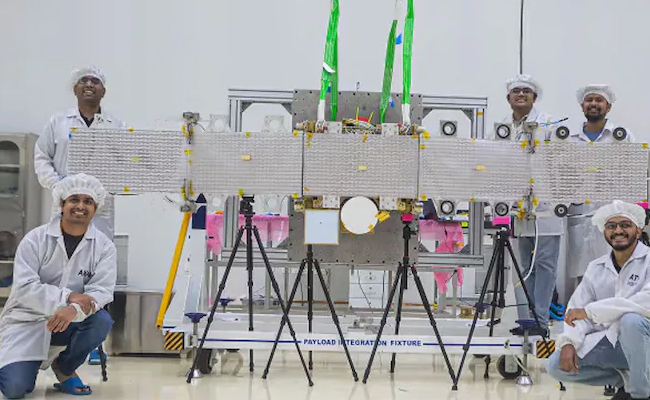
New Delhi (PTI): Bengaluru-based space start-up GalaxEye's Mission Drishti satellite was launched on Sunday aboard SpaceX's Falcon 9 rocket from California.
Mission Drishti is the world's first OptoSAR satellite, integrating electro-optical (EO) and synthetic aperture radar (SAR) sensors into a single operational platform, according to the company.
While EO sensors capture high-resolution images during sunlight and clear skies, SAR sensors provide all-weather and all-time images, using radar pulses.
In a statement, Suyash Singh, founder and CEO of GalaxEye, said, "With the satellite (Mission Drishti) now successfully in orbit, our immediate focus is on completing its commissioning. As we move through this phase, we are already witnessing strong global interest in the differentiated datasets enabled by our OptoSAR payload."
The satellite will help address long-standing limitations of conventional systems and enable more reliable and consistent data acquisition across diverse environmental conditions, the company said.
As a dual-use Earth observation satellite, the mission will support use cases across defence, agriculture, disaster management, maritime monitoring, and infrastructure planning.
The satellite is also expected to complement India's broader initiatives, including the 29 active Earth Observation satellites outlined in ISRO's recent annual report.
The launch came after five years of indigenous research and development, and extensive environmental testing and performance validation of the Mission Drishti.
In a statement, Lt Gen AK Bhatt (Retd), director general of Indian Space Association (ISpA), said, "GalaxEye has achieved what only a few global players have, which is seamlessly combining optical and SAR capabilities on a single platform to enable persistent, all-weather intelligence."
What stands out is not just the technology, but its broader impact on how downstream applications will increasingly define value in the space economy, particularly in Earth observation, where timely, decision-grade insights are critical," he added.
ISpA is the premier industry association of space and satellite companies in the country.
Union Minister Jitendra Singh also took note of the Mission Drishti launch, saying the development marked a significant milestone in India's space journey.
In a post on X, the minister said, "The successful launch of the world's first OptoSAR satellite, and the largest privately-built satellite in the country, reflects the immense potential of our young innovators driving nation-building."
GalaxEye aims to scale up Mission Drishti to a constellation of 10 satellites by 2030, developing a robust and sovereign Earth observation infrastructure for India.