Activist Gautam Navlakha withdraws from SC plea seeking transfer to Delhi from Mumbai
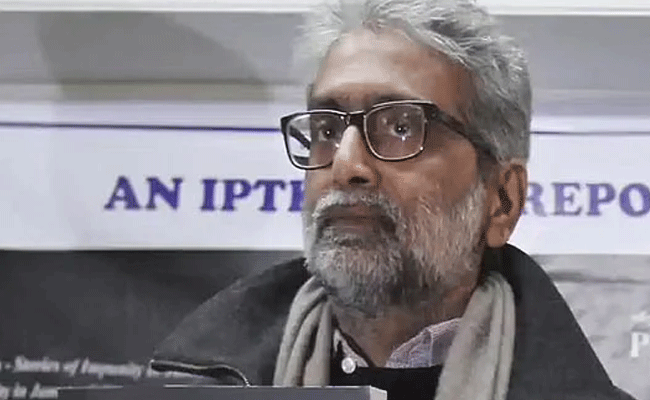
New Delhi (PTI): Social activist Gautam Navlakha, accused of having links to Maoists and Pakistan's spy agency ISI, on Friday withdrew from the Supreme Court his application seeking to be shifted to Delhi from Mumbai under house arrest.
Navlakha is under house arrest in Mumbai in connection with the Elgar Parishad-Maoist link case.
On November 10 last year, the 70-year-old was allowed by the apex court to be placed under house arrest owing to his deteriorating health.
His application, seeking to be shifted to Delhi, came up for hearing on Friday before a bench of Justices K M Joseph and B V Nagarathna.
Solicitor General Tushar Mehta opposed Navlakha's application.
Senior advocate Nitya Ramakrishnan, appearing for the activist, told the bench that Navlakha will look for some other place to stay in Mumbai. She said she would withdraw the application.
"Dismissed as withdrawn," the bench said.
Trashing NIA's apprehensions, the top court had on November 18 last year ordered that Navlakha be placed under house arrest "without fail" within 24 hours.
The bench, however, had ordered some additional security measures to be put in place at the building where Navlakha was to be kept under house arrest.
Prior to that, on November 15 last year, the apex court had cleared the hurdle for his release from Navi Mumbai's Taloja prison, where he was lodged in the Elgar Parishad-Maoist link case, by waiving the requirement of a solvency certificate for availing the benefit of house arrest.
Noting that the activist was in custody since April 14, 2020 and prima facie there was no reason to reject his medical report, the apex court had on November 10, 2022 said Navlakha does not have any criminal background except for this case and even the Government of India had appointed him as an interlocutor to hold talks with Maoists.
Putting a number of conditions, including a deposit of Rs 2.4 lakh as expenses towards providing him security, the top court had said the order to place the activist under house arrest for a month in Mumbai should be implemented within 48 hours.
The case relates to alleged inflammatory speeches made at the Elgar Parishad conclave held in Pune on December 31, 2017 which the police claim triggered violence the next day near the Koregaon-Bhima war memorial on the outskirts of the western Maharashtra city.
Let the Truth be known. If you read VB and like VB, please be a VB Supporter and Help us deliver the Truth to one and all.
Case registered over social media posts 'threatening' Kerala CM’s security officer
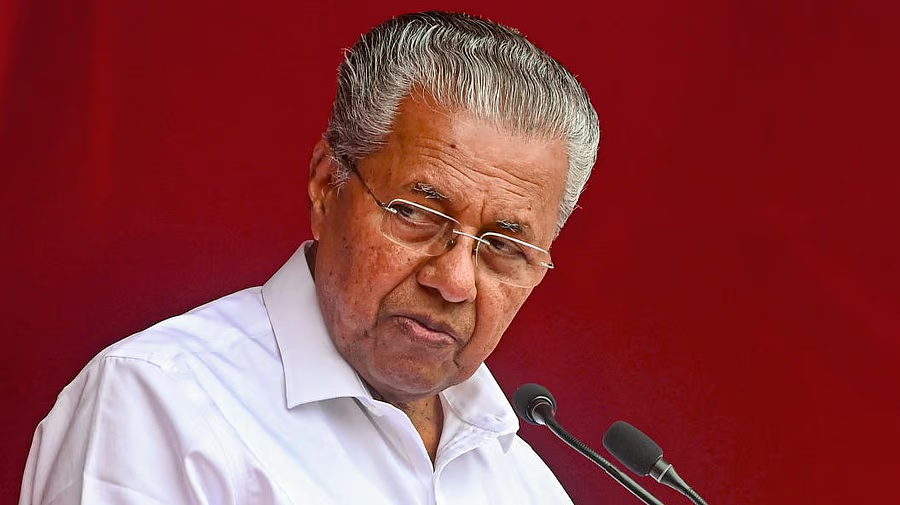
Thiruvananthapuram (PTI): A case has been registered and a probe launched into social media posts allegedly threatening a member of Chief Minister Pinarayi Vijayan’s security team with consequences once the UDF comes to power, officials said on Sunday.
The Thiruvananthapuram City Cyber Police registered the case based on a complaint filed by Chief Minister’s security staff member Sandeep Sasidharan.
The Congress had earlier alleged that Sandeep and another officer, Anil Kumar, brutally assaulted two Youth Congress-KSU activists including using flower pot when they protested against the Chief Minister during the Navakerala Sadas programme in Alappuzha in 2023.
A subsequent probe was conducted against both officers, and the Crime Branch later gave them a clean chit.
Recently, following the conclusion of the state assembly election on April 9, several social media posts allegedly made by Congress, Youth Congress and KSU activists claimed that revenge would be taken once the LDF government is removed and the UDF comes to power.
Police said cases have been registered against Facebook accounts named Arun Rajendran, Tom Kuriakose, Yaser KP, Sony Panamthanam, Sarath Pillai, KSU Kanjiramkulam, Rahul John C and Youth Congress Battle.
According to the FIR, the complainant’s photograph and name were used in several social media posts threatening him with consequences and containing abusive language.
Police said the social media account holders have been identified and will soon be summoned as part of the investigation.
The case has been registered under Sections 296(b) (uttering obscene words causing public annoyance), 351(2) (criminal intimidation), and 3(5) (acts done by several persons) of the Bharatiya Nyaya Sanhita.