Actor Deep Sidhu says did not remove tricolour, it was only a 'symbolic protest'
Amid outrage over flag incident
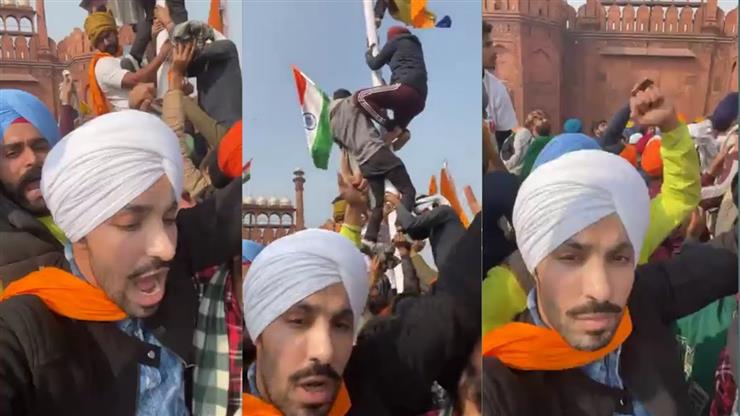
Chandigarh, Jan 26: Amid a massive outrage over protesters hoisting a religious flag at the Red Fort during the tractor rally on Republic Day, actor Deep Sidhu, who was present during the incident, sought to defend their action, saying they did not remove the national flag and had put up the 'Nishan Sahib' as a symbolic protest.
The 'Nishan Sahib' flag, a symbol of Sikh religion, is seen at all Gurdwara complexes.
In a video posted on Facebook on Tuesday evening, Sidhu claimed it was not a planned move and that they should not be given any communal colour or dubbed as fundamentalists or hardliners.
To symbolically register our protest against the new farm legislation, we put up 'Nishan Sahib' and a farmer flag and also raised the slogan of Kisan Mazdoor Ekta, said Sidhu.
The flag represents the country's unity in diversity , he said while pointing towards 'Nishan Sahib', the triangular saffron flag with the emblem of 'Khanda', a two-edged sword, Chakra, a disc, and two Kirpans that cross each other at the handles.
He stated that the national flag was not removed from the flagpole at the Red Fort and that nobody raised a question over the country's unity and integrity.
Leaders across the political spectrum condemned the violence and the Red Fort incident, with the Congress' Shashi Tharoor saying he supported the farmers' protests from the start but cannot condone "lawlessness".
"Most unfortunate. I have supported the farmers' protests from the start but I cannot condone lawlessness. And on #RepublicDay no flag but the sacred tiranga should fly aloft the Red Fort," the former union minister said on Twitter, tagging a tweet that carried a video of the incident.
Sidhu, who has been associated with the farmers' agitation for the last many months, said "anger flares up" in a mass movement like this when the genuine rights of people are ignored.
In today's situation, that anger flared up, he said.
Sidhu was an aide of actor Sunny Deol when the latter contested from Gurdaspur seat in Punjab during 2019 Lok Sabha elections. Deol, now a BJP MP, had distanced himself from Sidhu in December last year after he joined the farmers' agitation.
Swaraj Abhyan leader Yogendra Yadav, who is among the leaders spearheading the agitation against the farm laws, said Sidhu had been disassociated "from our protest right from the beginning".
"When he participated in a protest at Shambu border and seeing their activities, the farmer unions had decided to keep them away from our movement," he said.
The Samkyukt Kisan Morcha, an umbrella body of 41 farmer unions that is leading the protest against the three central farm laws, also disassociated itself from those who indulged in violence during the tractor parade and alleged that some "antisocial elements" infiltrated their otherwise peaceful movement.
Sidhu, however, said that Tuesday's incident should not be seen in isolation as they have been holding their protest for the last six to seven months.
And it (today's incident) was a continuation of that, he said.
Sidhu said the protesters did not go to Delhi to hurt anyone or damage public property, nor they had any weapon.
We held a peaceful protest without destroying anything or causing any damage to the public property we exercised our democratic right peacefully, he claimed, adding, If we think one person or a personality could do such a big mobilisation of people, then it will be wrong.
Wielding sticks and clubs and holding the tricolour and union flags, tens of thousands of farmers atop tractors broke barriers, clashed with police and entered the city from various points to lay siege to the Red Fort.
Over 80 police personnel have been injured in the violence.
Senior lawyer and activist Prashant Bhushan has tweeted on his microblogging site twitter as
This is Deep Sidhu with Modi & Shah. He led the mob at Red Fort today & unfurled the Sikh religious flag there pic.twitter.com/dX9bQjAIim
— Prashant Bhushan (@pbhushan1) January 26, 2021
Farmers, mostly from Punjab, Haryana and western Uttar Pradesh, have been camping at several Delhi border points, including Tikri, Singhu and Ghazipur, since November 28, demanding a complete repeal of three farm laws and a legal guarantee on minimum support price for their crops.
Let the Truth be known. If you read VB and like VB, please be a VB Supporter and Help us deliver the Truth to one and all.
Lungi Ngidi fit to play against CSK
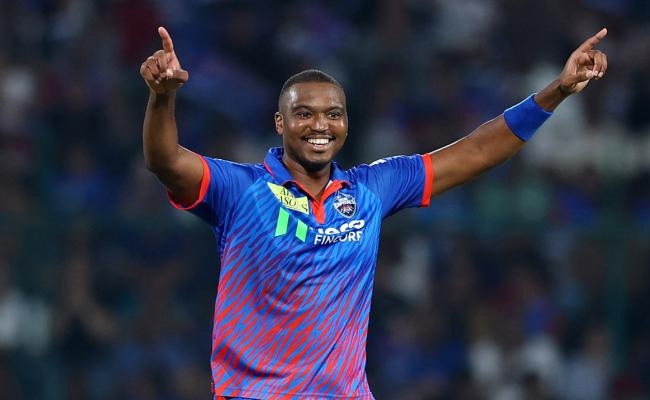
New Delhi (PTI): Delhi Capitals bowling coach Munaf Patel on Monday said Lungi Ngidi is set to return to action after recovering from the head injury he suffered in a home game against Punjab Kings on April 25.
Ngidi was stretchered off the field and rushed to a hospital after falling on his head while attempting a catch. The injury led to the South African pacer missing two games.
"Everyone is fit. Lungi is fit. He didn't play two games because of the criterion of six days' rest," said Munaf ahead of the game against Chennai Super Kings.
The bowling attack will be bolstered with the return of Ngidi. Mitchell Starc has also joined the team and made an instant impact in his first appearance of the season against Rajasthan Royals.
Against Punjab Kings, Delhi Capitals were not able to defend 264 conceding a record run chase.
Starc's presence is bound to make a difference, said Munaf.
"When there is a wicket-taking bowler in the PowerPlay, the whole scenario changes. 220 or 230 is being chased because you are not able to take wickets in the PowerPlay.
"When the main bowler is there and takes a few wickets in the PowerPlay, it makes a big difference. Bowling in partnerships was missing, but that has been added now," said Munaf.
On David Miller missing out from the playing eleven in the last game, Munaf added: "You can only fit in four foreigners in the XI. Sahil was injured, so we needed an opener and we thought of giving Pathum another chance. We had to play two overseas fast bowlers. So only one between Pathum and Miller could play. We went with Pathum because an opener was required."