Acts preceding actual partial penetration without ejaculation is attempt to rape: Chhattisgarh HC

Bilaspur (PTI): Noting that the act of the convict preceded the actual partial penetration but without ejaculation, the Chhattisgarh High Court has reduced the seven-year sentence awarded by a trial court to a man in a 2004 rape case and convicted him for attempted rape instead.
Partially accepting the accused's appeal, the High Court has reduced the convict's sentence to three years and six months' rigorous imprisonment. A fine of Rs 200 was imposed.
"The proof of penetration, even if partial, is necessary to prove rape. The evidence available in the present case does not prove complete rape, but it does prove that the accused attempted rape. The evidence available in the present case does not prove complete rape, but it does prove that the accused attempted rape," Justice Narendra Kumar Vyas stated in the order on February 16.
Additional Sessions Judge, Dhamtari (Camp-Raipur), had convicted Vasudeo Gond on April 6, 2005, under section 376(1) of the Indian Penal Code (IPC) and sentenced him to seven years’ rigorous imprisonment.
He was also sentenced to six months’ rigorous imprisonment under Section 342 IPC. Both sentences were to run concurrently.
Gond had lured the victim, a resident of Dhamtari district, to his house on May 21, 2004, under some pretext, and raped her.
He locked her in a room and tied her hands and feet. A case was registered at the Arjuni police station.
The prosecution examined 19 witnesses during the trial.
In her statement, the victim had claimed forced sexual intercourse by the accused. However, during cross-examination, she gave contradictory statements regarding penetration.
Medical examination revealed an intact hymen, but the possibility of partial penetration was raised. The FSL report also found human sperm in some samples.
The High Court noted that the victim's statement lacked clarity regarding penetration. The medical evidence also failed to establish complete penetration. Citing various Supreme Court decisions, the single-judge bench stated that proof of penetration, even if partial, is necessary to prove rape.
"The evidence of the victim is corroborated with the medical evidence brought on record by the prosecution and law on the subject. It is quite vivid that an offence of attempt to commit rape is made out against the appellant, as there is partial penetration by the appellant.
"As such, the act of the appellant forcibly taking the victim inside the room, closing the doors with the motive of carnal knowledge, was the end of ‘preparation’ to commit the offence. His following action of stripping the victim and himself, and rubbing his genitals against those of the victims and partial penetration, which was indeed an endeavour to commit sexual intercourse," the HC stated.
It said the acts of the appellant were deliberately done with manifest intention to commit the offence aimed at and were reasonably proximate to the consummation of the offence.
"Since the acts of the appellant exceeded the stage beyond preparation and preceded the actual partial penetration but without ejaculation, the appellant is guilty of attempting to commit rape as punishable within the ambit and scope of Section 511 read with Section 375 IPC as it stood in force at the time of occurrence," the HC stated.
The HC convicted Gond under sections 376 (1) and 511 of the IPC, instead of section 376, and sentenced him to three years and six months' rigorous imprisonment. The six-month sentence under Section 342 was upheld. Both sentences will run concurrently.
The bench ordered that the sentence already undergone by the accused be set off.
It cancelled the bail of the accused and directed him to surrender before the trial court within two months, failing which action for his arrest would be initiated.
Let the Truth be known. If you read VB and like VB, please be a VB Supporter and Help us deliver the Truth to one and all.
Karnataka School Edu Dept prohibits children from being made to dance to obscene songs
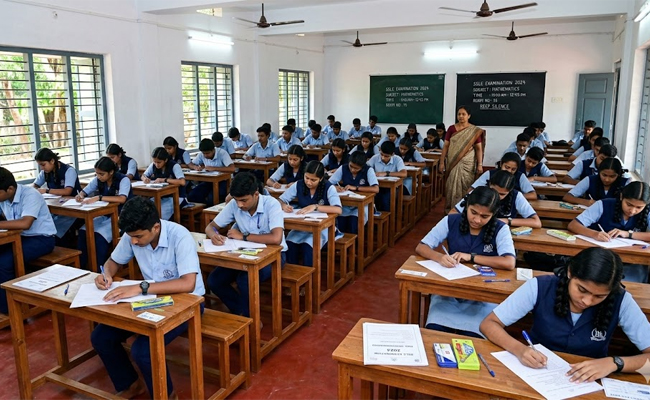
Bengaluru (PTI): The Karnataka School Education Department has issued a circular strictly prohibiting children from being made to dance to obscene songs in educational and cultural programmes.
It stated that such dances would negatively impact students' mental health and moral values. It will create indiscipline and harm the sanctity of education.
"All the Deputy Directors (Administration) of the state's School Education Department have been asked to take strict measures to prevent children or students from dancing to obscene songs in all government, aided and unaided schools in the state," the office of the commissioner of the School Education Department said in a recent circular.
"If it is found that children are being made to dance to obscene songs, appropriate action will be taken against the headmaster or management of such school," it added.
The department also listed certain measures in this regard, which include: strictly prohibiting children from being made to dance to obscene songs during educational and cultural programmes; selecting songs that are inspiring, positive, instilling national pride in children and reflecting the greatness, dignity, values, culture, and morality of the state.
Stating that the school headmaster and management are responsible for selecting songs and dances for cultural programmes, it said, they should also ensure that students wear decent clothes in dance or cultural programmes.