Adivasis in loggerhead against RSS over Hindutva flag at Aamagarh fort in Rajasthan
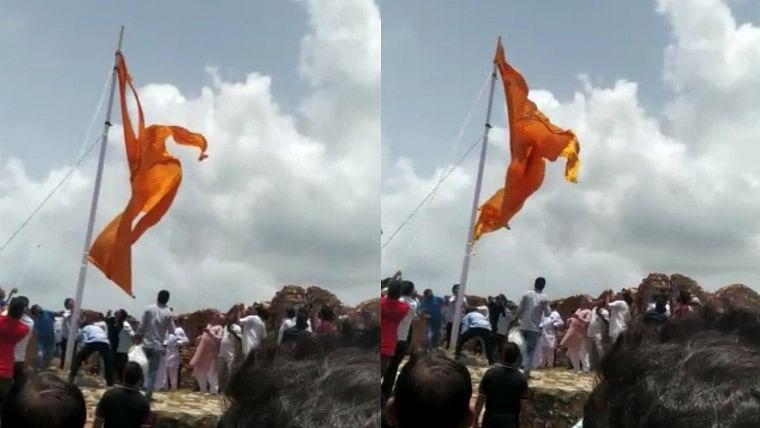
Aamagarh fort situated on Galta Hills of Jaipur in the capital of Rajasthan is in news these days. A controversial issue took place between the aboriginal Meena community and the pro-Hindu organizations.
A few days back a video went viral in which the aboriginal Meena Community’s people are taking off the Bhagwa flag from an 8-foot long wooden pole, which was earlier placed by the pro-Hindu organizations.
On 21st July State-president of Rajasthan Adivasi Meena Sewa Sangh and Gangapur city Independent MLA Ramkesh Meena with the people of the Meena community went to the fort and took off the saffron flag and thus the issue became controversial.
Speaking to Vartha Bharti Ramkesh Meena said “The point of dropping the flag is absolutely wrong, I went there with the people who had set the flag, and the same people were taking down the flag but its wooden pole broke while taking it down”
Ramkesh Meena Says “ The people of RSS want to end our tribal culture, they want to impose Hindu religion on us, we do not believe in the saffron flag as the tricolor flag of the country we already have, there will be either a tricolor flag or a tribal flag.”
The Meena community believes that this fort belongs to the kings of the tribal Meena community, where Amba Devi’s temple is the family deity of the Nagla gotra of the tribals. Some people changed the name to Ambika Bhavani.
Arjun Meher, the Convenor of the Rajasthan unit of the All India Students Association (AISA), speaking out loud in this matter and himself belonging to the tribal Meena community while talking to Vartha Bharti said that "Hinduists want to change our history, Who gave them this right to hoist the saffron flag of a particular religion on the national heritage under the Department of Archeology if any flag to be waved then only the tricolor should be waived.
Earlier on June 25, some idols of the tribal Meena community temple present in the fort were vandalized, which was accused of people of a particular religion, But Arjun Meher denies these allegations.
He further said that "our idols have also been broken by these Hindu organizations, because after dismantling them, they put their idols there, idols with which the tribal community has nothing to do".
Speaking to Vartha Bharati, MLA Ramkesh Meena said that “The act of RSS is always creating a clash between Hindus and Muslims, they deliberately want to give it a communal color, after all, the MLA Rafiq Khan whom they are accusing of having no connection with this, why will he go to Amagarh, the idols have been destroyed by the same people who later placed their idols there.”
As the matter escalated, there was a flood of reactions on social media. Updesh Rana, who gave an inflammatory speech on social media, posted a video on Facebook that he would come to hoist the saffron flag in Amagarh fort on 23 July, but he didn’t come.
Sudarshan channel’s editor Ashok Chavhanke has done a program on the whole matter and has challenged that he will go to Amagarh fort on 1st August and hoist the saffron flag, on which the Meena community of Rajasthan is appealing to its people to reach Amagarh on 1st of August.
Arjun Meher also said that “The tribal community of Rajasthan will gather in Jaipur on August 1 to save their heritage and land”.
Tribal leader Chhotubhai Vasava tweeted and wrote -
"Only 2 flags will be waved at Amagarh one the tricolor and the other one of the tribal community. The descendants of the people who ran their homes as slaves of the Mughals & Britishers will now teach us patriotism and flag to indigenous. Those Meenas who’re against Ramkesh give up the ST certificate.
Link - https://twitter.com/chhotu_vasava/status/1419632681915011074?s=21
Bhim Army convener Chandrashekhar Azad has also tweeted in the matter –
Trying to capture Ambagarh Fort with the help of the saffron flag hoisting is a shameful machination of RSS. Even though the Ambagarh Fort will be just a ruin for others but for the tribals it is a sign of their sacrifice. The tribals will put up their flag. RSS should stop interfering.
Link - https://twitter.com/bhimarmychief/status/1419525950740389890?s=21
Last year a similar dispute took place in Udaipur's Salumber. There was a dispute over the saffron flag at the Sonarmata temple on Sonar Pahari.
Rajkumar Raut, MLA of the Bharatiya Tribals Party from the Chaurasi Constituency of Dungarpur district, while talking to Vartha Bharti said that "the same act was done in Salumber, the red flag of the Dayma gotra of the tribal Bhil community is hoisted every year on the hills of Sonar".
“But Hindutva organizations hoisted the saffron flag there, we put our red flag there with the help of the administration but many of our people were booked for insulting the saffron flag.”
In the incident that took place at Sonar Mata Temple in Salumbar, BJP had accused the Bharatiya Tribals Party of removing the saffron flag and putting their party flag there.
Raut further says “Amagarh is the place of tribal Meenas and Meena group is politically and administratively strong so they are fighting, but other weaker tribes are suppressed as Naxalites”
Tribals -vs-Hinduism
For many years, the Tribals have been demanding that they should be separated from Hinduism because their mode of life, language, articles of clothing, and beliefs are different.
In March this year, in the assembly, Rajasthan Youth Congress President and Congress tribal MLA from Dungarpur, Ganesh Goghra, had demanded a separate code, describing the tribals as separate from Hinduism.
He spoke in the Rajasthan assembly “Our tribal religion is different, our culture is different, we worship nature! People of Rashtriya Swayamsevak Sangh (RSS) say tribals are Hindus, while we are being exploited in the name of Hindu. Our tribal religion code should be different, imposing Hindu religion on us should be stopped, we are not Hindus, and we do not consider ourselves Hindus.”
MLA Ramkesh Meena Says "Adivasis are not Hindus, we are worshipers of nature, we have a different culture, but RSS wants to impose Hindu religion on us."
Rajkumar Raut says "Adivasis are not Hindus, as they are not included in any of the four Varnas of Hinduism, nor does the Hindu Marriage Act apply to tribals".
Let the Truth be known. If you read VB and like VB, please be a VB Supporter and Help us deliver the Truth to one and all.
Bihar: Over 150 children fall ill after consuming 'mid-day meal' in Saharsa
Saharsa (PTI): More than 150 children were taken ill after allegedly consuming food that was part of the mid-day meal in a school in Bihar’s Saharsa district, a senior official said on Thursday.
The incident occurred at a middle school in Baluaha village of the district.
The official said that 115 children were undergoing treatment at the Sadar Hospital, while around 50 students were admitted to Mahishi Public Health Centre.
“We received information that several children fell ill after consuming the mid-day meal in Baluaha. The children were initially treated at the primary health centre, but later, many were referred to the Sadar Hospital,” Saharsa District Magistrate Deepesh Kumar told reporters.
“According to doctors, the health condition of the children has improved, but they will be kept under observation for some time. There is no need to panic. Some kids are having mild fever. They are being treated accordingly,” Kumar said.
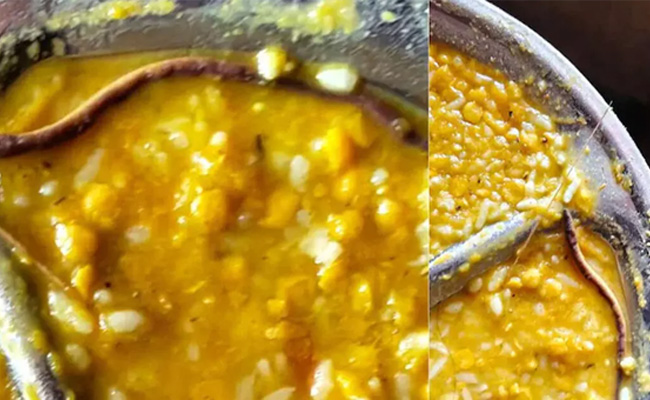
Meanwhile, family members of some children claimed that a snake was found in the container in which cooked pulses was stored at the school.
Of the 545 students present in the school, 200 had already eaten their meals by the time the snake was spotted, and later complained of stomach ache and vomiting, they said.
Regarding the claims, the DM said food samples have been collected from the school.
“We will be able to comment on this only after the results of the tested samples arrive,” he said.