African Swine Flu detected in India; 2,500 pigs killed in Assam
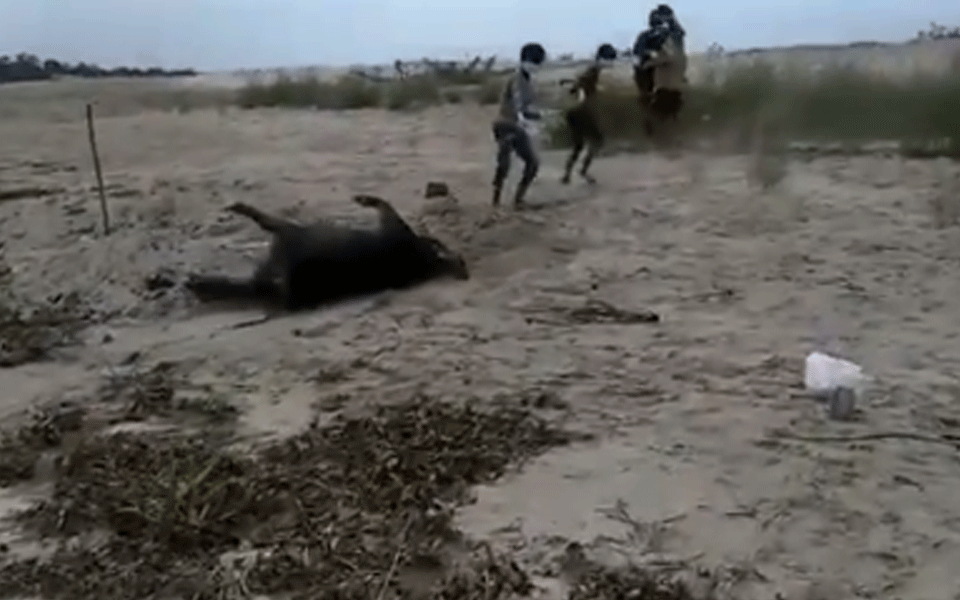
Guwahati: The Assam government on Sunday said the first instance of African Swine Flu has been detected in the state and it has already killed around 2,500 pigs across 306 villages.
Despite a go-ahead from the Centre, the state government will not resort to culling of the pigs immediately and will adopt an alternate mechanism to prevent the spread of the highly contagious disease, Assam Animal Husbandry and Veterinary Minister Atul Bora said at a press conference.
He said the disease has no relation at all with COVID-19.
"The National Institute of High Security Animal Diseases (NIHSAD), Bhopal has confirmed that it is African Swine Flu (ASF). The central government has informed us that it is the first instance of the disease in the country," Bora said.
As per a 2019 census by the department, the pig population was 21 lakh, but it has increased in recent times to around 30 lakh, he added.
"We have discussed with experts if we can save the pigs without culling them. The death percentage of the pigs affected by the disease is almost 100 per cent. So we have made some strategies to save the pigs, which are not affected by the virus," Bora said.
The department will collect samples within one km radius of the infected area and test them, he informed.
"After testing, we will cull only those pigs which will be found infected. We are avoiding the immediate culling of the pigs. We will take daily updates and will take a decision as and when the situation arises," Bora said.
The further testing will be done in Assam itself in three labs here, but these will not be sufficient and officials concerned have been asked to contact the Health Department for this, he added.
The minister said that the state government has requested the neighbouring states to take steps so that there is no movement of pigs.
"The virus spreads through pig's meat, saliva, blood and tissue. So there will be no transportation of pigs between districts. We will also check what can be done to the pigs passing through our state.
"We will have a surveillance zone within 10 km radius so that no pigs are transported out of the area or no feed is moved from a different location. We will also do GPS mapping," Bora said.
He, however, said the disease has not spread much yet and around 2,500 pigs have died due to ASF across 306 villages in seven districts in the state.
"The disease was detected during the last part of February. However, it started in April 2019 in China at a village of Xizang province bordering Arunachal Pradesh. It is suspected that the disease crossed over to Arunachal Pradesh and then reached Assam," Bora said.
Usually pigs roaming freely are infected, but off late those in the farms are also seen affected, he added.
"In a particular case of one farmer, whose 230 pigs have died, his employee's personal pig died due to this. So it is suspected that the employee carried the virus from his home to the farm and got the pigs infected. We have seen it in some other farms also. So humans also carry this virus," Bora said.
The Veterinary Department started giving the vaccine of classical swine flu to the pigs after this outbreak, but it was stopped as there was a danger of spreading the virus through the doctor, he added.
"However, it never affects humans. There is no problem in consuming pork from the areas where there is no infection. We will conduct awareness and training of farmers. We have selected 13 districts for this purpose," the minister claimed.
He also said that the government has formed district level committees to implement the guidelines such as pigs will not be allowed to roam freely and the farmers will have to keep them in enclosures.
When asked about compensating the farmers incurring losses, Bora said, "Farmers have been affected. We are assessing the total damage. We will see the provisions from the disaster management authorities and compensate them accordingly."
Let the Truth be known. If you read VB and like VB, please be a VB Supporter and Help us deliver the Truth to one and all.
Late flourish masks CSK’s batting woes on lively Chepauk track, hosts post 158/7

Chennai (PTI): Bowlers calling the shots in a format dominated by big hitters is a rarity, but that script played out at Chepauk on Sunday as Gujarat Titans exploited a lively, bounce-friendly surface to stifle Chennai Super Kings before the hosts managed a late flourish to reach 158 for 7.
On a pitch that offered sharp carry, stroke-making demanded discretion and adaptability. Instead, CSK’s batters often opted for high-risk shots without fully assessing conditions, and paid the price with a flurry of miscued dismissals.
Invited to bat, CSK never quite found rhythm but skipper Ruturaj Gaikwad’s maiden half-century (74 not out) of the current IPL season lent a semblance of respectability to the total in a season where 200-plus scores have become commonplace.
Gaikwad's knock came off 60 balls with six fours and four sixes after a laboured start.
The tone was set early by GT pacer Mohammed Siraj, who extracted steep bounce and forced errors.
Sanju Samson (11) began watchfully, negotiating the first over before opening up against Kagiso Rabada to bring up his 5000 IPL runs milestone. However, Rabada’s bounce soon accounted for him as a hard slash outside off resulted in a faint edge that Jos Buttler pouched safely.
The dismissal triggered a collapse. Urvil Patel (4) fell in the same Rabada over attempting an ambitious pull, while Sarfaraz Khan (0) succumbed to Siraj’s extra lift, mistiming a short ball to offer a simple catch.
At 28 for 3 inside the Powerplay, CSK were already in trouble.
Gaikwad and Dewald Brevis (2) needed to rebuild, but the latter’s impatience against spinner Manav Suthar led to his downfall, holing out after failing to get to the pitch of the ball.
The mounting wickets forced Gaikwad into a shell — an approach that, while understandable, further stalled the momentum. His reluctance to improvise allowed dot balls to pile up, with CSK reaching 50 only in the 12th over.
The skipper eventually broke free, taking on Arshad Khan and Jason Holder with a couple of towering sixes, but the acceleration came too late.
Shivam Dube, dropped thrice on 6, 11 and 22, struggled for fluency before Arshad cleaned him up.
Kartik Sharma (15) and Jamie Overton (18) provided late impetus with a few lusty hits, but the damage had already been done.
On a pitch that rewarded discipline and smart shot selection, Titans' bowlers executed their plans to perfection, while CSK’s batters failed to read the conditions in time, a lapse that ultimately defined the innings.