After 500 yrs, examining Babur's dedication of mosque 'little problematic': SC in Ayodhya case
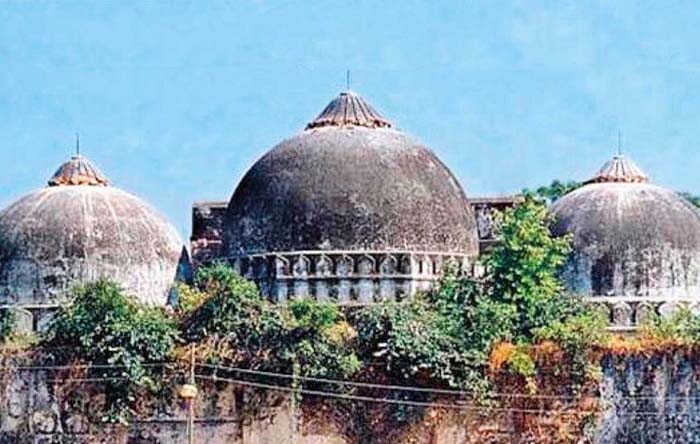
New Delhi, Aug 29: The Supreme Court Thursday termed as a "little problematic" the demand of a Hindu body that it judicially scrutinise, after almost 500 years, whether Mughal emperor Babur dedicated the disputed structure in Ayodhya to the 'Allah' for it to be a valid mosque under the tenets of Islam.
The counsel for 'Akhil Bhartiya Sri Ram Janam Bhoomi Punarudhar Samiti' told a 5-judge Constitution bench, headed by Chief Justice Ranjan Gogoi, that the Allahabad High Court erred in saying it will not go into the issue as to whether Babur constructed the mosque without following 'Sharia', 'hadith and other Islamic practices.
Senior advocate P N Mishra, appearing for the Hindu body, a defendant in a lawsuit filed by a Muslim party in the case, said that instead of deciding on the allegations that Babur was not the owner of the land and was incapable of validly executing 'wakf' for the mosque, the high court held that since almost 500 years have passed, it would not deal with the issue which may be a matter of "debate for historians".
"In Islam, even an absolute sovereign like Babur could not do everything. He still had to abide by the religion," Mishra told the bench, also comprising Justices S A Bobde, D Y Chandrachud, Ashok Bhushan and S A Nazeer, on the 15th day of the hearing in the politically sensitive case of the Ram Janmabhoomi-Babri Masjid land dispute.
"What High Court suggested here that Babur had the absolute power and he had done something...that cannot be reviewed. They (HC) said that now we cannot get into the question as to what Babur did was against 'sharia'," the bench said.
It added that rather than getting into the alleged violations of Islamic law and practices, the High Court said it would deal with the aspect of people believing it to be a mosque.
"This will be little problematic, if we asked the judicial validity of the dedication of the land as mosque by Babur," the bench observed.
It then said that Muslims have been claiming that they have been worshipping for more than 400 years and Hindus say that they are offering 'puja' for last two millennia and the argument was that the courts should examine the plea whether the act of the monarch was invalid.
Mishra said there was no religious forum for deciding such disputes and the courts cannot simply refuse to decide such issues and there are judgements which provided that it can be done on the basis of Hindu and Muslim laws.
"What you are saying is that the (High) court should have decided as to what Babur did was right or wrong," Justice Bobde asked.
To this, the senior lawyer said, "How can the court say that it will not decide" and the case is being pursued for almost 70 years in courts.
If there was continuous conflict between two communities, the religious tenets should be considered while deciding as to which side has got the better case to lay claim over the disputed party as both the religious place cannot be there on one plot, Mishra said.
At the outset, the lawyer referred to a High Court order to say that the historical books can be considered under the Evidence law to decide the dispute.
He said the majority verdict of the High Court had held that the Muslims failed to prove that the structure was built by Babur in 1528.
Justice S U Khan concurred with Justice Sudhir Agrawal on this but said that as there was no contrary evidence put up by Hindus so there was the probability that the structure was a mosque, Mishra said and referred to the gist of conclusions of the HC verdict to highlight the point that Babur was not the owner of the land.
Muslims had relied upon two inscriptions which were placed at entrance and pulpit of the structure, he said, adding that they were forged as they were first seen by a magistrate after 1934.
The bench said that irrespective of the fact that there was no valid 'wakf', a mosque existed there and asked the lawyer as to how he will deal with it.
"There are two aspects, first is the structure. The structure was built is not disputed. Second is that you are saying there was the issue whether it was dedicated or not.
"But there was a structure that was in shape of a mosque.. how do you deny its existence. It does not take away the validity of the mosque," the bench asked.
The structure cannot be treated as mosque, Mishra responded and referred to Islamic texts and testimonies of various religious experts who had testified as witnesses in the case.
He said a mosque is not valid if it is built on the land of people of another religion and the 'wakif" should be the owner of the land for dedicating it to the almighty.
He then referred to a 'shahi farman' (Royal order) of emperor Shahjahan and said that the land was ordered to be reverted to a Hindu temple owner, Sati Das in Gujarat, after prince Aurangzeb had forcibly taken it over and had converted into a mosque.
"The temple can be returned back to the real owner after the usurpation of land is held to be invalid," he said.
He then distinguished the characteristics of a temple and mosque and said that the disputed structure lacked the qualities of being a mosque.
The advancing of arguments would continue on Friday.
The Allahabad High Court, in its judgment of 2010 on four civil lawsuits, had partitioned the 2.77-acre disputed land equally among the three parties Sunni Waqf Board, Nirmohi Akhara and Ram Lalla.
Fourteen appeals have been filed in the Supreme Court against the verdict.
Let the Truth be known. If you read VB and like VB, please be a VB Supporter and Help us deliver the Truth to one and all.
Bengal: Over 55 pc turnout till 1 pm in repoll in 15 booths of 2 assembly seats
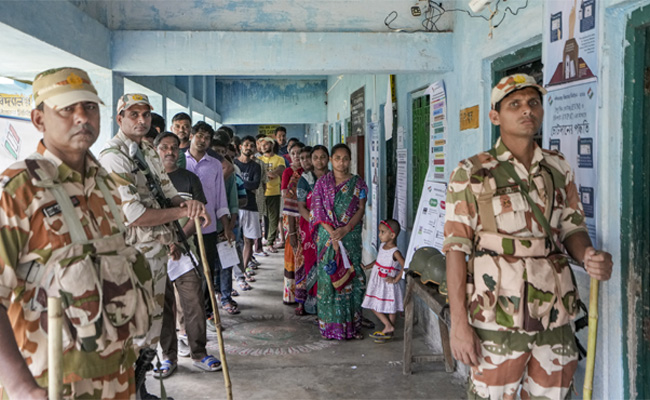
Kolkata (PTI): Over 55 per cent turnout was recorded till 1 pm in repoll in 15 booths of two assembly constituencies in West Bengal's South 24 Parganas district on Saturday, an official said.
Voting was underway more or less peacefully at 11 polling stations of Magrahat Paschim assembly constituency and four in Diamond Harbour, where the EC ordered repoll a day ago, following reports of electoral malpractices.
However, at booth number 179 at Chanda Primary School of Diamond Harbour seat, the Trinamool Congress alleged that a specially abled voter and his mother were harassed by central forces. The alleged incident sparked protests by party workers and locals.
The TMC claimed that the voter's mother, who had entered the booth to assist him, and her son were detained for a considerable time by central forces over alleged rule violations.
ALSO READ: Man arrested for duping Delhi resident of Rs 2 lakh in online car sale fraud
"TMC leaders Manmohini Biswas and Pratik Ur Rahman reached the spot and led the protests, with residents terming the action unwarranted harassment. The matter has been taken care of by our officials there," an official of the poll body said.
Polling was otherwise peaceful across 15 booths in the area, he added.
Voting began at 7 am and will continue till 6 pm, the official said, adding that till 1 pm, the turnout was 55.57 per cent.
Magrahat Paschim registered 56.33 per cent voter turnout, while in Diamond Harbour, it was 54.9 per cent, a poll official stated.
Voting in these two assembly constituencies was held in the second phase of the state elections on April 29.
The repoll order was based on reports received from returning officers and observers of the two constituencies and "material circumstances", the Election Commission official said.
In Magrahat Paschim, TMC's Md Samim Ahamed Molla is pitted against BJP nominee Goursundar Ghosh, while Abdul Majid Halder of the Congress and ISF candidate Abdul Aziz Al Hassan are also in the fray.
TMC candidate Panna Lal Halder is contesting against Dipak Kumar Halder of the BJP in the Diamond Harbour seat. Goutam Bhattacharya of the Congress and CPI(M)'s Samar Naiya are among other candidates.
The BJP had alleged rampant electoral malpractices in certain polling stations of both the assembly seats under the Diamond Harbour Lok Sabha constituency, which is represented by TMC national general secretary Abhishek Banerjee.
The EC had deputed its special observer, Subrata Gupta, to fact-check the allegations from the ground.
The poll panel will decide on repolling in the Falta assembly constituency on Saturday.
The West Bengal assembly elections were held in two phases -- April 23 and April 29 -- amid unprecedented security arrangements.
Counting of votes will take place on May 4.