After 84 days of lockdown in Valley, Kashmir Economy suffers Rs 10,000-Crore loss
Srinagar: The shutdown in Kashmir, following the abrogation of Article 370, has crippled the valley's economy as the business community has suffered losses amounting to over Rs 10,000 crore in three months, a trade body said here.
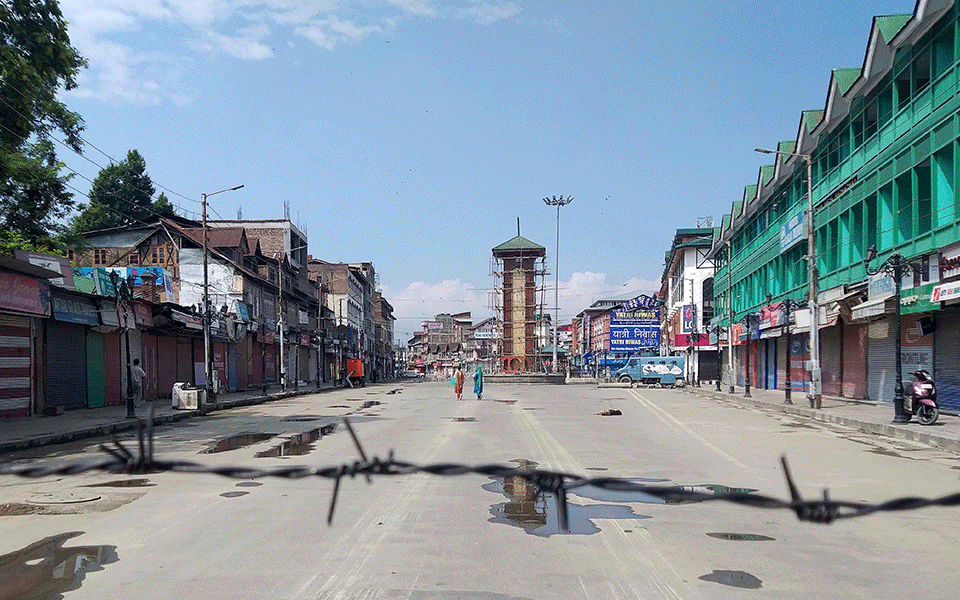
The deadlock in Kashmir, after the Centre announced the abrogation of Article 370 on August 5, completed 84 days on Sunday with the valley in shutdown as the main markets continued to remain shut and public transport off the roads.
Some shops open for a few hours early in the morning and late in the evening in certain areas, including in the city centre of Lal Chowk in Srinagar, but the main markets are shut.
Sheikh Ashiq, president of the Kashmir Chamber of Commerce and Industry (KCCI), said while it was difficult to assess the nature of losses as the situation was not normal yet, the business community has received a serious jolt from which it was very difficult to recover.
"The running business losses for Kashmir region have crossed Rs 10,000 crore and all sectors have been severely hit. It has been nearly three months now and yet the people are not doing business because of the prevailing situation. There has been some activity in the recent weeks, but the feedback that we are getting is that the business is dull," Ashiq told PTI.
He identified the suspension of internet services as the main factor for the losses.
"In today's times, the basic need of any business is the internet which is missing on the ground. We have conveyed it to the governor's administration that the businesses will suffer in Kashmir, the economy will weaken. Which will have huge consequences in the longer run," he said.
Giving examples of several sectors, Ashiq said the IT sector was an upcoming sector and there are companies which were providing services in the US, in Europe and their business has been affected by the suspension of internet facilities.
"If we take the handicraft sector, people associated with the trade receive orders in July-August and have to deliver the products around Christmas and New Year. When they can implement these orders, only then would they be served. There is no connectivity, so there were no orders resulting in loss of jobs to over 50,000 artisans and weavers," he said.
The KCCI president said the government should own responsibility for the losses and take steps to mitigate the sufferings of the traders.
"This is not about losses in business only. We will be facing technical issues like GST, online returns, whether you make business or not, we will face them and other issues like that. We are not falling under certain guidelines because we are missing them. So there should be a system for these sort of things for this region.
"We are disturbed even at the moment. Who will think about this? The government has to take the responsibility and it has to come out with the ways," he said.
He said the development of the valley has come to a standstill. "We had about Rs 2,000 crore worth of development projects which have been pushed back because the workforce has left the valley. Now, we have to assure them, like tourists, and it will take time," he said.
Ashiq said it is the responsibility of the government to come out with various measures like certain packages for the business community in the prevailing circumstances.
"They have not approached us yet, but they may in the coming month," he said.
Asked about the detention of some business leaders, Ashiq said it was unfortunate and believed that businesses in Kashmir valley should not be politicised. Let business be a separate thing. This is what KCCI believes in. Let there be no politicisation, he said.
He said the KCCI has taken up the release of Kashmir Traders and Manufacturers Federation (KTMF) president Mohammad Yasin Khan, whose mother passed away a few days ago. "At least, he should be released on humanitarian grounds.
Ashiq said the business community in Kashmir was not against outside investments in the valley and KCCI would always be at the forefront in inviting foreign investments.
We are not against investments, but we have not been taken on board on anything about some people wanting to invest here. It was the government's endeavour even before New Delhi took this decision (on Article 370) to get investments," the KCCI president said.
Let the Truth be known. If you read VB and like VB, please be a VB Supporter and Help us deliver the Truth to one and all.
SC to hear on May 4 PIL seeking stringent guidelines for issuing Aadhaar to adolescents, adults
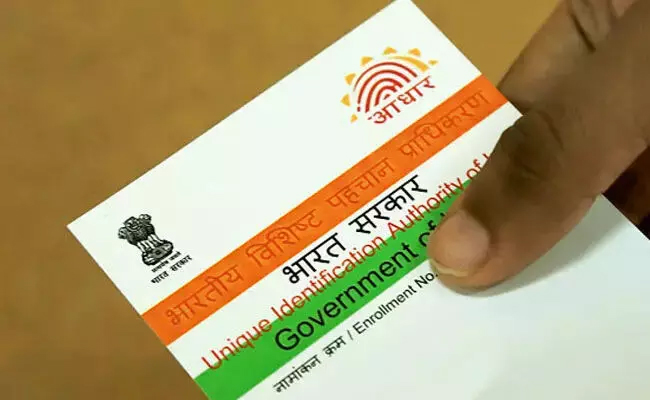
New Delhi (PTI): The Supreme Court is scheduled to hear on Monday a plea seeking a direction to the Unique Identification Authority of India to issue new Aadhaar cards only to citizens up to the age of six years, and frame stringent guidelines for its issuance to adolescents and adults to stop infiltrators from masquerading as Indian citizens.
As per the apex court's causelist of May 4, the plea would come up for hearing before a bench of Chief Justice Surya Kant and Justice Joymalya Bagchi.
The Public Interest Litigation (PIL) filed by lawyer Ashwini Upadhyay has also sought a direction to the authorities to install display boards at common service centres stating that the 12-digit unique identification number is only a "proof of identity" and not a proof of citizenship, address or date of birth.
Besides all the states and Union Territories, the plea has made the UIDAI -- which is the authority that issues Aadhaar -- and the Union ministries of home, law and justice, and electronics and information technology as parties.
The plea, filed through advocate Ashwani Dubey, said Aadhaar, originally intended as a proof of identity, has increasingly become a "foundational document" enabling individuals to obtain other identification documents, such as ration cards, domicile certificates and voter identity cards.
"The UIDAI has issued 144 crore Aadhaar and 99 percent Indians have been enrolled. Therefore, the petitioner is filing this writ petition as a PIL under Article 32, seeking a direction to UIDAI to issue new Aadhaar to children only and frame new stringent guidelines for adolescents and adults, so as to stop infiltrators from getting it and masquerading as Indian citizens," the plea said.
It said the need to file the plea arose when the petitioner came to know the manner in which infiltrators are able to procure Aadhaar through a verification process that is weak and can be easily manipulated.
"Foreigners apply for Aadhaar under the 'foreign' category. But infiltrators apply for Aadhaar under the 'Indian citizen' category and get it easily made. Thereafter, they obtain a ration card, birth and domicile certificate, driving licence, et cetera, essentially becoming indistinguishable from Indian citizens…," it said.
Besides seeking other directions, the plea has raised legal questions, including whether the Aadhaar Act 2016 has become "temporally unreasonable" for failing to keep up with the legislative intent of distinguishing foreigners from Indian citizens.
It said the alleged misuse of Aadhaar undermines targeted welfare delivery and leads to diversion of public resources.