After moon landing venture, ISRO eyes Sept 2 for launch of Aditya-L1 solar mission
Bengaluru, Aug 26: After the successful moon lander venture, ISRO is now gearing up for the launch of a solar mission in a week's time, likely on September 2, to study the Sun.
Aditya-L1 spacecraft is designed for providing remote observations of the solar corona and in situ observations of the solar wind at L1 (Sun-Earth Lagrangian point), which is about 1.5 million kilometres from the earth.
It will be the first dedicated Indian space mission for observations of the Sun to be launched by the Bengaluru-headquartered space agency.
The Aditya-L1 mission, aimed at studying the Sun from an orbit around the L1, would carry seven payloads to observe the photosphere, chromosphere and the outermost layers of the Sun, the corona, in different wavebands.
Aditya-L1 is a fully indigenous effort with the participation of national institutions, an ISRO official said.
The Bengaluru-based Indian Institute of Astrophysics (IIA) is the lead institute for the development of Visible Emission Line Coronagraph payload. While Inter-University Centre for Astronomy and Astrophysics, Pune, has developed the Solar Ultraviolet Imager payload for the mission.
Aditya-L1 can provide observations on the corona, and on the solar Chromosphere using the UV payload and on the flares using the X-ray payloads. The particle detectors and the magnetometer payload can provide information on charged particles and the magnetic field reaching the halo orbit around L1.
The satellite, realised at U R Rao Satellite Centre here, arrived at the ISRO's spaceport of Sriharikota in Andhra Pradesh, two weeks ago.
"Most likely the launch will take place on September 2 ", an ISRO official said.
The spacecraft is planned to be placed in a halo orbit around the L1 of the Sun-Earth system.
A satellite placed in the halo orbit around the L1 point has the major advantage of continuously viewing the Sun without any occultation/eclipses, ISRO noted.
"This will provide a greater advantage of observing the solar activities and its effect on space weather in real time," it said.
Using the special vantage point L1, four payloads directly view the Sun and the remaining three payloads carry out in-situ studies of particles and fields at the L1, thus providing important scientific studies of the propagatory effect of solar dynamics in the interplanetary medium.
"The suits of Aditya L1 payloads are expected to provide most crucial informations to understand the problem of coronal heating, coronal mass ejection, pre-flare and flare activities and their characteristics, dynamics of space weather, propagation of particle and fields etc", ISRO said.
The major science objectives of the Aditya-L1 mission are: Study of Solar upper atmospheric (chromosphere and corona) dynamics; Study of chromospheric and coronal heating, physics of the partially ionised plasma, initiation of the coronal mass ejections, and flares; Observe the in-situ particle and plasma environment providing data for the study of particle dynamics from the Sun.
They also include Physics of solar corona and its heating mechanism; Diagnostics of the coronal and coronal loops plasma: Temperature, velocity and density; Development, dynamics and origin of CMEs; Identify the sequence of processes that occur at multiple layers (chromosphere, base and extended corona) which eventually leads to solar eruptive events; Magnetic field topology and magnetic field measurements in the solar corona; Drivers for space weather (origin, composition and dynamics of solar wind.
The instruments of Aditya-L1 are tuned to observe the solar atmosphere, mainly the chromosphere and corona. In-situ instruments will observe the local environment at L1.
Let the Truth be known. If you read VB and like VB, please be a VB Supporter and Help us deliver the Truth to one and all.
Rickelton's ton in vain as SRH beat MI by 6 wickets
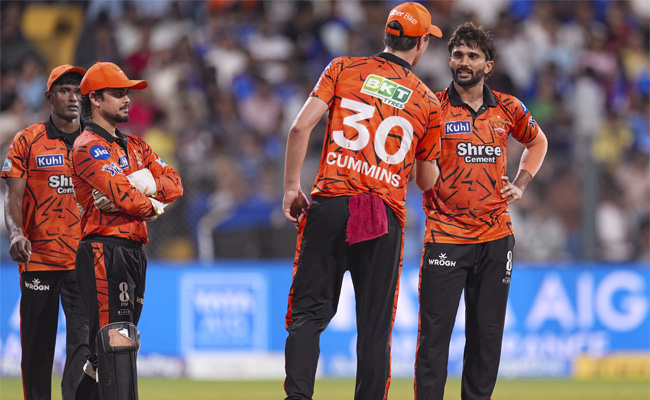
Mumbai (PTI): Ryan Rickelton's whirlwind unbeaten ton was overshadowed by Heinrich Klaasen's unbeaten 65 as Sunrisers Hyderabad defeated Mumbai Indians by six wickets in an IPL match here on Wednesday.
Chasing an imposing 244-run target, Travis Head (76 off 30) and Abhishek Sharma (45 off 24) shared 129 runs for the opening wicket to set the platform for SRH.
Klaasen (65 not out off 30 balls) then displayed his all-round hitting abilities to guide SRH home with the help of Nitish Kumar Reddy (21) and Salil Arora (30 not out off 10) in 18.4 overs.
Earlier, Rickelton's knock powered MI to 243 for five.
MI rode on a 93-run stand between Rickelton (123 not out off 55 balls) and Will Jacks (46 off 22) in 7.1 overs for the opening stand to power the side.
MI skipper Hardik Pandya scored a valuable 31 off 15 balls before being dismissed.
Praful Hinge (2/54), Eshan Malinga (1/29), Sakib Hasan (1/39) and Nitish Kumar Reddy (1/31) were the wicket-takers for SRH.
Brief Scores:
Mumbai Indian: 243 for 5 in 20 overs (Ryan Rickelton 123 not out; Praful Hinge 2/54).
Sunrisers Hyderabad: 249 for 4 in 18.4 overs (Travis Head 76, Heinrich Klaasen 65 not out; AM Ghazanfar 2/51).