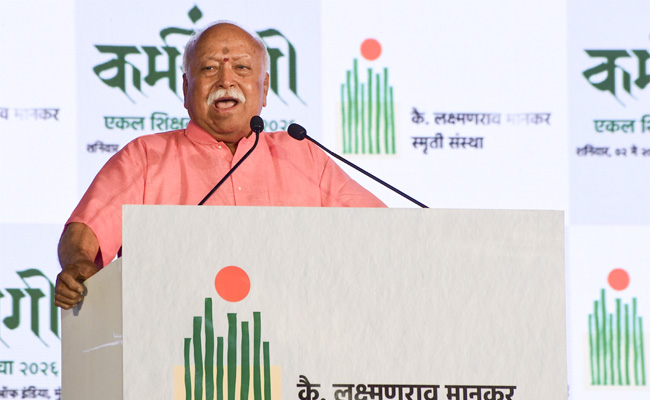
'Agni Missile fired by Nagpur': Cong's swipe at PM Modi over Mohan Bhagwat's 'Bhagwan' remark

New Delhi, Jul 18: The Congress on Thursday took a swipe at Prime Minister Narendra Modi over RSS chief Mohan Bhagwat's "bhagwan" remarks, calling the comments an "Agni Missile fired by Nagpur" and aimed at Lok Kalyan Marg.
While the Rashtriya Swayamsevak Sangh (RSS) headquarters is situated in Nagpur, 7 Lok Kalyan Marg is the prime minister's official residence.
The opposition party's swipe came after Bhagwat said in the course of self-development, a man may want to become a "superman", then "devta" and "bhagwan" and aspire for "vishwaroop" but nobody is certain what lies ahead.
Congress general secretary in-charge communications Jairam Ramesh tagged a clip of Bhagwat's remarks and said, "I am sure the self-anointed non-biological PM has got news of this latest Agni Missile fired by Nagpur from Jharkhand and aimed at Lok Kalyan Marg."
Several people linked with opposition parties also took similar digs on social media.
Addressing a village-level workers meeting, organised by non-profit organisation Vikas Bharti in Jharkhand's Gumla district, RSS chief Bhagwat asserted that people should work relentlessly for the welfare of mankind, since there is no end to the pursuit of development and human ambition.
"After achieving human qualities, man aspires to become superman with supernatural powers and then attain the status of 'devta' and 'bhagwan'. He then aspires for 'vishwaroop' (the supreme power's all-pervading form). What is beyond that, no one is certain," Bhagwat said.
There is no end to the development of the inner and outer self and one should work relentlessly for humanity, he said, adding that a worker should never be satisfied with his or her work.
"Work should continue, one should strive to work constantly in areas of environment, education and health...There is no end to it and constant work in different areas is the only solution...We should strive to make this world a beautiful place as is the nature of India," the RSS chief said.
मुझे यक़ीन है कि स्वयंभू नॉन-बायोलॉजिकल प्रधानमंत्री को इस ताज़ा अग्नि मिसाइल की ख़बर मिल गई होगी, जिसे नागपुर ने झारखंड से लोक कल्याण मार्ग को निशाना बनाकर दागा है। https://t.co/zjJswu6vPd
— Jairam Ramesh (@Jairam_Ramesh) July 18, 2024
Let the Truth be known. If you read VB and like VB, please be a VB Supporter and Help us deliver the Truth to one and all.
Nine dead as fire breaks out in residential building in east Delhi
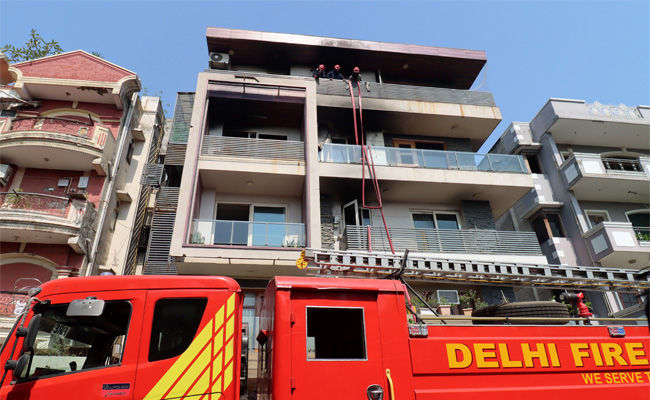
New Delhi (PTI): A fire broke out in a residential building in east Delhi's Vivek Vihar early Sunday, leaving nine people belonging to two families dead, including a toddler, officials said.
The incident was reported around 3.48 am at a four-storey building in Vivek Vihar Phase-I, following which police, fire and disaster management teams rushed to the spot.
According to the police, the blaze engulfed flats on the second, third and fourth floors of the building, prompting a large-scale rescue operation.The cause of the fire is yet to be ascertained.
The Delhi Fire Service (DFS) said nine charred bodies were recovered from different floors.
ALSO READ: Tribals, Scheduled Castes preserved India's identity and soul despite foreign invasions: Bhagwat
"One body was recovered from the first floor, five from the second floor and three from the staircase which was found locked," the DFS officer said.
Those found dead on the second floor have been identified as Arvind Jain (60), his wife Anita Jain (58), son Nishant Jain (35), daughter-in-law Anchal Jain (33) and grandchild Akash Jain.
On the third floor, three members of a family were found dead. They were identified as Nitin Jain (50), wife Shailey Jain (48) and son Samyak Jain (25).
On the first floor a woman identified as Shikha Jain (45) was found dead while her husband Naveen Jain (48) sustained injuries.
A senior police officer said, "Around 10 to 15 people were rescued from the premises during the firefighting operation. Two of them, who sustained minor injuries, were shifted to the Guru Teg Bahadur Hospital."
A total of 12 fire tenders were pressed into service to douse the flames, while teams from the Delhi Disaster Management Authority (DDMA), traffic police and local police assisted in the rescue and evacuation efforts.
Police said the fire was brought under control after several hours. Efforts are underway to determine the cause of the fire, police said.
Further investigation and proceedings are underway.