Agree 'in principle' with removing loudspeakers from religious places in Delhi: AAP
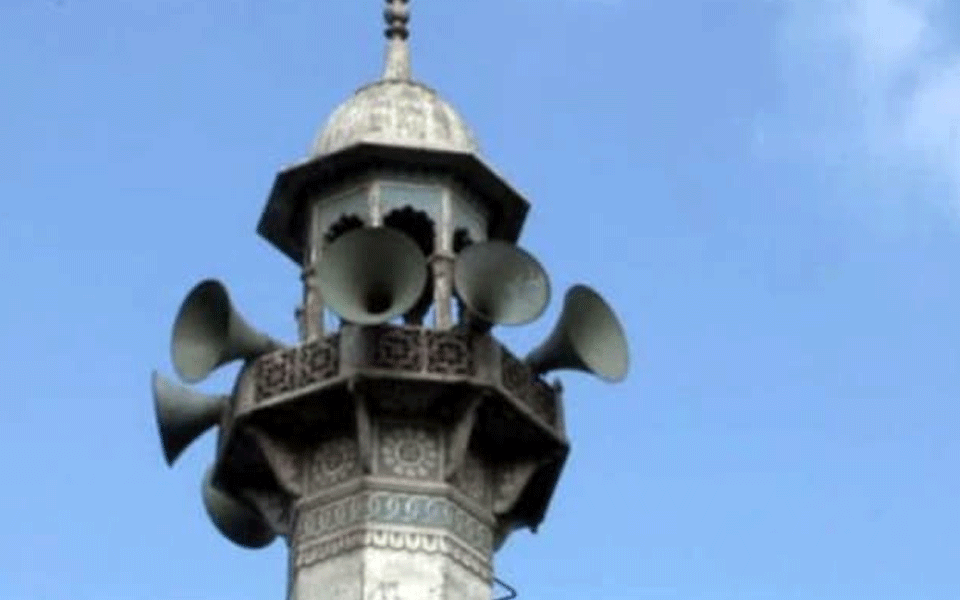
New Delhi(PTI): Hours after its Kalkaji MLA Atishi opposed the BJP's demand for removal of loudspeakers from religious places in Delhi, the AAP on Tuesday came out with a clarification, saying it agrees "in principle" with the idea that loudspeakers be removed from "every religious institution and centres of faith alike".
The party also urged the BJP to approach the Delhi Police seeking action on its demand pertaining to use of loudspeakers at religious places in the national capital.
"The Aam Aadmi Party (AAP) in principle agrees with the concept of repealing (removing) loudspeakers from every religious institution and centres of faith alike," the party said in a statement.
"The matter is subject to Delhi Police's jurisdiction which comes under the BJP's Central Government. Thus, we urge the BJP to seek action on the same from the Delhi Police itself," it added.
Addressing a press conference at party headquarters earlier in the day, AAP leader Atishi had said her party would oppose any move to remove loudspeakers from religious places in the national capital and accused the BJP of playing with people's faith.
She said loudspeakers are played during various religious occasions across the country and cited Ramlila as well as recitation of Hanuman Chalisa and 'Sunderkand paath' as examples.
"We will definitely oppose it," Atishi told reporters when asked if her party would oppose any move to remove loudspeakers from religious places in Delhi.
"Be it Ramlila or Sunderkand recitation, people's faith is attached to them. I want to ask what is their problem with the religious faith of people.
"Now you will tell us that we won't organise jagran, that we can't organise Sunderkand paath (recitation), can't recite Hanuman chalisa," she said, slamming BJP's Delhi unit president Adesh Gupta for seeking the removal of loudspeakers from religious places.
"Who is Adesh Gupta to play with our faith?" she added.
Gupta had on Monday written to Chief Minister Arvind Kejriwal demanding removal of loudspeakers from religious and other places as per the Supreme Court's order and on the lines of the action taken by other states in this connection.
This had came hours after BJP MP Parvesh Sahib Singh Verma made a similar request to Lieutenant Governor Anil Baijal and commissioners of the three municipal corporations in the national capital.
While 'Ramlila', organised during Dussehra every year across the country, is a dramatic re-enactment of the life of Lord Ram, 'Hanuman Chalisa' is a Hindu devotional hymn sung in praise of Lord Hanuman.
Sunderkand, a chapter in Hindu epic Ramayana, depicts the adventures of Lord Hanuman, highlighting his strength and devotion to Lord Ram.
Accusing Gupta of playing politics on the issue, the AAP leader questioned why he wrote a letter to the Delhi chief minister when it is the responsibility of the Delhi Police to ensure compliance of the apex court's orders on the use of loudspeakers at religious and other places.
The Delhi Police comes under the BJP government at the Centre, Atishi pointed out.
"I feel that Adesh Gupta has now made up his mind that he has to play with the faith of people in this city and do 'goonagardi' (hooliganism) with them," she charged.
Let the Truth be known. If you read VB and like VB, please be a VB Supporter and Help us deliver the Truth to one and all.
Congress using hijab issue to pacify minority anger, alleges Karnataka LoP R Ashoka
Bengaluru: Leader of Opposition in the Assembly R. Ashoka has accused the Congress government of using the hijab issue to placate what he described as discontent among minority voters after the Davanagere by-election.
In a post on X on Wednesday, Ashoka alleged that the state government, instead of addressing issues such as price rise, corruption, farmers’ distress and law and order, was attempting to retain its minority vote base by reviving the hijab issue.
Referring to the 2022 dress code introduced by the BJP government, which prohibited hijab in schools and colleges, Ashoka said the Karnataka High Court had upheld the policy and emphasised the importance of discipline in educational institutions.
He questioned the Congress government’s move to revisit the issue and asked whether setting aside the court-backed policy to benefit one community could be described as secularism.
Ashoka further alleged that while the government was willing to permit hijab, it continued to prohibit saffron shawls.
He accused the government of dividing students on religious lines rather than treating schools and colleges as spaces of equality.
Drawing a comparison with Mamata Banerjee’s government in West Bengal, Ashoka claimed that excessive appeasement politics had harmed the state and warned that the Congress in Karnataka could face a similar political response.
He said voters in Karnataka would teach the Congress a lesson for what he termed “vote-bank politics” and for compromising constitutional and judicial principles.