Agusta case: Indian authorities fail to produce evidence against Michel in UAE court

New Delhi, July 17 : In a setback to efforts to extradite British national Christian Michel James -- one of the alleged middlemen in the Rs 3,600 crore AgustaWestland VVIP chopper deal case -- Indian authorities failed to produce any evidence before the UAE courts within the stipulated time, according to the lawyer of the accused.
The Indian government was supposed to produce evidence in the United Arab Emirates (UAE) court by May 19, 2018 against Michel. "But the government did not present any evidence," Michel's lawyer, Rosemary Patrizi Dos Anjos, told IANS over phone from Milan in Italy.
She said the government "does not have any evidence against" him and therefore its officials were unable to produce any, adding that there was "no evidence against Michel in Italy, Switzerland or India."
Dos Anjos said the Indian government was given a further time of 45 days by the UAE court at its next hearing to produce evidence out of which 30 days had already expired without any movement.
Dos Anjos also said that Michel was questioned by CBI officials in Dubai a month ago. Michel is still in the UAE, according to her. Neither the Enforcement Directorate (ED) nor the Central Bureau of Investigation (CBI) were willing to comment on the case.
In January this year, the ED had lodged a request with the UAE authorities for extraditing Michel. Both the ED and the CBI had filed chargesheets in bribery cases in Indian courts and non-bailable warrants had been issued against the accused.
Last year, a red corner notice was issued against Michel by the Interpol on a request by the CBI. RCNs were also issued against two Italians involved in the scam -- Carlo Gerosa and Guido Haschke.
According to Indian investigative agencies, Michel had received at least Rs 235 crore for ensuring that the chopper contract went to AgustaWestland. He was a frequent visitor to India, having undertaken 300 trips to this country between 1997 and 2013.
ED sources said that bribes to Michel were paid through a web of companies located abroad and in India on the pretext of payment for consultancy work. He also used his Dubai-based firm Global Services FZE as a conduit for money.
In its chargesheet, the CBI had named former Indian Air Force chief S.P. Tyagi, his cousin Sanjeev Tyagi, alias Julie, the then IAF Vice Chief J.S. Gujral and advocate Gautam Khaitan as the four Indians involved in the scam. The chargesheet mentioned Khaitan as the "brain" behind the deal.
Others named in the chargesheet included Giuseppe Orsi, the former chief of Italian defence and aerospace major Finmeccanica and Bruno Spagnolini, former CEO of AgustaWestland, apart from middlemen Michel, Haschke and Gerosa.
On January 1, 2014, India cancelled the contract with Finmeccanica's British subsidiary AgustaWestland for supplying 12 AW-101 VVIP choppers to the IAF, over alleged breach of contractual obligations and on charges of paying kickbacks amounting to Rs 423 crore.
The CBI, which registered an FIR in the case on March 12, 2013, had alleged that Tyagi and the other accused received kickbacks from AgustaWestland to help it win the contract. The FIR mentioned charges of criminal conspiracy, cheating and those under the Prevention of Corruption Act.
According to the CBI, Tyagi allegedly took bribes of several crores from AgustaWestland through the middlemen -- and a complex set of companies in several countries -- to change the specifications of the contract. The operational flight ceiling of the choppers was reduced from 6,000 metres, as originally proposed, to 4,500 metres and the cabin height was brought down to 1.8 metres.
The twin modifications were allegedly meant to rig the deal in favour of AgustaWestland, which eventually walked away with the order to supply the 12 choppers for the Communication Squadron of the IAF for ferrying the President, the Prime Minister and other VVIPs.
The CBI probe revealed that several payments were made to the Tyagis by Haschke, Gerosa and Michel.
Tyagi, who was IAF chief from 2004 to 2007, his cousin and Khaitan were arrested in December last year by the agency. They are now out on bail.
Let the Truth be known. If you read VB and like VB, please be a VB Supporter and Help us deliver the Truth to one and all.
Representative of Iran's Supreme Leader in India calls current situation 'no war, no peace'
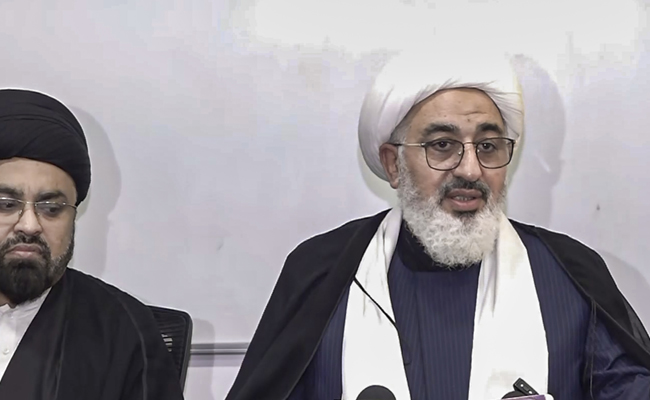
Bengaluru (PTI): Representative of Iran's Supreme Leader in India, Abdul Majeed Hakeem Ilahi on Saturday characterised the ongoing tensions between his country and the Israel-US alliance as a state of “no war, no peace”.
Calling for an immediate halt to the conflict, he said the global stability hinges on those who initiated the war.
He questioned why countries affected by the war and suffering from the energy crisis are not pressuring the US and Israel to stop the aggression.
Addressing a press conference here, Ilahi said Iran did not want the conflict, but was compelled to respond amid continued attacks, even as negotiations were expected to continue.
"Iran didn't want this war, but Iran was forced by the war and several times Iran tried to avoid this war... I don't know what is the condition of these people and these countries (US-Israel)... they want to impose on other countries what they want, and who gave them this authority?" he questioned.
Recalling the negotiations Iran held in Oman, he said talks later moved to Geneva and made progress before being disrupted by sudden attacks.
Ilahi claimed that airstrikes and missile attacks led to the deaths of Iran’s supreme leader Ayatollah Ali Khamenei, ministers, commanders and civilians.
"They killed a lot of civilians… They attacked a primary school, and they killed 175 innocent girls," he said, claiming over 4,000 deaths, more than 40,000 injuries, and widespread damage to houses, hospitals, universities and public infrastructure.
Despite these losses, he said Iran resisted calls for “unconditional surrender” and stood firm and defended itself.
"They wanted unconditional surrender. Which no one—no one can accept it. Iran said, 'Okay, we are ready to be sacrificed,' but we are not ready to submit ourselves," he added.
He argued that they (US-Israel) proposed the current ceasefire only after realising that they could not achieve any of their objectives after 40 days of conflict.
The envoy further claimed that the ceasefire is not an actual ceasefire, but a “no war, no peace” situation.
Explaining the current situation in Iran, he said conditions remain stable and people are going about their daily lives.
"They are working ....(leading) their ordinary life. They are working—they're going farming and they do everything....and they aren't scared of anything. And they are ready to defend themselves," he added.
Addressing the crisis in the Strait of Hormuz, he said the situation was stable before February 28 and all countries benefited from it.
"(For) 10,000 years, the Strait of Hormuz was open...and Iran daily yearly spent a lot for providing security in the Strait of Hormuz... so no one even complained anything about the Strait of Hormuz. Everyone was free...and even our enemies their warship was passing through the Strait of Hormuz," he said.
However, he linked the current maritime instability to the actions of the US and Israel.
"So Iran cannot do anything. Those people who initiated, created and started this war, they have to stop it. And everything will go back to normal," he said.
Criticising the mentality of the "great powerful country", Ilahi said, "they think they have the right to do whatever they want. It should change."
He sought to know why the countries affected by the conflict are not exerting pressure on the US and the "Zionist" regime to halt the war.
"Why are they not asking them? This crisis and problem by which a lot of countries are affected was created by them. A lot of factories are closed and even working days in some countries reduced... A lot of restaurants are closed," he said.
Seeking fairness and justice, Ilahi said instead of asking Iran, all those nations should ask those who initiated this war to stop it, by telling them, "we are suffering."
To a query on international mediation, Ilahi, referring to the US, asked, "Is it acceptable and reasonable that one country orders all countries -- you should not deal with this country, You should not purchase from this country. You should not have business with this country. You should not buy from this country."
Ilahi also highlighted Iran's long-standing ties with India and said, "It is a great country and we respect India and Indians."
"We have 5,000 years relationship and friendship. We are connected to India by education, by philosophy, by culture, by civilisation and by the economy," he said.
According to him, the bilateral cooperation remains strong, citing diplomatic engagement.
"At the moment also, our relationship, collaboration, cooperation with India is very good," he said, adding Iran allowing Indian ships to pass through Strait of Hormuz reflects the ties.
"Iran allowed Indian ships to pass through the Strait of Hormuz. Why? A lot of countries couldn't get this permission?... The relationship between Iran and India is very good," he added.
He expressed confidence that in future too, the ties between Iran and India will be strong.