Agustawestland "Middleman" Christian Michel Sent To 5-Day CBI Custody
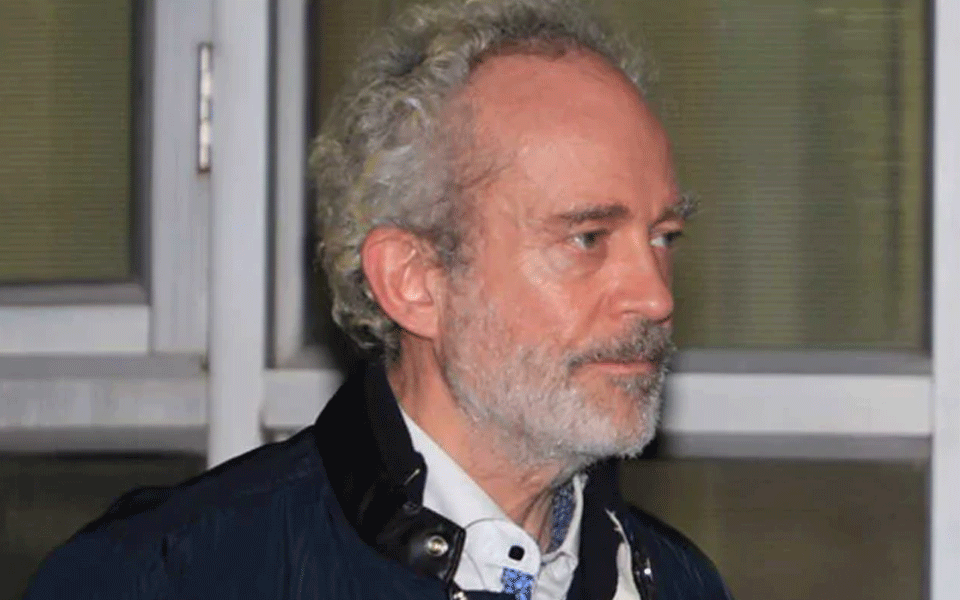
New Delhi, Dec 5: Christian Michel, the alleged middleman who has been chargesheeted in the Rs 3,600-crore AgustaWestland VVIP chopper deal, was Wednesday produced before a Delhi court which allowed his five-day custodial interrogation by the CBI.
He will again be produced in the court on December 10.
Michel, who is a citizen of United Kingdom, was brought to India late Tuesday night following his extradition by the UAE in connection with the case.
He was produced before Special CBI Judge Arvind Kumar which allowed discussions between him and his advocate for five minutes.
Michel's advocate asked the court to send him to judicial custody but the CBI sought his 14-days custodial interrogation to confront him with evidence and unearth the money trail in the scam.
However, the judge allowed CBI to interrogate Michel for five days in its custody.
The court asked the CBI to provide all relevant documents including the charge sheet to Michel.
A bail plea was also moved on his behalf. The court did not give any specific date for hearing the bail plea.
Security was tightened at the Patiala House court complex hours before the production of Michel.
Around 15-20 personnel of the CRPF and 30 Delhi Police officials had been deputed in the court complex as well as outside several of its gates, said one of the police officials. The police force, included women officials.
Michel, 54, landed at the Indira Gandhi International Airport on a Gulfstream jet at 10.35 pm Tuesday night after which he was arrested by the CBI in connection with the case.
Michel is one of the three middlemen being probed in the case, besides Guido Haschke and Carlo Gerosa, by the ED and the CBI. Both the agencies have notified an Interpol red corner notice (RCN) against him after the court issued a non-bailable warrant against him.
Michel had denied the charges.
The CBI has alleged there was an estimated loss of Euro 398.21 million (approximately Rs 2,666 crore) to the exchequer in the deal that was signed on February 8, 2010 for the supply of VVIP choppers worth Euro 556.262 million.
The Enforcement Directorate (ED), in its charge sheet filed against Michel in June 2016, had alleged that he received EUR 30 million (about Rs 225 crore) from AgustaWestland.
The money was nothing but "kickbacks" paid by the firm to execute the 12 helicopter deal in favour of the firm in the "guise of" genuine transactions for performing multiple work contracts in the country, according to the charge sheet.
The ED investigation found that remittances made by Michel through his Dubai-based firm Global Services to a media firm he floated in Delhi, along with two Indians, were made from the funds which he got from AgustaWestland through "criminal activity" and corruption in the chopper deal, which led to the subsequent generation of proceeds of crime.
On January 1, 2014, India scrapped the contract with Italy-based Finmeccanica's British subsidiary AgustaWestland for supplying 12 AW-101 VVIP choppers to the IAF over alleged breach of contractual obligations and charges of paying kickbacks to the tune of Rs 423 crore by it for securing the deal.
The CBI on September 1, 2017, had filed a charge sheet in the case in which Michael was named as one of the accused.
Former IAF Chief S P Tyagi was also chargesheeted by the CBI in a Delhi Court along with nine others in connection with a bribery case in the VVIP chopper deal.
Tyagi (73) is the first chief of the Indian Air Force to be chargesheeted in a corruption or a criminal case by the CBI and he has denied all charges against him.
Besides him, the agency has also chargesheeted retired Air Marshal J S Gujral along with eight others, including five foreign nationals, in the charge sheet filed before the Special CBI Judge.
Anglo-Italian company, AgustaWestland, is also one of the accused.
Others named in the charge sheet are -- Tyagi's cousin Sanjeev alias Julie, advocate Gautam Khaitan, alleged European middlemen Carlo Gerosa, Christian Michel, Guido Haschke, former AgustaWestland CEO Bruno Spagnolini and former Finmeccanica Chairman Giuseppe Orsi.
They have been chargesheeted for offences under the Prevention of Corruption Act and the IPC in the case relating to alleged bribery of Rs 450 crore.
Tyagi, who had retired in 2007, his cousin Sanjeev and Khaitan were arrested on December 9 last year by the CBI in the case. These accused are currently on bail.
Let the Truth be known. If you read VB and like VB, please be a VB Supporter and Help us deliver the Truth to one and all.
4 workers die after being buried under coal slurry in Jharkhand's Dhanbad

Dhanbad (Jharkhand) (PTI): At least four workers died after being buried under coal slurry in Jharkhand's Dhanbad district on Saturday, a police official said.
The incident took place at Moonidih coal washery in the command area of Bharat Coking Coal Limited (BCCL).
"Bodies of all four workers were dug out of debris during a rescue operation," Putki police station in-charge Waqar Hussain told PTI.
The incident took place when coal slurry was being loaded into trucks by workers, during which a large chunk of slurry fell and trapped several workers underneath, officials said.
The deceased have been identified as Manik Bauri, Dinesh Bauri, Deepak Bauri, and Hemlal Gope.
Meanwhile, the family members of the deceased and local villagers placed the bodies in front of the washery gate and began a protest.
They demanded compensation, jobs for dependents and action against those responsible for the incident.
Police and administration officials are trying to pacify the protesters, an official said.